
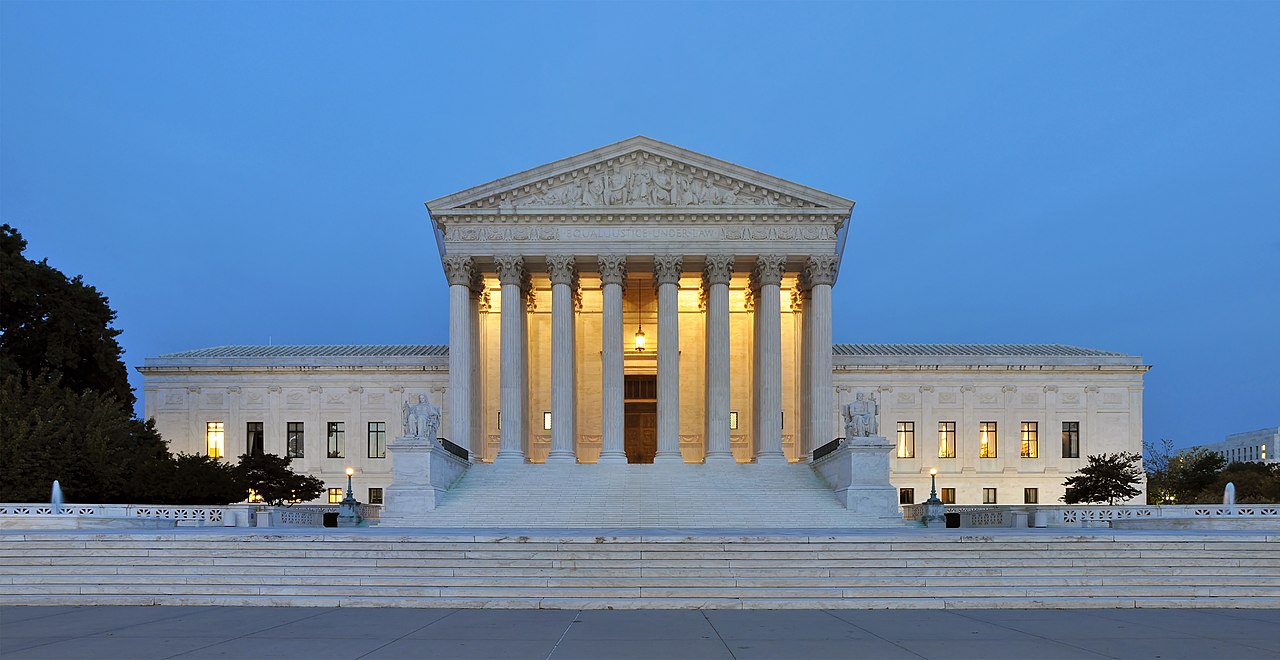
The Supreme Court on Monday declined to lift a nationwide injunction blocking a U.S. Postal Service rule that would impose new envelope and voter-data requirements on federal ballot mail.
The unsigned order said the government was unlikely to succeed in challenging the district court’s preliminary injunction. The justices also found that the equitable factors governing emergency relief did not favor a stay.
The application was presented to Justice Jackson, who referred it to the Court.
The rule, titled Ballot Mail for Federal Elections, was published in the Federal Register in late August. It would require federal ballot mail to be sent in envelopes carrying an election-mail logo and a barcode unique to each voter.
The envelopes would also have to support scanning by high-speed processing equipment. States would be required to submit compliant envelope designs to the Postal Service for review and upload basic voter information to an agency portal.
Under the rule, the Postal Service would review mail sent by states to voters. Mailings that failed to meet the requirements would not be accepted and would be returned to the state for correction and possible resubmission.
Kavanaugh Cites Insufficient Implementation Time
Justice Brett Kavanaugh agreed with the denial of the government’s stay request. Based on the briefing available at this interim stage, he wrote, there was at least a fair prospect that the rule fell within the Postal Service’s statutory authority.
Kavanaugh concluded, however, that applying the rule during the 2026 elections would be arbitrary and capricious under the Administrative Procedure Act.
State and local election officials lacked sufficient time to implement the requirements reasonably before the elections, he wrote.
Alito and Thomas Dissent
Justice Samuel Alito dissented, joined by Justice Clarence Thomas. Alito argued that the government had made the required showing for a stay and that the Court was wrong to leave the injunction in place.
Several organizations challenging the rule likely lacked standing, according to the dissent. Alito wrote that their claimed injuries involved broad advocacy interests and unnamed members who had not submitted declarations.
Alito also concluded that the plaintiff states were unlikely to succeed. Their Elections Clause argument, he wrote, depended on whether the Postal Service had statutory authority to issue the rule.
Congress broadly exempted the Postal Service’s exercise of its powers from Administrative Procedure Act review, the dissent said. That left the states to argue that the agency had acted ultra vires, or beyond its legal authority.
Quoting the Court’s 2025 decision in NRC v. Texas, Alito described that type of claim as essentially a “Hail Mary pass” that “rarely succeeds.”
The dissent pointed to the Postal Service’s broad authority over mail collection, handling, transportation, delivery and return. Alito wrote that the states were unlikely to establish that the rule clearly exceeded the agency’s delegated powers.
He also rejected the states’ interpretation of provisions governing nonmailable matter. The rule’s conditions resembled threshold mailing requirements, such as providing an address or affixing postage, Alito wrote.
Dissent Addresses Timing and Election Effects
Alito acknowledged the difficulties of implementing the requirements close to the midterm elections but concluded that the remaining factors favored a stay.
The dissent noted that the states disagreed about the rule’s practical effects. Twelve states had supported the rule in the lower court and maintained that compliance was practicable.
Citing the rule’s stated purpose, Alito wrote that implementation would enhance the visibility of federal ballot mail to help detect election fraud. He also concluded that the government would suffer irreparable harm without relief.
Alito attributed a substantial share of the delay to the plaintiff states and the courts. He pointed to litigation that began in April and injunctions that the Supreme Court later determined were likely issued without jurisdiction.
That earlier dispute began after President Donald Trump directed the Postal Service to initiate rulemaking concerning election ballot mail. Organizations and a group of states led by California sued days later in the District of Massachusetts.
The district court entered several injunctions blocking implementation of the directive. The Supreme Court stayed one injunction in Trump v. California after concluding that the lower court likely lacked jurisdiction because the lawsuit was premature.
The Postal Service issued its final rule in late August. Within days, the district court entered a temporary restraining order and later converted it into the nationwide preliminary injunction now at issue.
The order does not provide a complete vote breakdown beyond Kavanaugh’s concurrence and the dissent from Alito and Thomas. It leaves the underlying legal questions unresolved while the litigation continues.

A global media for the latest news, entertainment, music fashion, and more.