

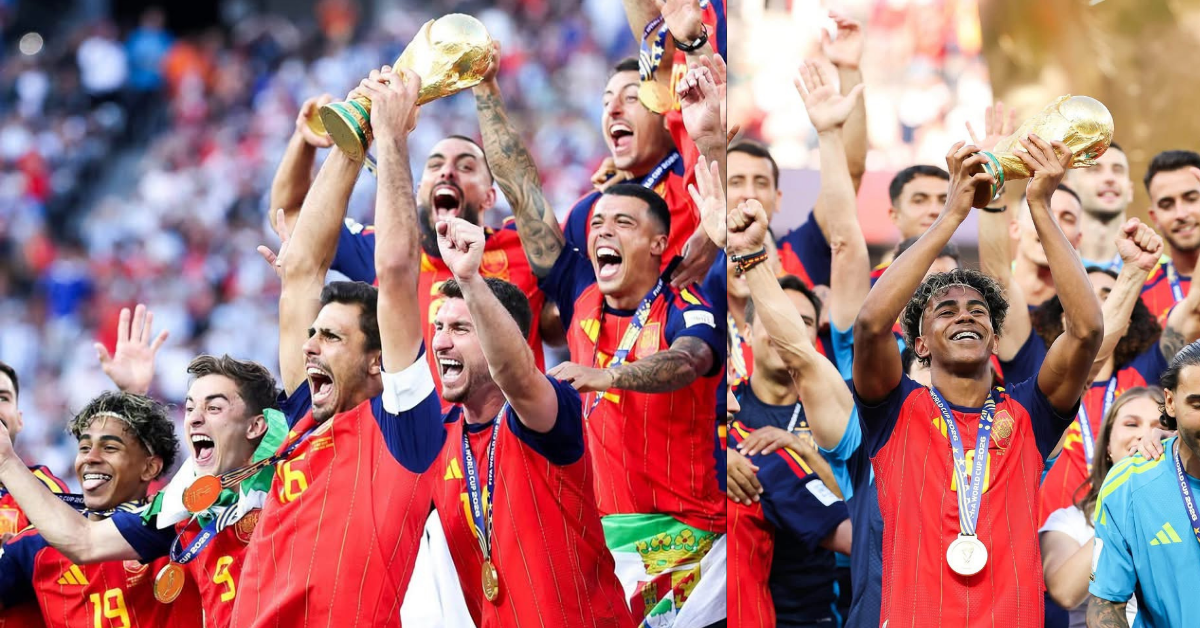
EAST RUTHERFORD, N.J. — There’s a particular kind of silence that falls over a stadium when 80,000 people realize the miracle isn’t coming. It arrived here at the 106th minute on Sunday, when Ferran Torres smashed a left-footed shot into the roof of Argentina’s net and everyone in blue and white understood, all at once, that this time there would be no comeback.
Spain 1, Argentina 0. After extra time. World champions for the second time, sixteen years after the first.
And look — the score flatters Argentina. It really does.
Torres had only been on the pitch a while, one of those substitutions that coaches make hoping for fresh legs and get a place in history instead. The move that produced the goal was pure Spain: patient, almost boring, right up until it wasn’t. Pedro Porro swung the ball to the far post. Nico Williams rose and nodded it back across the six-yard area. Torres met it first time. Emiliano Martínez, who had spent two hours performing wonders, finally had no answer.
He becomes only the second substitute ever to score the winner in a World Cup final. Trivia now. Immortality in Spain.
A siege, not a match
Here’s the thing about this final. Everyone expected a chess match between the tournament’s best attack and its best defense. What we got instead was a siege.
Spain had roughly 65 percent of the ball. They took 20 shots to Argentina’s two. Twelve of Spain’s attempts were on target. Argentina’s? None. Not one shot on goal, in a World Cup final, from a team that had scored 19 times in seven games getting here. At halftime the defending champions had no shots, no corners, and had barely touched the ball in Spain’s half, let alone their box. The expected-goals count read 1.94 to 0.2, which is the statistical way of saying it wasn’t close.
That it stayed scoreless for 105 minutes was down to one man. Martínez made 11 saves — nobody had ever made that many in a men’s World Cup final — and some of them were genuinely absurd. There was a Torres header from close range that he somehow smothered. There was a Williams strike that actually beat him, only for the goal to come back off the review for a foul in the buildup. For a while you started to wonder whether Argentina might steal this thing on penalties, which would have been larceny, but also very Argentina.
Then Enzo Fernández got himself sent off.
It came in second-half stoppage time, a second yellow for a late one on Pau Cubarsí, and you could feel the air go out of the Argentine end. Fernández had been the hero four days earlier, the man whose late equalizer broke England. Now he was walking off with his shirt untucked and his team down to ten for extra time. Cruel game, football.
The quiet machine
Give Spain their due, because this was one of the great tournament runs of the modern era.
They opened with a goalless draw against Cabo Verde — Cabo Verde! — and got mocked for it. They then won seven straight without ever really looking stressed. Fourteen goals scored. One conceded. One! Charles De Ketelaere’s strike for Belgium in the quarterfinal was the only ball that got past Unai Simón in a month of football. Seven clean sheets, including shutouts of Uruguay, Portugal, France and, when it mattered most, the highest-scoring team in the competition.
Luis de la Fuente’s side doesn’t have the poetry of the 2010 team, the Xavi-and-Iniesta generation that turned possession into art. This version is harder, more vertical, less romantic. But the DNA is unmistakable, and so is the echo: 2010 ended 1-0 in extra time too, Iniesta instead of Torres. Some countries just have a way of winning.
Add it to the Euro 2024 title and Spain now hold the European and world crowns together. And here’s a fact that deserves its own headline: with their women having won in 2023, Spain becomes the first country ever to hold the men’s and women’s World Cups at the same time. Nobody’s done that. Ever.
Messi, denied the fairytale
It shouldn’t have ended like this for him, but sport doesn’t do scripts.
Lionel Messi is 39. This was, barring something strange, his last World Cup match, and he spent it surrounded — Rodri in his pocket, Cubarsí stepping in front of everything, the supply lines cut before the ball ever reached him. Argentina, the comeback kings of this tournament, the team that came from 2-0 down against Egypt and flipped the England semifinal in stoppage time, never got the chaos they needed. Spain simply refused to provide it.
Messi finishes the tournament with eight goals and four assists, and finishes his World Cup career with 21 goals and a silver medal to set beside the gold from Qatar. Argentina finish runners-up for the fourth time, after 1930, 1990 and 2014. The dream of going back-to-back — something nobody has managed since Brazil in 1962 — dies in New Jersey.
He walked slowly to collect his medal. The Spanish players applauded him. So, eventually, did most of the stadium. It felt right.
Rodri, Simón, Cubarsí — a Spanish sweep
The individual awards told the same story as the scoreboard. Rodri took the Golden Ball as the tournament’s best player, which felt inevitable if you watched him run Spain’s midfield for a month. Simón collected the Golden Glove, hardly a debate given the one goal conceded. And young Cubarsí was named best young player for anchoring a defense that blanked Portugal, France and Argentina in the knockouts.
The Golden Boot went to Kylian Mbappé, and there’s a story there too. His two goals in Saturday’s third-place game gave him 10 for the tournament, made him the first man to win the Boot twice, and — this is the big one — carried him past Messi to 22 career World Cup goals, the most in history.
That third-place game, by the way, was madness. England beat France 6-4 in Miami, a scoreline that belongs in a playground. England led 4-0 at halftime through Declan Rice, Ezri Konsa and a Bukayo Saka double; Mbappé and Bradley Barcola hauled France back to 4-3; Saka finished his hat trick from the spot in the 87th. It was also Didier Deschamps’ last match after fourteen years in charge of France, which is a strange way to say goodbye.
Four years ago Mbappé scored a hat trick in the final, won the Golden Boot, and watched Messi lift the trophy. This time Mbappé has the records and Messi has the runner-up medal, and the World Cup itself belongs to neither of them. Football’s sense of humor is undefeated.
Sixteen years, second star
The first 48-team World Cup — 104 matches sprawled across three countries — ends with the trophy in Spanish hands, and it’s hard to argue. They conceded once in eight games. They held the tournament’s most dangerous attack without a shot on target with everything on the line. They won the way champions win: not always beautifully, but completely.
They won the way champions win: not always beautifully, but completely.
At the final whistle the Spanish players collapsed into a pile near the center circle while red confetti drifted down through the New Jersey evening. Somewhere in that pile was Torres, the substitute who scored the goal a country will replay for the next fifty years.
Spain 1, Argentina 0. Second star. No arguments.
Have something to promote?
Bring your business, services or event to our readers.