

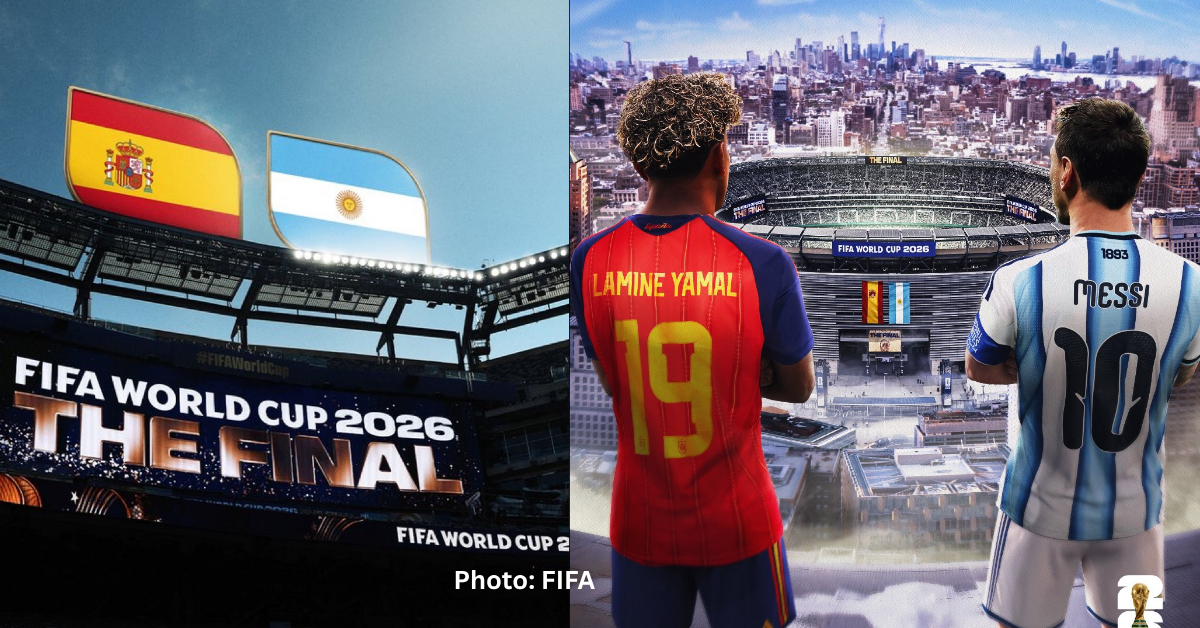
EAST RUTHERFORD, N.J. — Defending champion Argentina will meet European champion Spain in the 2026 FIFA World Cup final Sunday, bringing together the tournament’s highest-scoring team and its strongest defense — and, in Lionel Messi and Lamine Yamal, the defining player of one era against the brightest star of the next.
The match kicks off at 3 p.m. ET at New York New Jersey Stadium in East Rutherford. It will be the 104th and final game of the first 48-team World Cup.
Argentina are seeking a fourth title and a place in history as the first nation to retain the trophy since Brazil in 1962. Spain are chasing their second championship, 16 years after their first.
The final is the tournament’s only remaining match after England secured third place with a 6-4 victory over France on Saturday in Miami.
It is also a fixture the sport has waited for. The two nations were scheduled to meet in the Finalissima after winning Euro 2024 and the 2024 Copa América, only for the match to be canceled.
Their sole previous World Cup meeting came in the 1966 group stage, when Argentina won 2-1 — exactly 60 years ago.
How Argentina reached the final
Argentina won Group J with three victories and eight goals, then survived a knockout run that tested every ounce of the resilience that defined their 2022 triumph.
| Stage | Result |
|---|---|
| Group stage | Argentina 3-0 Algeria |
| Group stage | Argentina 2-0 Austria |
| Group stage | Argentina 3-1 Jordan |
| Round of 32 | Argentina 3-2 Cabo Verde (a.e.t.) |
| Round of 16 | Argentina 3-2 Egypt |
| Quarterfinal | Argentina 3-1 Switzerland (a.e.t.) |
| Semifinal | Argentina 2-1 England |
Messi opened the tournament with his first World Cup hat trick against Algeria, becoming the oldest player to score three goals in a World Cup match.
Since then, drama has followed the champions everywhere. Cabo Verde, the tournament’s Cinderella story, forced Argentina into extra time.
Egypt led 2-0 with 11 minutes remaining before Argentina scored three times, capped by Enzo Fernández’s 92nd-minute winner. Switzerland took the quarterfinal into an additional 30 minutes before Julián Álvarez and Lautaro Martínez struck late.
Then came the semifinal. England led through Anthony Gordon until the 85th minute, when Messi assisted two goals in seven minutes — Fernández’s equalizer from outside the penalty area and Martínez’s stoppage-time header — to complete a 2-1 comeback.
Argentina have won all seven matches, scoring 19 goals and conceding seven. They kept clean sheets in their first two games but have been breached in each of their last five.
How Spain reached the final
Spain’s story has been the mirror opposite: quiet, patient and defined by ruthless control. After a surprising scoreless draw with Cabo Verde on opening day, La Roja have won six consecutive matches without trailing.
| Stage | Result |
|---|---|
| Group stage | Spain 0-0 Cabo Verde |
| Group stage | Spain 4-0 Saudi Arabia |
| Group stage | Spain 1-0 Uruguay |
| Round of 32 | Spain 3-0 Austria |
| Round of 16 | Spain 1-0 Portugal |
| Quarterfinal | Spain 2-1 Belgium |
| Semifinal | Spain 2-0 France |
Spain have scored 13 goals and conceded exactly one. Belgium’s Charles De Ketelaere remains the only player to beat Unai Simón, who has recorded six clean sheets.
The team has not played a minute of extra time.
The semifinal was Spain’s masterpiece. Facing a France side that had scored 16 goals, Spain held the attacking trio of Kylian Mbappé, Michael Olise and Ousmane Dembélé to 0.26 expected goals.
Mikel Oyarzabal converted a first-half penalty won by Yamal, Pedro Porro added a second after the break and France never seriously threatened.
Performance comparison: fire vs. ice
Argentina have produced far more goals, while Spain have been substantially stronger defensively. Remarkably, both teams arrive with a goal difference of plus-12.
| Category | Argentina | Spain |
|---|---|---|
| Matches | 7 | 7 |
| Wins | 7 | 6 |
| Draws | 0 | 1 |
| Goals scored | 19 | 13 |
| Goals conceded | 7 | 1 |
| Clean sheets | 2 | 6 |
| Extra-time matches | 2 | 0 |
| Goal difference | +12 | +12 |
Argentina average 2.71 goals per match, compared with Spain’s 1.86. Spain concede an average of 0.14 goals per game, compared with Argentina’s 1.00.
The tactical question is clear: Can Spain’s possession, midfield control and compact defense contain an attack that has scored at least twice in every match?
The psychological question may matter just as much. Spain are supremely comfortable protecting a narrow lead, but they have not trailed for a single minute during the tournament. Nobody knows how they will respond if the final descends into chaos.
Chaos, for Argentina, is familiar territory. All four of their knockout victories were secured by decisive goals after the 85th minute. That is no longer a coincidence; it has become part of the team’s identity.
There is also the matter of fatigue. Argentina’s two extra-time matches have added a full hour of football to their knockout workload. In a final played in mid-July heat, those additional minutes could tell late — or they could mean Argentina are more battle-hardened for exactly the kind of contest this promises to become.
Messi leads Argentina’s stars
At 39, in what may be his final World Cup appearance, Messi remains Argentina’s decisive player. He has eight goals and four assists and orchestrated the semifinal comeback against England by creating both goals.
Messi moved past Miroslav Klose during the tournament to reach 21 career World Cup goals. That record changed hands Saturday, however, when Mbappé scored twice against England to reach 22.
Messi can draw level with one goal against Spain or retake the career record with two.
Around him, Argentina’s supporting cast has delivered in the biggest moments. Martínez has three goals, including the semifinal winner. Fernández has scored twice, both at crucial points.
Álvarez provides pressing and movement, while Alexis Mac Allister and Fernández supply the midfield energy that allows Messi to operate in more dangerous areas.
Argentina’s concern is defensive. They have conceded in five consecutive matches and were twice breached by both Cabo Verde and Egypt. Spain may not create many chances, but they have converted the moments that matter throughout the tournament.
Oyarzabal, Simón and Yamal lead Spain
Oyarzabal, the Real Sociedad striker who scored the winner in the Euro 2024 final, leads Spain with five goals, including three in the knockout rounds.
Mikel Merino has become the knockout specialist, scoring the late winners against Portugal and Belgium. Porro has contributed at both ends, scoring against Austria and France.
Captain Rodri, Fabián Ruiz and Dani Olmo give Spain the midfield control that defines them, while Simón and a backline anchored by Aymeric Laporte have limited seven opponents to a single goal.
Then there is Yamal. The 19-year-old’s raw numbers — one goal and no assists — look modest beside Messi’s production, but his influence extends beyond the box score.
His movement stretches every defense he faces, and he won the penalty that broke open the semifinal against France.
Sunday also carries a storybook subplot. As a baby, Yamal was photographed being bathed by a 20-year-old Messi during a charity shoot. Nearly two decades later, they will meet with the World Cup on the line.
The individual edge belongs to Argentina whenever Messi touches the ball near the penalty area. The collective edge — organization, balance and depth — belongs to Spain.
World Cup history
Argentina are appearing at their 19th World Cup and in their seventh final. They won in 1978, 1986 and 2022 and finished runners-up in 1930, 1990 and 2014.
Victory would make Argentina only the third country to win consecutive World Cups, following Italy in 1934 and 1938 and Brazil in 1958 and 1962.
Spain are appearing at their 17th World Cup but only their second final. Their first, in 2010, ended in a 1-0 extra-time victory over the Netherlands, the crowning moment of the generation led by Xavi, Andrés Iniesta and Sergio Busquets.
Before that title, Spain’s best finish was fourth place in 1950.
Across all competitions, the rivalry is dead even: six victories apiece and two draws.
Final prediction: Spain 2-1 Argentina after extra time
The case for Spain is statistical and structural: one goal conceded, six clean sheets, no extra time played and a midfield that has controlled Portugal, Belgium and France in succession.
Spain’s defense made one of the tournament’s most dangerous attacks look ordinary in the semifinal. Argentina, by contrast, have conceded in five consecutive matches and carry 60 additional minutes in their legs.
The case for Argentina is harder to quantify but impossible to ignore. They are the comeback kings of this World Cup, a team that does not break when trailing late — and Spain have never been tested in that situation.
Argentina also have Messi, the one player capable of deciding a final with a single pass, free kick or moment of invention.
On balance, Spain hold a slight edge. Their fresher legs, midfield superiority and defensive organization should eventually tell, but the final is unlikely to be settled comfortably or within 90 minutes.
Spain 2-1 Argentina after extra time. — Final prediction
If Argentina score first, however, Spain will enter genuinely uncharted territory — and uncharted territory is where this Argentina team has repeatedly found a way to survive.
England beat France 6-4 to secure third place
Bukayo Saka scored a hat trick as England beat France 6-4 Saturday, surviving a second-half comeback to secure the country’s first third-place finish at a World Cup.
England took control early and carried a 4-0 lead into halftime at Miami Stadium. Declan Rice scored in the third minute, Ezri Konsa followed in the 18th and Saka struck twice — first in the 37th minute and again one minute into first-half stoppage time.
Rice capitalized on an error by Désiré Doué and scored from beyond the penalty area. He then delivered the corner that Konsa converted for England’s second goal.
Marcus Rashford provided the assist for Saka’s first goal, while Eberechi Eze set up the second.
France made four substitutions at halftime, and the response came quickly. Mbappé scored in the 48th minute, Bradley Barcola followed in the 54th and Mbappé struck again in the 66th.
A four-goal deficit had been reduced to one.
Michael Olise supplied both assists for Mbappé, who set up Barcola’s goal.
England extended its lead in the 87th minute after Malo Gusto brought down Djed Spence inside the penalty area. Saka converted from the spot to complete his hat trick and make it 5-3.
Dembélé reduced the deficit to 5-4 six minutes into stoppage time. Two minutes later, substitute Jude Bellingham moved through the French defense and scored the match’s 10th and final goal.
England held 54% possession and put 11 shots on target. France recorded nine.
England changed seven players from the team that lost 2-1 to Argentina in the semifinals. Dean Henderson made his World Cup debut in goal, Rice wore the captain’s armband and regular captain Harry Kane began the match on the bench.
England had lost its previous third-place matches to Italy in 1990 and Belgium in 2018. Saturday’s victory gave the country its highest World Cup finish since winning the title in 1966.
France entered the match after a 2-0 semifinal defeat by Spain. The loss also ended Didier Deschamps’ 14-year run as France coach.
No replacement has been announced, although Zinedine Zidane is widely viewed as the leading candidate.
Mbappé takes control of the Golden Boot race
Mbappé began the third-place match level with Messi on eight goals. His two second-half strikes raised his tournament total to 10, giving him a two-goal advantage before Sunday’s final.
The brace also made Mbappé the first player since Gerd Müller in 1970 to reach double figures at a single World Cup.
| Player | Team | Goals | Assists |
|---|---|---|---|
| Kylian Mbappé | France | 10 | 4 |
| Lionel Messi | Argentina | 8 | 4 |
Messi must score at least twice against Spain to keep the Golden Boot race alive. Two goals would draw him level with Mbappé, while a hat trick would move him ahead outright.
If the players finish level on goals, assists are the first tiebreaker. If they also remain level on assists, the award is decided by fewer minutes played.
That leaves Messi facing the tournament’s most difficult defense. Spain have conceded only once in seven matches, making the two or three goals Messi needs an imposing challenge.
Golden Boot prediction: Kylian Mbappé, with 10 goals. Messi still has one final opportunity to change the outcome, but Mbappé now holds a commanding advantage.
The 2026 FIFA World Cup final between Argentina and Spain kicks off Sunday, July 19, at 3 p.m. ET at New York New Jersey Stadium in East Rutherford, New Jersey.
Have something to promote?
Bring your business, services or event to our readers.