

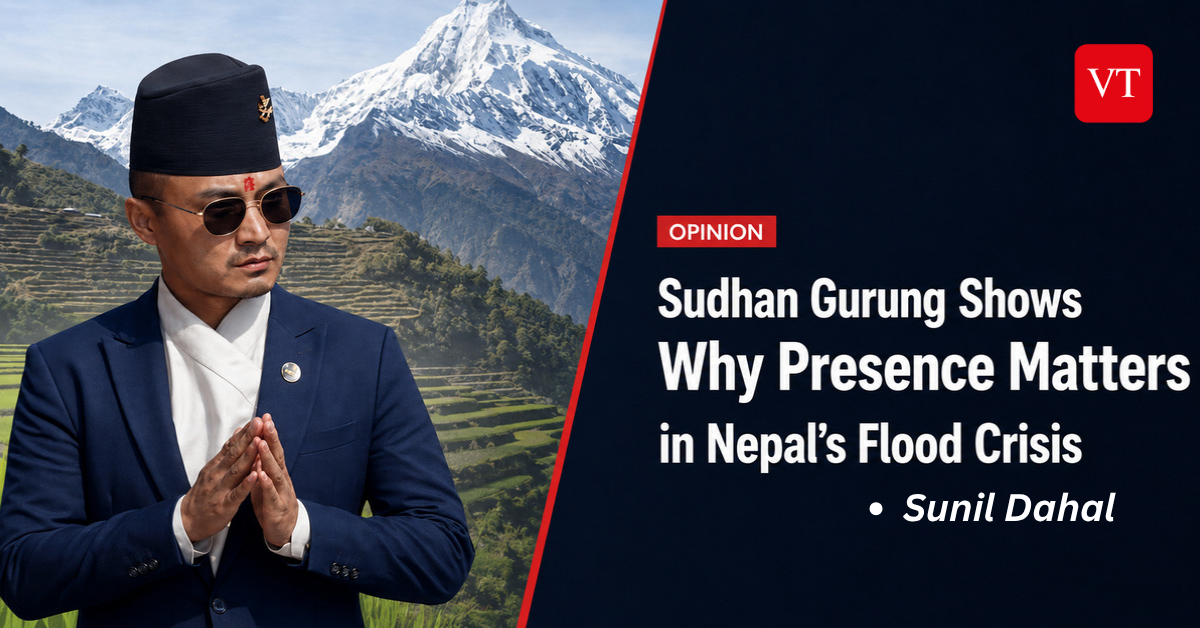
A devastating flash flood struck communities in Nepal’s Bhote Koshi-Trishuli region on Aug. 26, leaving behind a staggering human toll.
In its Aug. 30 update, Nepal Police said 734 bodies had been recovered and 2,699 people had been injured or rescued. Police reported deploying 7,293 personnel, while 25 police personnel remained out of contact.
According to the U.S. Geological Survey, the flooding was triggered by the collapse of a glacier that released ice and rock debris.
These figures convey the scale of the tragedy. They cannot fully describe the pain of families waiting for news, the exhaustion of rescue workers or the uncertainty facing people who have lost relatives, homes and property.
The Question Every Disaster Asks
In a disaster of this magnitude, one question becomes unavoidable: Where should the government’s presence be seen? On paper, in meetings and official statements—or at the scene, beside the people enduring the crisis?
Home Minister Sudhan Gurung’s response in the flood-affected areas offers an answer.
Nepal has had many home ministers. Different leaders have occupied the ministry at different times. What distinguishes Gurung during this disaster is not simply the office he holds, but his willingness to leave that office, enter the affected areas and remain visibly engaged with rescue workers and victims.
“During a disaster, citizens need presence more than speeches, action more than promises and leadership more than instructions.”
As floods ravaged settlements in Rasuwa, Gurung did not confine himself to issuing instructions from an office. He went to the field and stood alongside officers and personnel from the Nepali Army, Nepal Police and Armed Police Force. He sought updates on search and rescue operations and encouraged those working under dangerous conditions.
His willingness to monitor operations late into the night and return to the field early the next morning has helped citizens see and feel the presence of the state during a period of fear and uncertainty.
Why Presence Matters
A minister cannot replace trained rescuers. A field visit alone cannot find the missing, deliver relief or rebuild a destroyed community. Physical presence must never become a substitute for an organized and effective response.
But that does not make presence meaningless.
For security personnel working under dangerous conditions, sincere words of encouragement from national leadership can carry considerable weight. Soldiers and police personnel do not need a minister to perform their duties for them. They do, however, deserve to know that their risks are understood, their work is valued and their needs are being heard by those directing the national response.
By standing beside the personnel conducting rescue operations, Gurung has offered more than instructions. He has offered encouragement and helped boost morale.
His engagement with flood victims is equally important.
People who have lost relatives, homes and property do not merely need official announcements. They need someone to listen, understand what they are facing and ensure that their urgent concerns reach the agencies responsible for acting.
By hearing victims’ grievances, trying to understand their circumstances and directing the responsible agencies, Gurung has helped create a sense that the government is standing with affected citizens rather than observing their suffering from a distance.
During a disaster, citizens need presence more than speeches, action more than promises and leadership more than instructions. Gurung’s response so far appears close to that public expectation.
Listening Must Become the Standard
His approach becomes even more significant amid complaints about the conduct of some government employees.
Some affected families seeking information about missing relatives say they have been met with irritation and unhelpful responses from government staff. Such behavior has no place in a disaster response.
A person desperately searching for a family member should never be treated as an inconvenience. Patience, compassion and clear communication are not optional courtesies during a crisis. They are part of the government’s duty.
Against that background, Gurung’s calm and attentive approach carries greater meaning. But his example cannot remain limited to the minister himself. It must become the standard for every official and employee involved in the response.
The message must reach the entire administrative system: Listen to victims. Answer their questions respectfully. Provide accurate information when it is available. Do not dismiss their fear, grief or frustration.
Government Is More Than a Building
A government is not simply a structure operating from inside Singha Durbar. During a crisis, it must also become a human presence that reaches citizens where they are suffering.
People who have lost everything in the floods need to see that face of the state.
Questions may have been raised about Gurung’s previous actions, and criticisms of his earlier work should not simply be forgotten. Public praise does not require public amnesia. It is possible to examine a leader’s wider record while also recognizing when that leader responds well in a moment of national crisis.
Credit should therefore be given where it is due.
Gurung’s activity and leadership during the present disaster have, at least for now, placed some of those earlier concerns in the background. His presence has shown that the person responsible for directing the country’s emergency response can stand near the citizens and rescue personnel confronting the crisis.
Leadership is not truly tested when conditions are normal. Its real test comes when institutions are under pressure, citizens are frightened and decisions carry immediate human consequences.
This is the kind of administration people want: one that listens to victims without irritation, gives rescue workers encouragement as well as orders, sees conditions at the disaster site rather than relying only on reports and refuses to let citizens feel abandoned during their darkest hours.
So, yes, Home Minister Gurung deserves a salute for the leadership he has shown in the field.
But the Salute Is Conditional
That salute is for the work visible so far. It is not a declaration that the government’s responsibility has been fulfilled.
The same commitment must continue until rescue operations are completed, every credible avenue in the search for the missing has been pursued, affected families receive relief and rehabilitation moves forward. The government must also ensure that victims and their families are treated with patience, dignity and compassion at every level of the administration.
A brief period of visible activity may attract public attention. Sustained leadership earns public trust.
Citizens will ultimately remember not only who arrived at the disaster site, but who remained engaged until the search was completed, relief reached those in need and the long work of rebuilding lives had truly begun.