
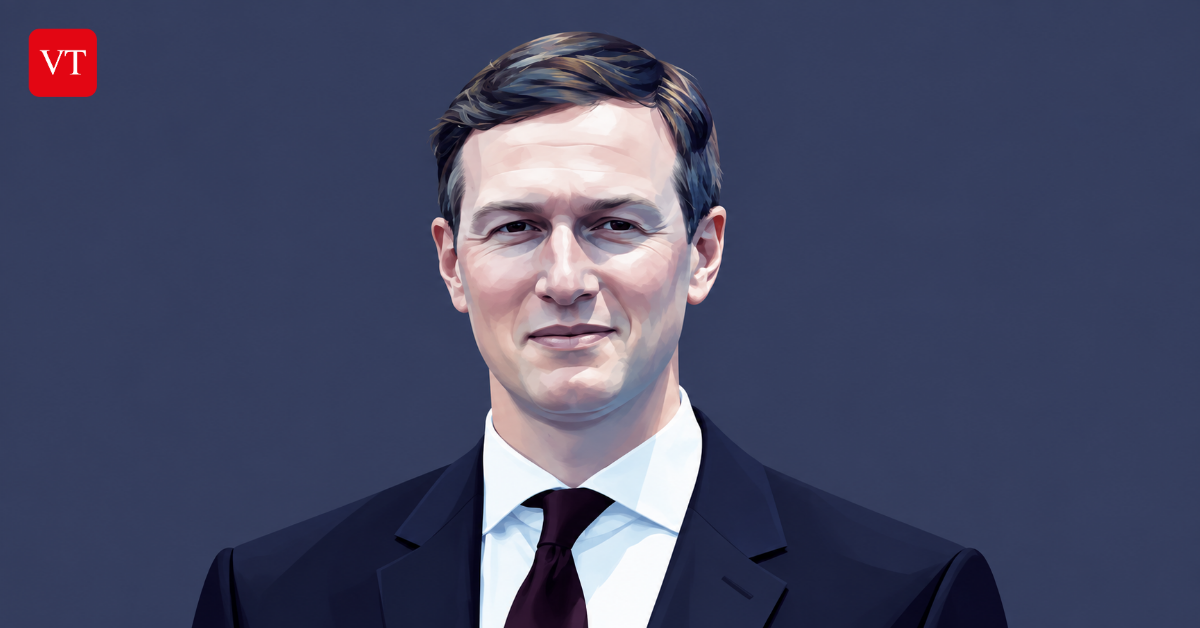
Jared Kushner managed billions of dollars that Gulf governments invested in his private equity fund while serving as one of President Donald Trump’s top peace envoys, The New Yorker reported.
The Sept. 14 report says Kushner was discreetly raising another $5 billion in the Middle East for his firm, Affinity Partners, earlier this year while he negotiated with Iran over its nuclear program.
Dexter Filkins, an American journalist who writes for The New Yorker, wrote the report, “Jared Kushner’s Dollar Diplomacy.” He was a Pulitzer Prize finalist in 2002 for his dispatches from Afghanistan. He won a Pulitzer in 2009 as part of a New York Times team reporting from Pakistan and Afghanistan. The Washington Post that year called him “the premier combat journalist of his generation.”
Virginia Times has not independently verified the report’s claims or reviewed the meeting minutes, intelligence report and court records it cites.
Kushner, Trump’s 45-year-old son-in-law, has worked with special envoy Steve Witkoff to try to end wars in Gaza, Ukraine and elsewhere. He took no government salary, and White House lawyers argued this ruled out any conflict between his public and business roles.
Most ethics specialists consider the salary question irrelevant, the magazine reported. It noted that federal law bars government agents from taking part in matters in which they have a financial stake. “Kushner is plagued with conflicts of interest,” said Virginia Canter, a former White House counsel and an ethics lawyer at the Securities and Exchange Commission.
Kushner is plagued with conflicts of interest. — Virginia Canter, former White House counsel
Kushner and Witkoff have brushed off concerns about their conflicts. Witkoff says he divested by handing control of his businesses to his sons. White House press secretary Karoline Leavitt said Kushner is donating his time and energy to the government “to secure world peace.”
At a Miami investment conference in 2024, Kushner defended his work in Trump’s first term. He challenged critics to “point to a single decision we made that wasn’t in the interest of America.”
Saudi Arabia’s Public Investment Fund committed $2 billion to Affinity in 2021, after Trump’s first term ended. According to meeting minutes cited by the magazine, the fund’s investment committee objected. Members cited the lack of a measurable track record, the heavy risk to Saudi Arabia and fees they considered excessive.
A due-diligence review rated the firm’s operations “unsatisfactory in all aspects.” The fund’s chairman was Mohammed bin Salman, a son of the Saudi king. The committee was overruled, and the deal went through, the article said.
The Saudi contributions promised large income for Kushner and his team regardless of the fund’s performance, the magazine reported. With a 1.25% management fee, the fund would receive more than $25 million a year, plus 20% of any profits.
The United Arab Emirates and Qatar each added $200 million. The two countries contributed another $1.5 billion shortly before the November 2024 election.
In 2024, Affinity chief legal officer Chad Mizelle told Senate Finance Committee investigators the fund had not yet delivered returns. Nearly three years into a five-year term, it had invested barely a third of the $3 billion it managed. The committee estimated its fees over that period at $157 million.
Sen. Ron Wyden was among those who suspected Affinity was a vehicle for Gulf leaders to enrich Kushner, according to the magazine. In a letter to Mizelle, Wyden wrote that the investments would give the Gulf states enormous leverage if Trump won a second term. A Kushner spokesman denied that Affinity served that purpose.
The magazine said there is no direct evidence that the Saudis intended to reward Kushner or Trump for their actions in office.
New Middle Eastern investment helped Affinity grow 30% in 2025, to more than $6 billion, according to the magazine. The firm estimates its annual internal rate of return at 25%.
In February, Kushner and Witkoff met Iranian negotiators in Geneva. The magazine reported that neither envoy brought a technical adviser, and that an Energy Department expert assigned to Witkoff was not in the room. The White House denied that account.
Some experts who followed the talks viewed Iranian Foreign Minister Abbas Araghchi’s proposals as earnest, including an offer to suspend enrichment entirely. At a news conference after the talks, Kushner argued that Iran was stalling to outlast Trump’s term.
Oman’s foreign minister, Badr Albusaidi, who hosted the talks, said on CBS that a peace deal was within reach. Hours after Kushner and Witkoff told Trump that Iran had refused to capitulate, the U.S. and Israel launched strikes that killed Ayatollah Ali Khamenei and many other senior Iranian leaders, the magazine reported.
According to Secretary of State Marco Rubio, Trump decided war could not be avoided because a planned Israeli action would prompt an attack on American forces.
On Ukraine, Kushner and Witkoff met delegates from both sides in South Florida. They emerged with a peace plan that would have required Ukraine to accept nearly all of Russia’s demands. The plan collapsed amid outrage once it became public.
A classified European intelligence report obtained by The New Yorker says Trump and people around him discussed potential contracts in Russia. The undated document lists 10 possible ventures, including reopening the Nord Stream 2 pipeline under American control. It names Trump, Witkoff, Kushner and former presidential envoy Richard Grenell as possible participants.
The intelligence report’s claims have not been independently verified. Kushner’s spokesman denied that U.S. officials would profit from the deals under discussion. Grenell also denied any wrongdoing.
Affinity is part of a consortium bin Salman assembled to acquire video game maker Electronic Arts for $55 billion. The magazine called it the largest leveraged buyout in history.
Kushner connected bin Salman with EA chief Andrew Wilson in August 2025, and the two played golf in Neom, the magazine reported. An American with ties to Middle Eastern leaders told the magazine that Kushner “brought M.B.S. the deal.”
The acquisition raised potential regulatory concerns because EA handles large amounts of users’ private data. The Committee on Foreign Investment in the United States, the federal panel that reviews such deals, is largely made up of Trump officials. The president has final authority. The deal was approved in August.
In Albania, Kushner plans luxury resorts on Sazan Island and the Zvërnec peninsula, projects expected to require about $4 billion. Protesters in Tirana have rallied against the development. Prime Minister Edi Rama said no protest would stop it.
A legal case poses another potential obstacle. In April, a company developing the project paid businessman Artur Shehu $125 million for land in Zvërnec. Two months later, Albanian prosecutors issued a new arrest warrant for Shehu on suspicion of drug trafficking and money laundering.
In documents filed in an Albanian court, prosecutors argued that the land in Kushner’s development was “suspected of having been illegally acquired through forgeries.” Shehu denied all accusations. If the court sides with prosecutors, the project may have to be halted, the magazine reported.
If Democrats win a majority in either chamber of Congress this fall, Kushner’s dealings will likely face greater scrutiny, the magazine reported. A Democratic aide said lawmakers could call him to testify or seek records from SEI Investments, which administers his funds.
It is unclear how much lawmakers or prosecutors could do. Trump, whom the Supreme Court has granted sweeping legal immunity, has vowed to pardon members of his team who face investigation, according to the magazine. Canter said Kushner would be under FBI investigation if he were not the president’s son-in-law.

A global media for the latest news, entertainment, music fashion, and more.