

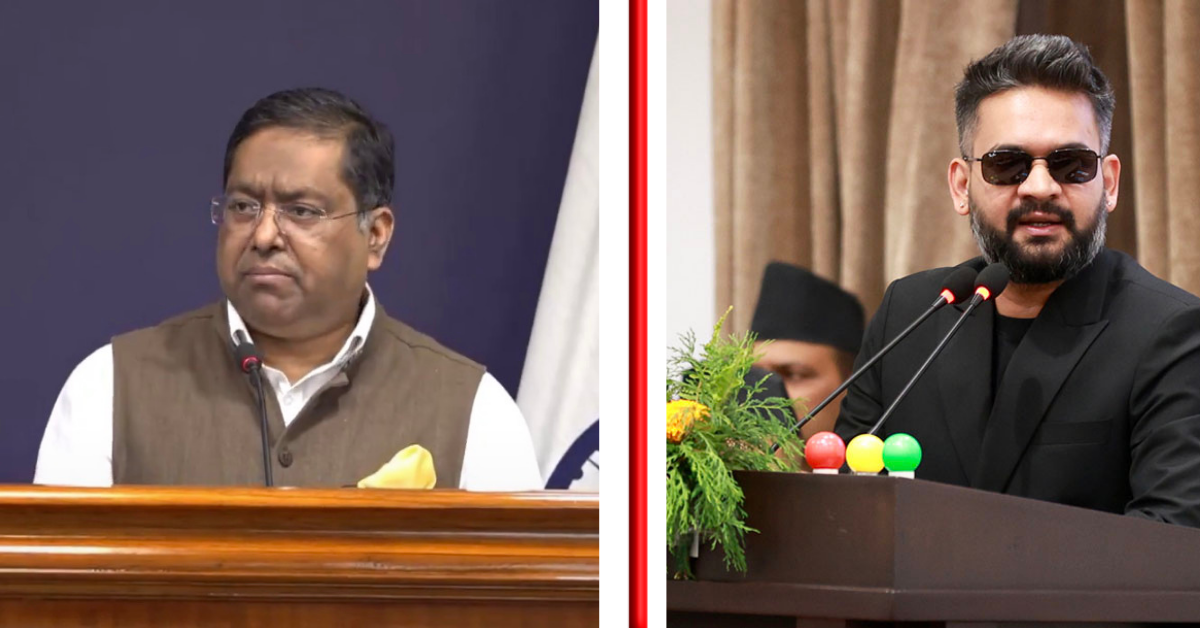
New Delhi made clear Monday that its border differences with Nepal will not involve outside parties, responding to a rare public admission by Nepal’s prime minister that encroachment along their shared frontier goes both ways.
MEA spokesperson Randhir Jaiswal told reporters that approximately 98 percent of the India-Nepal border has been demarcated. He said unresolved sections remain, partly due to changes in the course of the Gandak River, and that cross-border encroachment and encroachment on no-man’s land in some demarcated areas are being jointly mapped through established bilateral mechanisms.
The remarks came a day after Nepal’s Prime Minister Balen Shah told lawmakers the border dispute was not one-sided. Speaking to the House of Representatives on Sunday, Shah said he had learned only after taking office that Nepal had also encroached on Indian land in several places.
He called on both sides to sit together as friends and resolve the matter.
The remarks drew sharp reactions inside parliament, with opposition lawmakers demanding they be struck from the record.
Nepal’s Ministry of Foreign Affairs issued a clarification the same day, saying Shah’s comments referred to a technical land-use issue and not to encroachment by the Nepali state. The ministry said the remarks were rooted in the issue of cross-border occupation and encroachment along the Dashagaja — a ten-yard boundary strip running along the Nepal-India border.
The ministry explained that the issue arose because a fixed boundary principle was applied along river boundary zones during the original demarcation process, leaving some citizens on each side farming or living on land that falls within the other country’s territory. Technical committees from both countries are collecting data on boundary pillar construction, Dashagaja encroachment, and cross-border occupation. Joint data collection, long stalled, has recently resumed, the ministry said.
Nepal’s boundary with India was established by the Sugauli Treaty of 1816. Demarcation remains incomplete in the Susta, Limpiyadhura, Lipulekh, and Kalapani areas. On Lipulekh, Nepal sent a diplomatic note to India on May 3, 2025, and India responded through its own note. Both governments have committed to resolving disputes through diplomatic channels, the ministry said.
“Nepal is always committed to resolving boundary-related issues through diplomatic negotiations based on historical treaties, agreements, and maps,” the ministry said.
Have something to promote?
Bring your business, services or event to our readers.