











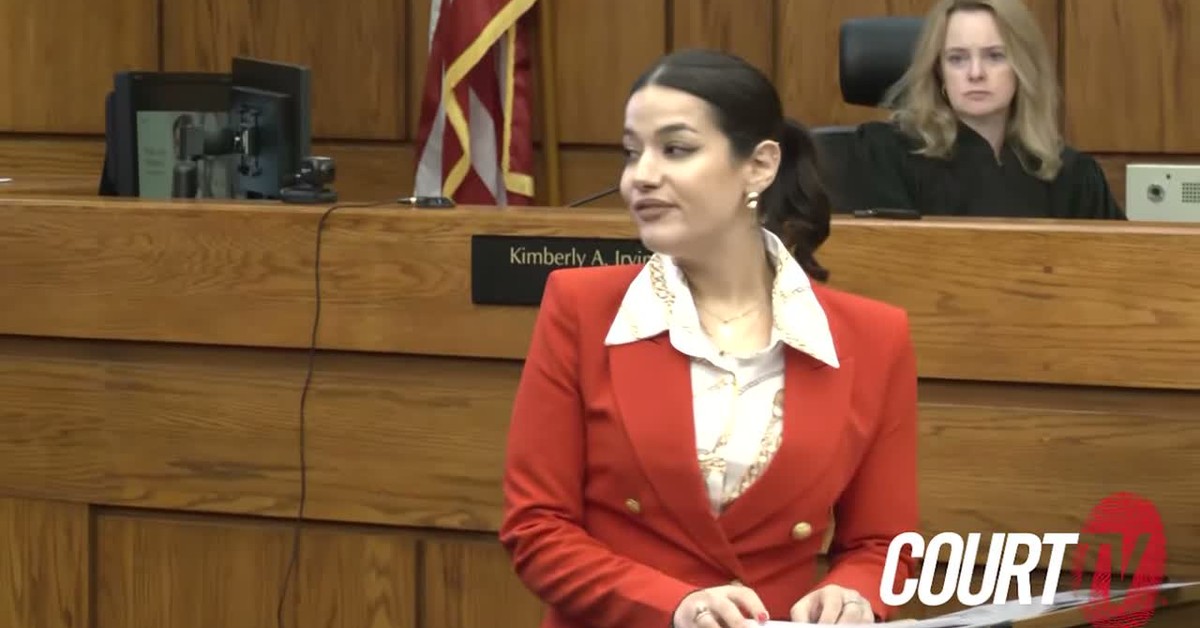
MANASSAS, Va. — “Raja” was Mamta’s word. It means king, and it is what Mamta Kafle Bhatt called her husband at home in Manassas Park. On Tuesday, Sarah Sami took the dead woman’s own word for Naresh Bhatt and turned it into the last portrait the jury would carry out of the courtroom: a “raja” ruling a “house of terror,” a “kingdom of torture” — a “master manipulator, master liar” who had cut off his wife’s phone use and who, in the end, decided whether the world would ever find her body.
It took the senior assistant Commonwealth’s attorney 47 minutes on Tuesday to build that portrait, test it against Bhatt’s own testimony and hand it to the jury. The twelve were out a little more than four hours. The king, they decided, was a murderer.
Her first exhibit, though, was a text message. She began the closing arguments with the one Bhatt sent his wife at 1:31 a.m. on Feb. 19, 2024. “The days are coming that you will regret a lot,” he had written. Mamta Kafle Bhatt died 162 days later, on the Commonwealth’s account.
Reporters covering the trial for WJLA heard a prosecutor very aware of the need to solve a particular problem. Murder in the first degree requires intent. Horror itself is not sufficient, and there was horror enough in the case — blood in the Manassas Park house, the searches on his devices, the cameras. A written threat, documented and dated, five months before the day that Mamta died, gave the jurors something else. It provided a starting point of a sentence Bhatt typed himself. All the rest could be read in its continuation.
Why build a closing on the wife’s own word for her husband? Because of the alternative it killed. Tracey Lenox needed to paint for the jury the picture of a man who found his wife dead and panicked. The “raja” left no room for that man. Control her while she lives, Sami was saying. Control the story once she is gone. Panic does not look like that.
Most of the closing, however, was the witness stand. “We proved our burden before he took the stand,” Sami told the jury. Then she went to the witness stand again, because Bhatt’s own testimony there was the best evidence she could use. “He had to admit what he could not deny and deny what he could not admit.” Admitting was the disposal: the saw, the remains put out with the trash, lie after lie to the police, family members and neighbors, confirmed name by name when prosecutors questioned him. Denying came down to one question: Did he kill her? “No, not even imagination.” Sami’s reply: “Where is Naresh Bhatt’s truthfulness? There is none.”
See what she did not have to do. She did not have to show which part of his suicide story is a lie, because the parts had already been knocked loose by witnesses his own side called or could not avoid. Bhatt’s version mentioned Celphos, a pesticide. The account he provided to Dr. Barry Rosenfeld, the defense’s psychologist, mentioned pills — up to ten of them, in two different colors. And Rosenfeld confirmed on cross-examination that Celphos was not mentioned by Bhatt. In Tuesday’s court, a toxicologist explained how Celphos works when put into water: it reacts and becomes activated. Bhatt had testified he poured some water into his wife’s mouth. Rosenfeld provided Sami with another piece of evidence. Panic, Rosenfeld agreed, could happen in Bhatt due to his PTSD. Not planning. Not disposing. And when he took her apart, Bhatt was not dissociating at all. A story can survive one loose thread. Bhatt’s story was loose at every seam she pulled.
Now, there was only the missing element of the case, and Sami ended with that. “The defendant killed Mamta Kafle. The defendant concealed the remains Mamta Kafle, and the defendant got rid of her like garbage,” she stated. And then came the line: “Don’t let him control the last memory of Mamta. Don’t let him do that.”
Don’t let him control the last memory of Mamta. Don’t let him do that.
This is how a prosecutor uses a weakness as the last image of the case to take into the deliberation room. Body not found is usually reasonable doubt dressed up in a suit. In Sami’s words, the missing body was the last act of the crime, and “raja” had done it for the same reason he did anything else she described. Control.
It was all Lenox could do with 24 minutes. Mamta, Lenox noted, was not a “pure victim.” She was “deeply unhappy.” She left the jury with the law’s own words, or close to them: “If a doubt about what happened lives in your mind, based on reason, you must render a not guilty verdict.”
It did not take Sami five minutes to reply. The circumstances, she said, are “consistent with guilt.” The jury’s job is “to give justice to people who couldn’t protect themselves.” And then, done: “Every action has a consequence.”
The jury was out a little more than four hours. Judge Kimberly A. Irving’s instructions gave them a softer option — second-degree murder was open to them — and the jury passed on it. First-degree. Concealing. Defiling. All three. The suicide story, the entire defense, did not convince anyone in that room.
Naresh Bhatt is 39. He appears before Judge Irving again on March 12, 2027, to hear the sentence — 20 years or life in prison. Sami’s last sentence is hanging over the case, and now after Tuesday’s trial it is hard to see it as anything but the draft of the verdict.
Also Read: Naresh Bhatt Guilty of First-Degree Murder, Jury Finds | ‘Don’t Let Him Control the Last Memory of Mamta’: Jury Begins Deliberations in Bhatt Trial
Sources. This report draws on the following coverage; quotes are reproduced as those outlets printed them. WJLA, InsideNoVa, Court TV, NBC4 Washington, FOX 5 DC and WUSA9.