

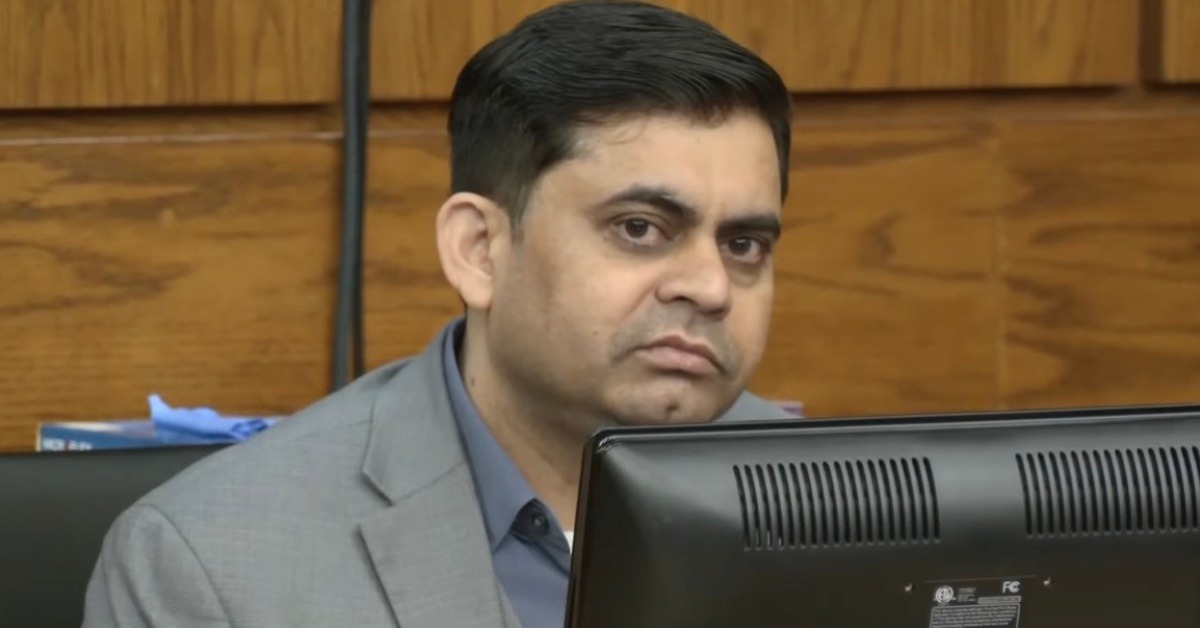
“You’re a liar.” “Yes.”
Three words from the prosecutor. One word back. And then applause rolled through the Prince William County courtroom on Thursday, before Judge Kimberly Irving called the room to order.
But it is the numbers that tell the colder story. A 28-year-old nurse. A baby girl, 11 months old. Forty-five minutes of CPR, by his account — and not one call to 911. Three knives bought on July 30, 2024, the day prosecutors say she died. One reciprocating saw, handed to a landscaper, later found with hair inside it. More than 70 witnesses called by the Commonwealth. Two years of lies, admitted on the stand one name at a time.
Then prosecutor Matthew Sweet asked the question that put two of the three charges in a new light: “Did you conceal the dead body of your wife?”
“Yes.”
And when he was asked whether he killed her, Naresh Bhatt gave the only answer he has left: “No, not even imagination.”
That is where this case now stands. Bhatt has, by his own sworn testimony, admitted the conduct at the heart of two of the three charges — the hiding of his wife’s body, and the cutting of it. What he has never done is plead guilty — to any of it. In Virginia, sworn admissions like his are evidence for a jury to weigh. They are not verdicts. The verdicts remain where the law puts them: with twelve jurors. What remains genuinely in dispute is the question he still contests — and it is the one that carries life in prison.
His Story: Suicide, Panic and a Saw
Start where he wants the jury to start: with a husband who says he found his wife dead. Bhatt testified that on the morning of July 30, 2024, he found Mamta Kafle Bhatt on their bedroom floor, vomit beside her and the pesticide Celphos nearby — dead, he says, by suicide. He says he worked over her with CPR for 45 minutes; at no point in those 45 minutes did he pick up a phone and call 911. He covered her face, as he says her family would have done. What he did next, by his own account, was take a saw to her body, bag the pieces, and put his wife out with the trash where she would not be found — the biggest mistake of his life, he says, and his biggest regret.
The Woman Who Vanished
Now go back to where the story actually begins — with a woman who simply stopped existing in public. Mamta’s own story starts in Nepal. The move came in 2021: Nepal to Manassas Park, and a nursing post at UVA Health Prince William Medical Center. By the summer of 2024 there was a baby girl at home, not yet a year old. Her last shift at the hospital fell on July 27, 2024. She spoke to her mother in Nepal by video call on July 29. After that, silence — no shift, no call, no message, nothing.
The Story He Told Police
What happened next happened around him, not because of him. When Mamta missed work, it was her coworkers who raised the alarm, and on August 2 police knocked on the couple’s door for a welfare check. Bhatt’s account to the officers was calm and complete: they had argued, Mamta had left to visit family in New York or Texas, she was not missing, and there was nothing to report. The centerpiece of it was false: Mamta had no biological family in the United States — police reported her relatives were all in Nepal — and prosecutors say she never left that house alive at all. Still, he declined to report her missing. Only on August 5, three days after police had already come asking, did he file the report himself, telling them he had last seen his wife at dinner on July 31 — a day after the date prosecutors allege she was killed, on or about July 30.
The Searching Husband
Then came the performance. In the weeks that followed, Bhatt played the searching husband: he sat for interviews as the worried spouse pleading for his wife to come home, and in a live interview with a Nepali journalist he insisted that he never lies. More than two years later, prosecutors played that clip back to him on the witness stand, in front of the jury, after he had admitted lying to nearly everyone he knows. To Mamta’s mother, Gita Kafle, who would soon fly from Nepal to search for her daughter, he maintained the story. To her brother Mahesh, to friends, to the tenant in his home, to the babysitter, to officers who kept coming back with questions — the story held: she left, she is somewhere else, she will return. On Thursday, under cross-examination, he admitted he had lied to them all, name by name — her mother, her brother, her friends, the police. While he was telling it, investigators say, he sold his Tesla, moved to sell the house, and packed bags and passports for himself and his daughter.
What the House Told Investigators
Then investigators searched the Manassas Park home, and the case turned. They found a substantial amount of blood in the couple’s bedroom and bathroom — pooled in a way that suggested a body had been dragged across the floor. They learned he had bought a set of three knives on July 30, the very day prosecutors say Mamta died, and cleaning supplies on July 31. On August 21, police named him a person of interest. On August 22, 2024, Naresh Bhatt was arrested and charged with concealing a dead body. He has not spent a night outside a jail cell since.
Two Years Without a Grave
What followed was two years of waiting, and Mamta’s family waited through all of it without a body to bury. On December 2, 2024, a Prince William County grand jury indicted him on first-degree murder and physically defiling a dead body, on top of the concealment charge. The concealment case alone had first been set for trial that same month; the three-charge case then moved — first to September 2025, and then, in July 2025, to October 5, 2026 — after the defense said it needed more time with the digital evidence. When the trial finally opened in Prince William County Circuit Court — jury selection on October 5, opening statements on October 7 — the Commonwealth spent four weeks and more than 70 witnesses on the blood evidence, the saw, the searches and the surveillance video, before prosecutors rested on November 2. The next day, Judge Kimberly Irving refused the defense’s motion to throw out all three charges. On November 4, the defense opened its case, and Naresh Bhatt did the one thing no one could make him do: he climbed into the witness box, raised his hand, and began to talk.
The Commonwealth’s Web
The Commonwealth’s case at trial was a web, not a single thread. Forensic testing put Mamta’s blood at the center of it: a scientist testified that blood taken from a reciprocating saw was very likely hers, measured against a profile developed from her hairbrush. The same saw — which Bhatt had given to the family’s landscaper as payment in the days after Mamta vanished — was found with reddish-brown stains an investigator believed to be blood and strands of hair inside it, findings the jury heard described separately from the DNA results. Surveillance video showed him carrying large bags to dumpsters and trash compactors across Northern Virginia. Detectives walked jurors through his searches: in March 2024, months before Mamta disappeared, he was looking into bringing a woman from Colombia to marry and asking what happens if a spouse disappears — his wife’s name saved in his phone as “bad memory.” In those same months came another search the jury will not forget: how long to wait to remarry after a spouse dies. Early on July 30, the day prosecutors say she died, he searched for a diagram of the human brain. Her brother Mahesh testified that Mamta had him keep a photograph of her injuries because she might need it one day. She was right to worry. She just never got to use it.
The Marriage Her Friends Saw
If the jury wants to know what that marriage looked like from inside, it does not have to take the Commonwealth’s word for it — it heard from the people Mamta confided in. Her close friend Sarita Neupane testified that Bhatt hit his wife during an argument over house cleaning, leaving a large bruise on her face — a bruise so visible that the rice ceremony for the couple’s baby daughter had to be put off. Mamta, she said, came to stay at her home for nearly two weeks while the marriage was breaking down. The control, on her account, was total: he turned off Mamta’s cellphone, would not let her drive, and kept money out of her reach. Sarita was helping her friend build a life he could not switch off — her own bank account, the first steps toward U.S. citizenship — when Mamta disappeared.
Her family carried the rest of it into the courtroom. Mahesh Kafle, her brother and the prosecution’s final witness, told jurors he had warned his sister not to marry Bhatt after the first time he met him. A couple of months before she vanished, Mamta secretly texted him a photograph that appeared to show her with a black eye and told him Naresh had given her the bruise. Keep it, she told him — she might need it one day. She would delete her own copy, she said, so Bhatt would not find it. Her mother, Gita Kafle, testified that she and Mamta spoke every day, morning and evening, until the calls stopped dead in July 2024; when she finally reached her son-in-law after days of trying, he told her Mamta had gone to visit friends. And a friend of the couple told the court that about two weeks after Mamta disappeared, Bhatt gave her all of Mamta’s jewelry — and his own wedding band.
Bhatt’s answer, from the stand, was a flat denial: asked whether he ever laid hands on his wife, he said, “Never ever ever.” He described the first two years of the marriage as very happy and admitted only that after the baby came, the two of them “weren’t being kind to each other.” The record kept interrupting him. On Valentine’s Day 2024, after a fight, Mamta called the police; a recording played in court captured him sarcastically thanking her for the call, and he conceded he had been furious because it could damage his reputation. In another incident, she called police saying he had taken her identification documents; his anger then, he admitted, was also about his government job. On cross, prosecutors confronted him with the photograph of the bruised face. He allowed it looked like the same mark that had delayed the rice ceremony. He denied causing it. Two fairness notes belong here. Before trial, the judge limited how much of the abuse history jurors would hear. And the defense warned in its opening that the people who knew the marriage might not be neutral witnesses. Both cautions are proper. Neither explains away a photograph a young wife sent her brother in secret, to keep safe from her husband.
The Suicide Story Meets Virginia Law
Against all of that, the defense offers suicide and panic. Virginia law gives that story a hard road — but it is a road the Commonwealth still has to walk. A jury may convict on circumstantial evidence, and a missing body is no bar to a murder conviction; the Commonwealth must prove death and a criminal act, and it may prove both by circumstance. The evidence, taken as a whole, must exclude every reasonable hypothesis of innocence — and the key word is reasonable: a hypothesis is not reasonable merely because a defendant can say it out loud. It must fit the facts. Suicide by pesticide, he asks the jury to believe, with no body left to examine and no toxicology left to run. The reason there is no body to test is that the man advancing the theory put it in the trash. His admitted disposal of the remains is a powerful reason to question his account. But it does not relieve the Commonwealth of proving murder beyond a reasonable doubt. Jurors must weigh his explanation against all the evidence — and the burden never moves.
What His Own Words Do — and Do Not — Decide
Then there are the two counts his testimony now shadows. Concealing a dead body, under Virginia Code § 18.2-323.02, means transporting, secreting, concealing or altering a body with malicious intent, to prevent detection of the death or of its manner or cause. Bhatt did not merely admit the act; on the stand he described the purpose himself — the remains went into the trash, as he put it, so they would not be found — and then came two years and more of lies: to her mother, to her brother, to her friends, to the police, to anyone who asked. Defiling a dead body, § 18.2-126(B), is the willful and intentional physical defilement of a corpse. What Bhatt described doing with a saw — and the trash can he said he made her body fit into — is the conduct the jury will measure against those words. Each of those counts is a Class 6 felony: one to five years in prison or, in the discretion of the court or jury, up to 12 months in jail and a fine of up to $2,500. None of this makes the verdicts formalities. His admissions are evidence — on these two counts, the most damaging the jury heard, because it came out of his own mouth — but he has pleaded not guilty to all three charges and remains presumed innocent of each unless the Commonwealth proves every element beyond a reasonable doubt.
The Only Question Left
Which leaves murder. Virginia’s statute, § 18.2-32, defines first-degree murder as a willful, deliberate and premeditated killing and grades it a Class 2 felony: twenty years to life. Prosecutors allege a uglier, simpler version: Bhatt came home around midnight on July 29, found Mamta on the phone with a male coworker, and strangled her in a rage. And if the judge instructs jurors on second-degree murder, they could consider that lesser offense — five to 40 years — instead. But jurors do not assess the suicide story in a vacuum. They assess it beside the knives bought the day she died, the cleanup, the blood, the saw, the dumpsters, the searches about remarrying, the two years of lies he has now admitted to, and the fact that the man who admits dismembering and disposing of her body is the man asking them to believe she died by her own hand. And jurors may weigh the simplest sequence in the whole case: no call to 911, not once — and the saw gone from the house, in a landscaper’s hands, within days.
What Mamta Deserved
Let the record be precise about what remains his right: Naresh Bhatt is presumed innocent of all three charges until twelve jurors say otherwise, and the verdicts are theirs alone. But an opinion page is allowed to say what a courtroom full of people already understands. On Thursday, this trial narrowed to the hardest question in it — and to whether a story told by an admitted liar, a story that required a young mother to vanish into a landfill without a trace, can survive contact with everything else he has done. It should not. Mamta Kafle Bhatt deserved a funeral, a grave, and a husband who picked up the phone. She got a trash can. Whatever the jury decides about how she died, the charges for what he did next will be settled by the same jurors, weighing his own sworn words against the law — and on those counts, the most damaging witness against Naresh Bhatt has been Naresh Bhatt.
Also Read: ‘No, Not Even Imagination’: Bhatt Denies Killing Mamta on Cross
Also Read: Bhatt Admits Lying as Cross-Examination Opens: ‘You’re a Liar’
Also Read: Naresh Bhatt’s Bombshell Testimony: Says Mamta Died by Suicide and Admits He Dismembered Her Body
Have something to promote?
Bring your business, services or event to our readers.