
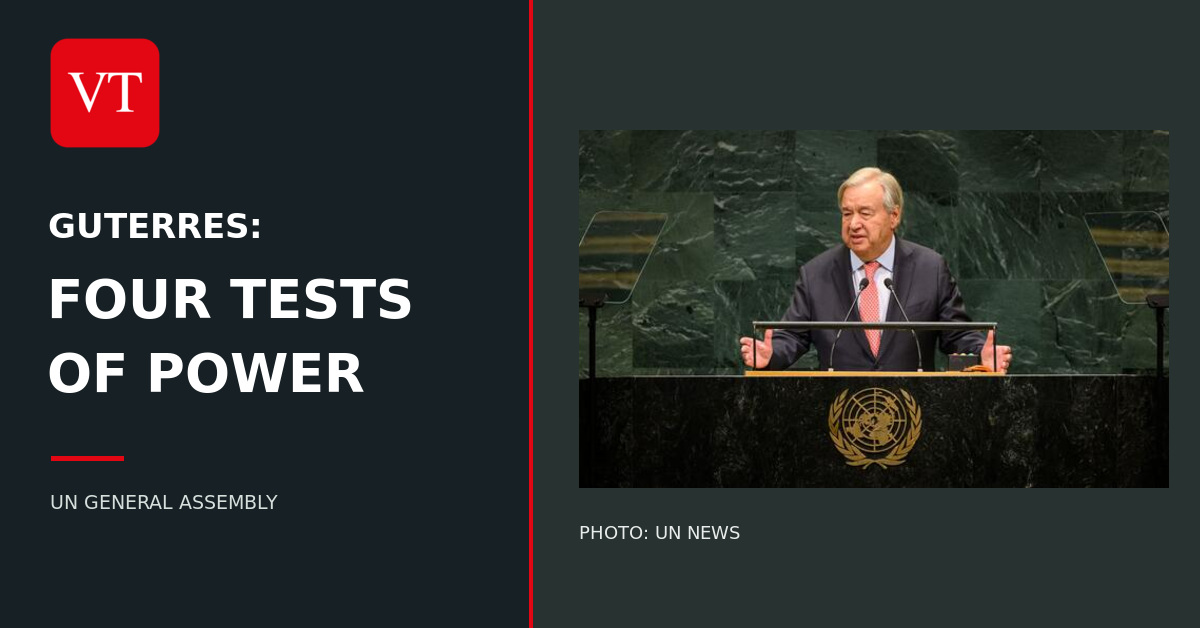
U.N. Secretary-General António Guterres said Tuesday that four “tests of power” — war or peace, inequality, climate change and artificial intelligence — will determine whether the world moves toward cooperation or deeper division.
With roughly 100 days remaining in his term, Guterres delivered the wide-ranging address while presenting his annual report on the organization. UN News described the speech as an effort to connect the world’s gravest crises to a broader question: who holds power and how it is used.
“The greatest power is not the power to dominate. It is the power to build a future that works for everyone.”
Looking back over the past decade, Guterres said basic international rules have begun to give way. Civilians have been attacked in war, aid workers have been killed, international law has been pushed aside and trust among nations has faded.
Power is changing hands as well. Guterres pointed to the rise of new state powers and to the influence that corporations and individuals now hold. At the same time, AI and autonomous weapons are taking a growing role in decisions once made by people.
Still, he rejected the idea that a more divided world is unavoidable. Countries can choose cooperation, he said, by recognizing their dependence on one another and working under shared rules. Otherwise, the world could split into competing economic and security camps — the divide he calls the Great Fracture.
Conflicts and Security Council Reform
Addressing crises in the Middle East, Ukraine, Sudan and Myanmar, Guterres said so-called ceasefires have often amounted to little more than “lesser fires,” with civilians continuing to suffer.
Guterres turned to Gaza, calling for the International Court of Justice’s orders to be followed. Expanding Israeli settlements in the occupied West Bank, he said, could close the door on a two-state solution.
On Ukraine, Guterres called Russia’s full-scale invasion a clear breach of the U.N. Charter.
The Security Council, he said, still reflects another geopolitical era. Africa has no permanent seat on the 15-member body, an absence Guterres called “unjust and indefensible.”
Inequality and Gender Parity
The world has never been wealthier, yet billions of people still go without food, clean water, education or health care, Guterres said. For him, that divide is not simply about money. It is also about who gets opportunities, who controls resources and who can shape their own future.
Developing countries face an added burden. According to Guterres, many are struggling with debt while dealing with climate disasters they did little to cause. He urged faster debt relief, greater action by multilateral development banks and fairer access to the International Monetary Fund’s Special Drawing Rights.
Guterres pointed to the U.N. itself as evidence that established systems can change. For the first time, he announced, the organization has reached full gender parity across senior leadership, headquarters staff and professional roles.
Climate Change and AI
On climate change, Guterres warned that exceeding the 1.5-degree Celsius threshold is nearly certain. He called for polluters to pay and for developed countries to triple adaptation funding.
Major oil companies have earned substantial profits since Russia’s invasion of Ukraine, he said, while global adaptation financing for developing countries remains a fraction of that amount.
Turning to AI, Guterres warned that power is becoming concentrated in data, computing capacity and algorithms faster than humanity can establish safeguards.
“The danger is not technology. The danger is technology without accountability,” he said.
Guterres proposed a multilateral AI risk-management framework with independent oversight. Children should never become test subjects for unregulated systems, he said, and “life-and-death decisions must never be surrendered to machines.”
He also rejected a future role for killer robots.
Final Months in Office
Guterres called peace, development and human rights inseparable pillars of the U.N. Charter. He rejected separating dignity and rights from security and opportunity.
Referring to the founding of the United Nations after World War II, he described the organization as a recognition that countries’ futures are bound together.
With about 100 days left in office, Guterres said he would spend the rest of his term defending the U.N. Charter and continue that work after stepping down. His closing point was direct: today’s crises demand a stronger United Nations, not a weaker one.

A global media for the latest news, entertainment, music fashion, and more.