

Russian President Vladimir Putin said Thursday that Moscow has accepted the compromise terms worked out with U.S. President Donald Trump at their Anchorage meeting — and that the war in Ukraine could be over quickly if Kyiv does the same.
“Russia agrees to the compromises discussed in Anchorage,” Putin said. “It is necessary that Ukraine also agrees to make them. Then, the conflict will be resolved naturally and quickly.”
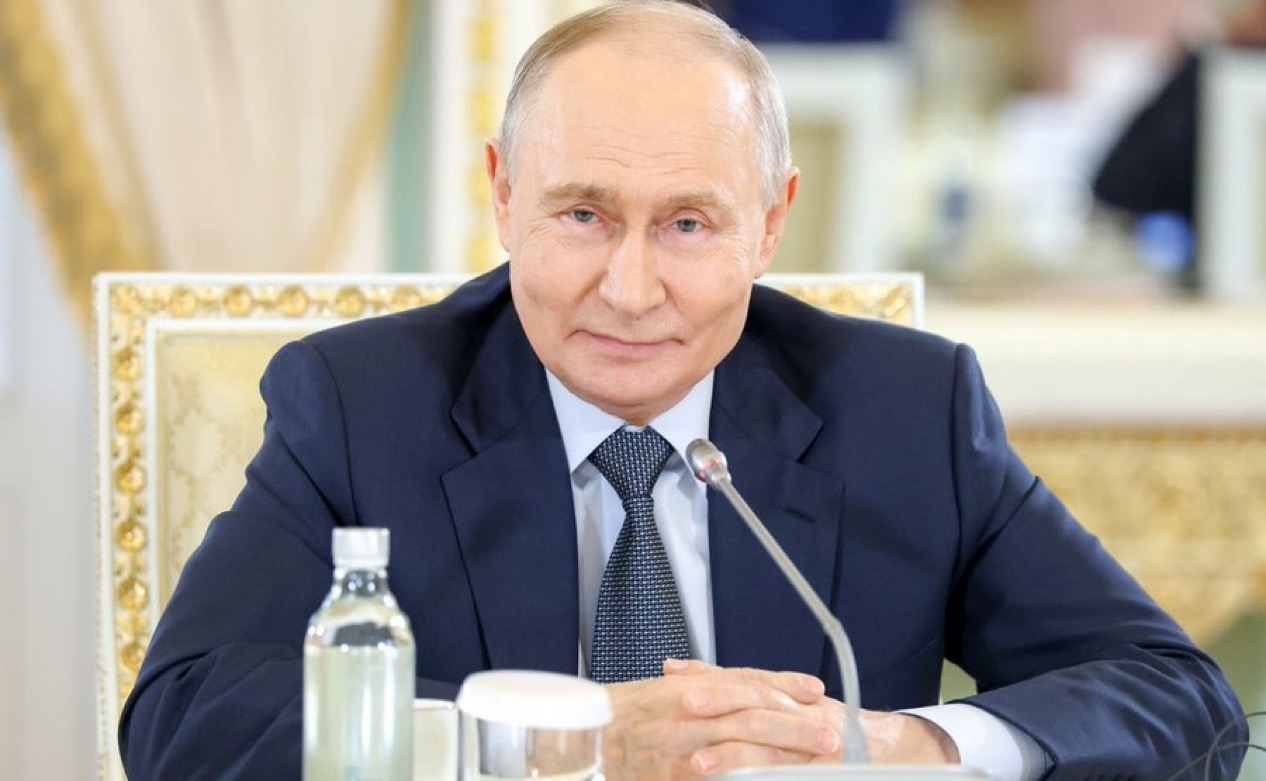
Putin spoke at the Constantine Palace in St. Petersburg, where he met with heads of international news agencies on the sidelines of the city’s annual economic forum. TASS Director General Andrei Kondrashov moderated the session, which drew news agency chiefs from China, India, Germany, France, Britain, Egypt, and several former Soviet states.
When asked why Kyiv was not moving toward a deal, Putin was direct: Ukraine’s leadership, he said, has no political incentive to stop fighting. Peace, in his telling, would open the door to a power struggle in Kyiv and leave the government to face an economy in ruins. “The ruling authorities are not interested in stopping the hostilities,” he said, “because in this situation they are unlikely to have any good prospects for retaining power.”
Battlefield claims
Putin said Russian forces are moving forward across every stretch of the front line. Ukraine, he claimed, is hemorrhaging troops faster than it can replace them.
His numbers: about 40,000 Ukrainian soldiers lost each month to combat. Coming back the other way — roughly 15,000 to 16,000 fresh conscripts and around 14,000 wounded returning from hospital care. Do the math, he said, and Ukraine is still short about 10,000 fighters every single month.
Desertion is eating into those numbers further. Around 20,000 Ukrainian soldiers are walking away each month, Putin claimed, and close to 200,000 criminal cases for desertion have been filed since the start of the year. He described men being pulled off the streets to fill the ranks — forced into uniform with, in his words, no motivation to fight.
He said Russian forces now hold all of the Luhansk People’s Republic, more than 85 percent of the Donetsk People’s Republic, and 80 percent of the Zaporizhzhia region.
He acknowledged that Ukrainian drones punched through Russian air defenses the day before, hitting a naval base and an oil depot near St. Petersburg. The defense network needs work, he said, and will get it.
Oreshnik disclosure
Putin confirmed that Russia has used its Oreshnik hypersonic missile in strikes over Ukraine, though he stopped short of calling it full combat deployment. The strikes, he said, were partly observational — drones were sent into the hit structures afterward to measure how the warheads dispersed, with the results calculated “to the millimetre.” He said that data would inform future use of the system, including, in his words, against urban areas.
Zelensky’s legitimacy
Putin raised questions about whether Zelensky has the legal standing to sign any peace agreement, pointing out that Zelensky’s elected term expired in May 2024. He said whoever signs for Ukraine would need to be clearly legitimate under the country’s constitution. He named the Chairman of the Verkhovna Rada as one possibility and did not rule out Zelensky entirely, saying the question needs careful legal analysis.
“When there is a will, there is a way,” he said.
European mediation
Putin was skeptical that the European Union could serve as a neutral mediator, given that EU members have been sending weapons to Ukraine. A mediator, he said, has to be trusted by both sides — and that rules out much of Europe in his view.
He held up former German Chancellor Gerhard Schröder as someone who could fill that role, saying Schröder had spent decades proving his word was good. He brushed aside objections that Schröder was too friendly with Moscow, calling him a German statesman with the spine to defend his own positions regardless of pressure. That quality, Putin said, is what matters — not personal friendship.
He said EU governments could still be useful, just not as arms suppliers. Their leverage, he argued, would be better used convincing Kyiv to accept the Anchorage terms.
Nord Stream
One string of the Nord Stream 2 pipeline is undamaged and ready to carry gas, Putin said, and Russia could start delivering to Germany tomorrow if Berlin gave the go-ahead. Gazprom has kept its supply contract in place and is ready, he said. The obstacle is U.S. sanctions, which he said the German government could work to lift if it chose to.
“You just need to press a button, and the gas will start flowing,” he said.
He added that Gazprom needs a clear answer from its German partners soon. If they will not take the gas, Russia will sell it elsewhere.
Iran nuclear offer
Putin said Russia is ready to repeat what it did in 2015 — broker the removal of enriched uranium from Iran to Russian territory — if all parties want a way out of the current crisis. Under his proposal, Iran’s uranium stockpile would be transferred to Russia, placed under IAEA oversight, and gradually diluted for civilian nuclear use. That would give the United States, Israel, and others full visibility into the material, he said.
“Wherein lies the problem? I see none,” Putin said.
He acknowledged that talks had broken down over the years but said Russia’s offer remains on the table. He pointed to the Bushehr nuclear power plant project as evidence that Iran trusts Russia to follow through.
Economy
Putin rejected the idea that the Russian economy is buckling. Over the past three years, he said, Russia’s economy grew roughly 10 percent — about three times the EU’s growth rate over the same period. Germany, he noted, managed less than 1 percent.
He did not deny that inflation has been a problem. The Central Bank raised interest rates sharply on purpose, he said, to cool the economy rather than let inflation spiral out of control. The key rate has since come down to 14.5 percent. He said real household incomes are up more than 28 percent, the share of Russians living in poverty dropped to 6.7 percent in 2025 — ahead of a 2030 target — and public debt sits at 15.6 percent of GDP.
NATO attack claims
Putin called suggestions that Russia is planning to attack NATO territory not just wrong but deliberately manufactured. The point, he said, is to frighten European populations into approving bigger defense budgets and continued support for Kyiv. He said there is no logical reason for Russia to attack Europe and no strategic goal that would justify it.
“It is not simply nonsense,” he said. “It is a provocation.”