

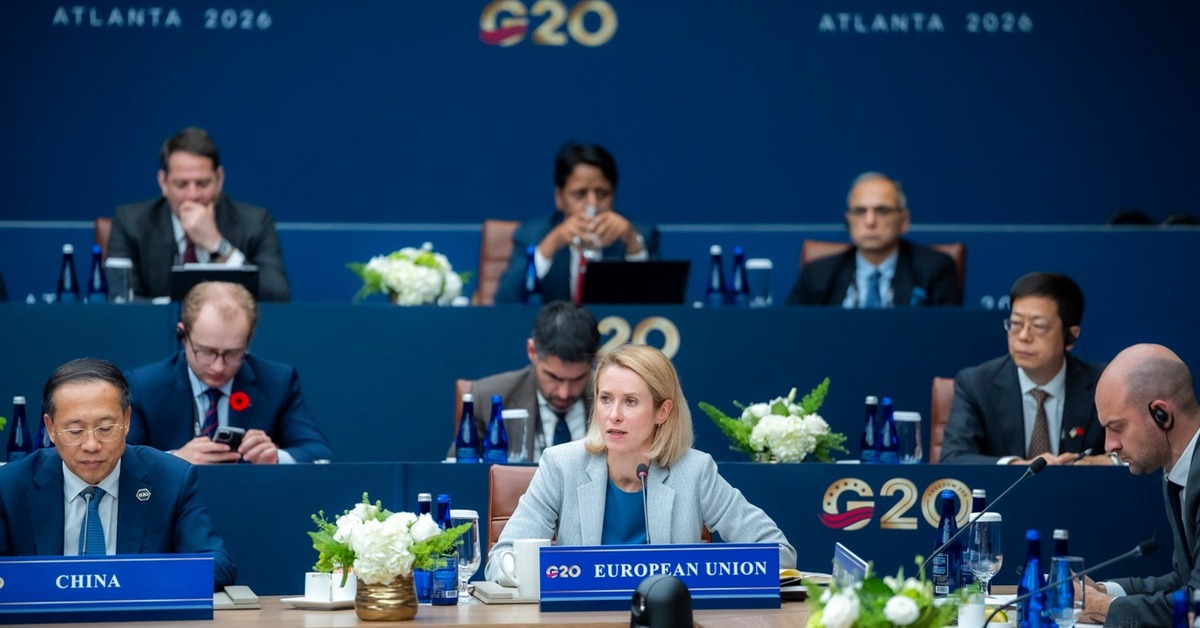
European Union foreign policy chief Kaja Kallas told Russia at a G20 foreign ministers meeting that it should let Black Sea grain pass if it cares about Africa, according to remarks released Saturday.
Kallas said most of the grain moving through the Black Sea goes to Africa, and that holding it back is causing food insecurity she called “really urgent.” She backed calls from other ministers for a Black Sea ceasefire and said Moscow could show goodwill by starting there.
The remarks, published by the European External Action Service, were delivered during a plenary session on supply chains. After addressing Russia, Kallas urged G20 members to work together so that dependence on critical minerals cannot be used as a tool of coercion.
Kallas challenges Moscow’s claims
Kallas said she agreed with Russia that the world faces a “systemic problem,” but argued that the problem is Russia. She accused Moscow of disregarding international law and the U.N. Charter, and of using food, energy, migration and trade routes as weapons.
Addressing the Russian delegation directly, she said Moscow had made plain that it does not care about Ukraine while claiming to care about Africa.
Kallas also rejected Russian accusations that others are waging colonial wars. If any war today fits that description, she said, Russia’s war against Ukraine is the clearest example. She said she was building on points raised by Jean-Noël Barrot.
She pointed to what she described as a contradiction in Moscow’s position: Russia says sanctions have not hurt its economy, yet it wants them lifted.
“So either it has an impact on your economy, or the sanctions could just remain.”
Push for cooperation on critical minerals
Kallas warned that disruptions and unpredictable restrictions drive up costs, hit industrial production and hold back economic development — one reason, she said, no G20 economy can secure resilient supply chains on its own, even though every one of them depends on reliable access to critical minerals. With major producers and consumers in the group, she argued, the G20 should use that position to get practical cooperation moving, starting with more transparency and dialogue about measures that affect supply, which would cut uncertainty and keep disruptions from spilling into wider economic and political tensions.
Diversification should open opportunities for producing and consuming countries alike, Kallas said. She wants more viable sources of supply and more processing capacity, along with stronger links between partners across the value chain. Producer countries must benefit from the effort, she said, through partnerships that support local value creation, skills, infrastructure and sustainable industrial development.
The ‘three I’s’
Kallas described what she called a very practical framework. Its three parts are information-sharing, innovation and investment, and she said G20 members agreed to them on a voluntary basis.
The first is about seeing trouble coming. Kallas wants countries to swap more information on market developments, planned capacity and disruptions so they can anticipate pressures and respond earlier. On innovation, she called for working together on recycling, resource efficiency and substitution. Those steps could ease the strain on primary supplies, she said.
Investment is where diversification plans have to become viable projects. Kallas said that means connecting producers, investors and buyers. It also means closing gaps in infrastructure and skills.
The EU is already doing this through its raw materials partnerships, Global Gateway and cooperation on strategic projects, she said. Kallas added that the bloc wants to develop investment opportunities with interested G20 partners and businesses.
Have something to promote?
Bring your business, services or event to our readers.