

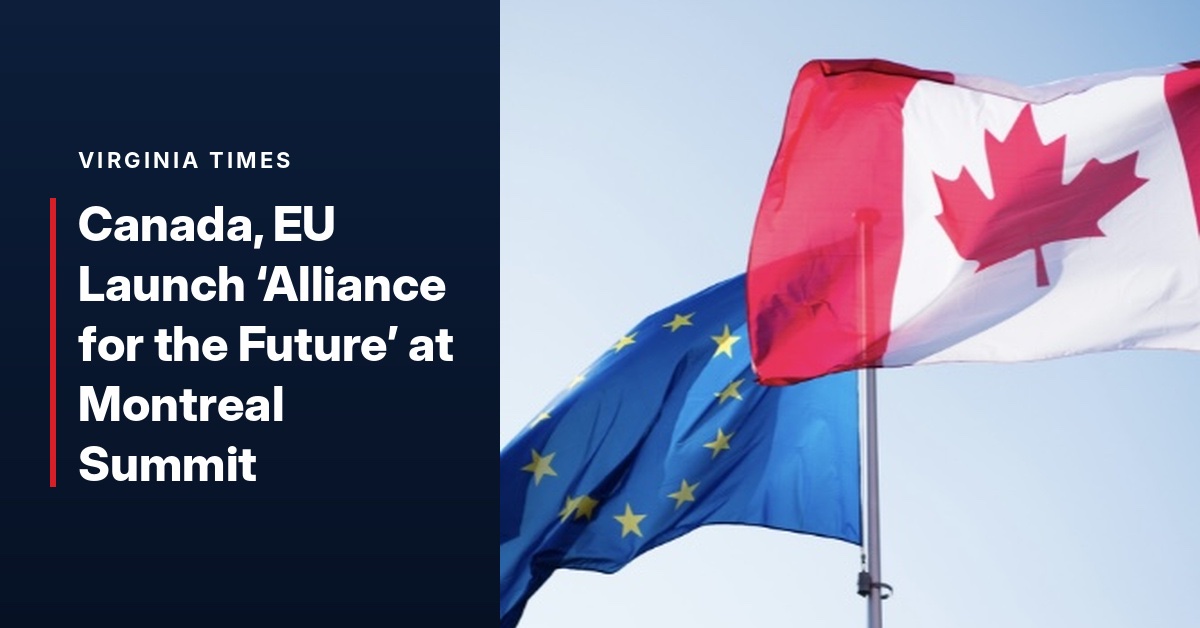
MONTREAL — Canada and the European Union launched a new partnership called the Alliance for the Future on Friday, unveiling more than 20 measures on trade, research, defense and critical minerals.
The two sides are also working toward making Canada the EU’s first associate member, described as the deepest possible partnership short of joining the bloc, according to the Prime Minister’s Office. What that membership would include, and how far it would go, is still to be decided in the months ahead.
Prime Minister Mark Carney hosted the 21st Canada-EU Summit from Oct. 29 to 30. Joining him were European Council President António Costa and European Commission President Ursula von der Leyen.
Negotiators wrapped up two deals at the summit. One lets Canadian and European authorities go after anti-competitive practices by companies doing business on both sides of the Atlantic.
The second deal covers digital trade, the first agreement of its kind for Canada. Canadian companies exported nearly $15 billion in digitally deliverable services to the EU in 2024, International Trade Minister Maninder Sidhu said.
Canada has also signed on to the European High Performance Computing Joint Undertaking. Through it, Canadian researchers and businesses get access to JUPITER, among the world’s most powerful supercomputers.
Montreal-based Galvion landed a contract worth more than $44 million to make military helmets for Latvia, where Canada has its largest military presence abroad. The deal is Canada’s second under the EU’s Security Action for Europe initiative, which it joined in February as the first non-European country.
Alberta-based De Havilland will receive up to $2.5 billion in financing to boost waterbomber production. Canada also signed a treaty framework allowing the European Investment Bank to invest in Canadian critical minerals projects.
“Ours is an Alliance that delivers now and for the future.”
In the coming months, Canada and the EU plan to negotiate Canada joining the next Horizon Europe research program, expanding its role in the Erasmus+ exchange program and connecting their instant payment systems. They will also study a new transatlantic data cable and increased liquefied natural gas exports.
The EU is Canada’s second-largest trading partner, with about $178 billion in goods and services trade in 2025.
Have something to promote?
Bring your business, services or event to our readers.