

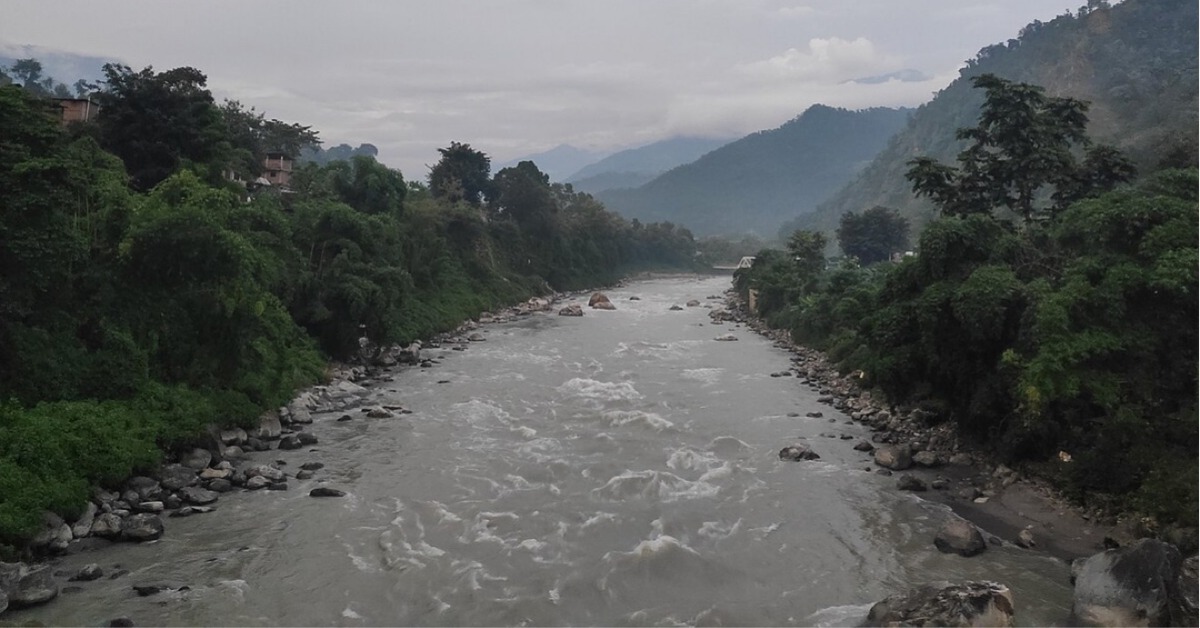
KATHMANDU, Nepal — Six people died in the Budhigandaki flood, and six remained missing or out of contact, Nepal’s National Disaster Risk Reduction and Management Authority reported.
In its fourth situation report, issued Friday, Oct. 16, the authority listed figures as of 10 a.m. Rescuers had brought 1,039 Nepalis and 89 foreign nationals to safety — 1,128 people in all. The agency listed the dead as four men and two women.
Initial inspections found 145 houses damaged or destroyed. Along the river, floodwaters washed away farmland and damaged bridges and hydropower projects, with settlements downstream toward Philim and Arughat also affected.
Landslide temporarily blocked river flow
The authority’s preliminary technical assessment traced the flood to a landslide near the Hinang Glacier, roughly 5,500 meters above sea level, above Dading Dada in Sirdibas, Gorkha district.
Debris entered the Hinang River and its confluence with Gyap Khola, temporarily blocking the flow. Water repeatedly broke through the obstruction, sending surges into the Budhigandaki, according to the report.
Near the Upper Budhigandaki Hydroelectric Project construction site, the river rose an estimated 20 to 25 meters within two hours.
The flood’s cause, casualty figures and damage estimates have not been independently verified.
Homes and infrastructure damaged
In Chhekampar, in Chumanubri rural municipality’s Ward 2, the report listed four houses destroyed and six residents missing or out of contact.
Its village-level assessment recorded 44 houses flooded in Shanti Bazar, 36 in Penga and 19 in Soti. Water entered about 62 houses in Bishalnagar, in Tripurasundari.
In Salleri, three to five houses were damaged or swept away, while another 20 to 22 were considered at risk.
The report’s infrastructure summary listed damage to three hydropower projects, one school, two paved bridges, six suspension bridges, one Bailey bridge and one cantilever bridge.
An earlier assessment in the same document listed two damaged hydropower projects, two Bailey bridges and one suspension bridge. The report did not explain the differences between those figures and the infrastructure summary.
An estimated 140 to 150 livestock were lost or swept away.
Helicopters carry rescuers and supplies
Army, police and Armed Police Force teams joined the response. Four army helicopters were deployed, and the report’s air operations table recorded 258 flights over five days.
Relief dispatched to Gorkha included 150 tents, 150 tarpaulins, 505 mattresses, 440 blankets, 690 food baskets and 348 sacks of rice. Shipments also included kitchen sets, hygiene supplies and solar lighting.
For affected communities in Dhading, authorities dispatched 58 tents, 240 blankets, 540 jackets and 180 food baskets, along with other supplies.
The air transport tables recorded 13,165 kilograms of food and relief materials and 6,930 liters of aviation fuel and diesel over four days.
The assessments remained preliminary, with six people listed as missing or out of contact at the report’s cutoff.
Have something to promote?
Bring your business, services or event to our readers.