

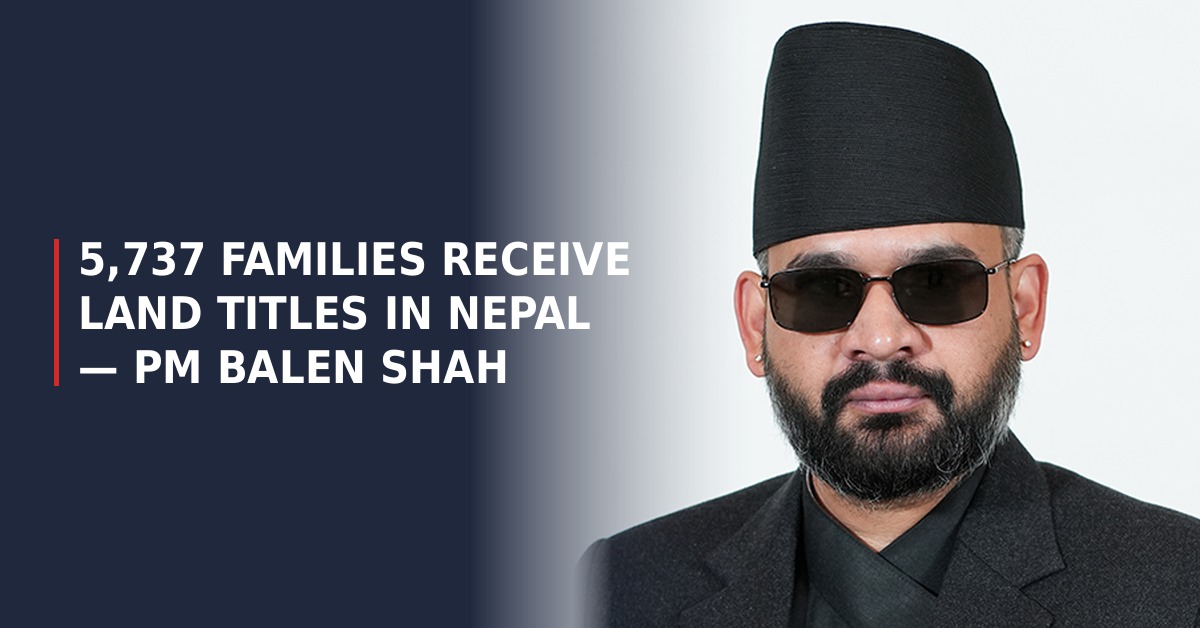
Nepal’s government has given land ownership certificates to 5,737 families, Prime Minister Balen Shah said in a Facebook post outlining his plan to end the country’s decades-old landlessness problem.
The certificates, known as lalpurja, went to landless Dalits, landless squatters, longtime residents without ownership papers and people living in informal settlements. Shah said the distributions took place in several districts but did not name them or say over what period they occurred.
He called the handouts “the beginning” and said the government now plans to expand them quickly nationwide. His figures could not be independently verified.
1.3 million applications under review
A Land Problem Resolution Committee is collecting and processing records from across the country in one system, according to the post. So far, 1,311,197 applications have been entered.
Officials are reviewing and verifying those applications. Priorities for resolving cases will be set next, Shah wrote.
The government is also relocating squatters from hazardous sites and areas of public importance to safer places. Families displaced from the Kathmandu Valley will receive land in the districts listed as their permanent homes.
Authorities have begun cross-checking records to find people accused of falsely claiming to be landless, and legal proceedings have started, the post said. It gave no case count and did not identify anyone.
Laws to be amended
To speed up the work, the government plans to amend the Land Act, the Forest Act and related laws. Shah said legal, procedural and institutional barriers would be changed where needed.
His Rastriya Swatantra Party promised during the election campaign to resolve the problem of landless squatters within 1,000 days. That pledge is now a formal performance target for the government, according to the post.
Under the plan, districts would be declared free of the squatter problem one at a time until the issue is resolved nationwide.
Criticism of past efforts
Shah sharply criticized earlier governments. He accused them of creating commissions and other bodies built around politics that consumed large amounts of money and time without delivering expected results.
From 2077 B.S. through last year, the state spent more than 2 billion rupees on those bodies, he wrote. The post did not include spending records.
Shah said his government has replaced that model with one based on subject expertise, coordination with local governments and clear responsibility, rather than political power-sharing and extra layers of bureaucracy.
The landless problem dates back about seven decades. In the 2015 B.S. parliamentary election, the Nepali Congress, then the largest party, pledged in its manifesto to give landless farmers priority when distributing fallow land, cleared forest land and surplus land above legal ownership limits.
Governments and political systems have changed many times since then, Shah noted, but the problem remains a major national issue.