

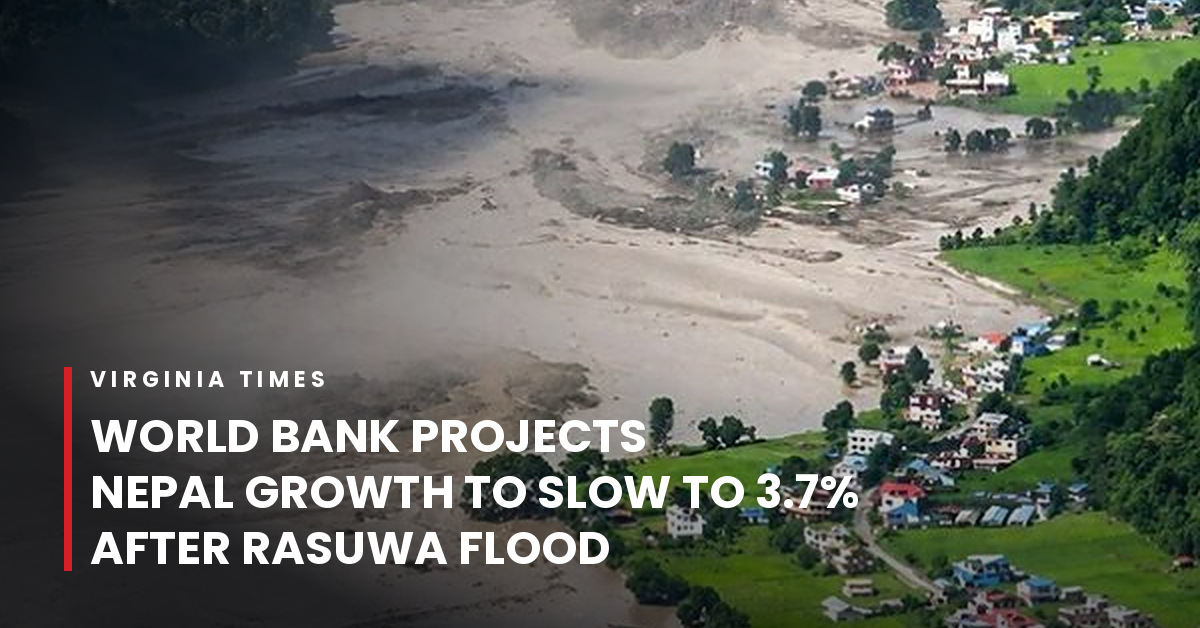
KATHMANDU, Nepal — Nepal’s economic growth is expected to slow to 3.7% in fiscal 2027 after the Aug. 26 Rasuwa flood disrupted industry and services, the World Bank said Tuesday.
The lender expects growth to recover to 5.2% in fiscal 2028, as reconstruction and rehabilitation work begins to lift economic activity.
Industry is expected to be the main drag on growth, according to the bank’s latest report, “Nepal Development Update: Building Back Differently for the Future.” Widespread damage to hydropower, solar energy, power transmission and transport infrastructure is likely to limit electricity generation and production and slow the movement of goods.
The report projects that services will be affected as trade, transport, tourism and financial activity are disrupted. Farm losses are likely to have little effect on overall output, but the bank expects them to significantly affect livelihoods in the hardest-hit areas.
David Sislen, the World Bank’s division director for Maldives, Nepal and Sri Lanka, said the flood caused devastating human and economic losses.
“This is a moment of opportunity for Nepal to think about its infrastructure,” Sislen said. He said resilience and redundancy should be central to the country’s planning and investment, citing a changing climate and shifting risks, and added that the bank “stands ready to assist the authorities.”
As Nepal shifts from relief to reconstruction, the report calls for rebuilding that does more than replace what was lost. Its recommendations include updated assessments of multiple hazards, closer attention to where infrastructure is placed and how it is designed, and backup capacity in key transport, energy and communications networks.
The bank also recommends stronger early warning systems. It says building an Integrated Social Protection System would provide a foundation for getting disaster aid quickly to vulnerable households.
The Nepal report accompanies the South Asia Economic Update, which the bank publishes twice a year. The latest edition, titled “Adopting AI for Growth,” forecasts that South Asia’s growth will rise to 6.9% this year, with strong domestic demand helping the region withstand global shocks. Regional growth is projected to ease to 6.7% in 2027.
That report finds that artificial intelligence use in South Asia is accelerating but remains well behind advanced economies. Firms are turning to AI to identify new markets. Recent data show that suppliers in the region with heavy AI exposure are gaining opportunities through links to global value chains, according to the report.
The bank also sees potential for AI in delivering public services such as health, education and agriculture, where skilled workers are in short supply.
“The adoption of AI has the potential to transform South Asia’s development trajectory by boosting labor productivity, expanding export opportunities, and improving public service delivery,” said Franziska Ohnsorge, the World Bank Group’s chief economist for Asia.
“But to reap these benefits, governments need to address the foundational gaps that hold back adoption.”
To close those gaps, the report urges governments to improve workforce skills, make the business climate friendlier and upgrade physical and digital infrastructure. It also recommends lowering obstacles for small firms adopting AI, supporting homegrown AI development and setting clear rules that reduce uncertainty while protecting data security and privacy.