

Nepal’s prime minister described climate-related disaster response as a global responsibility and called for Nepal to present its case more forcefully to the international community.
Addressing the Nepali community in a Facebook post Tuesday evening, Sept. 1, Prime Minister Balen Shah provided an update on the government’s flood-relief and recovery work.
The government released 1 billion rupees for flood-hit areas as it began moving toward rehabilitation while continuing search, rescue, relief, medical treatment and mental health counseling, Shah said.
Death Toll and Rescue
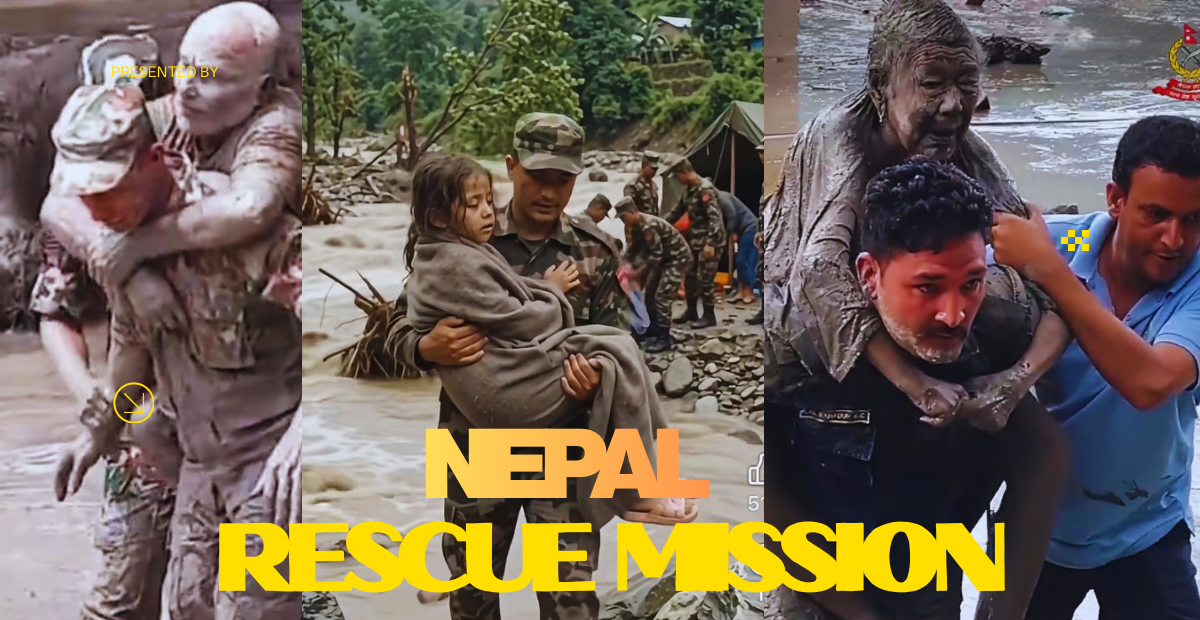
In the update, Shah reported that 1,050 bodies had been found, 11,884 people rescued and 3,916 remained out of contact after the Bhote Koshi-Trishuli flood.
Of 292 injured people admitted to hospitals, 182 had been discharged shortly before the update.
Shah listed 2,466 people staying at holding centers in Nuwakot, 260 in Dhading, 398 in Rasuwa and 329 in Kathmandu.
Separately, 2,653 people were receiving shelter and relief at 19 temporary sites in Nuwakot. Flood victims from Rasuwa were also being accommodated there.
Funding and Relief
The government directed the National Disaster Risk Reduction and Management Authority to distribute the new 1 billion-rupee allocation to affected local governments according to need.
Of that amount, 67.5 million rupees had been released Tuesday to 15 local governments across three districts, Shah wrote.
Immediately after the flood, the government sent 10 million rupees each to Rasuwa and Nuwakot and 5 million rupees to Dhading.
By midday Tuesday, 6,366,551,227 Nepali rupees had been deposited across nine commercial-bank accounts in the Prime Minister’s Relief Fund. After the 1 billion-rupee disbursement, the fund held 5,366,551,227 rupees.
Another $6,111,148 had been deposited at Himalayan and Laxmi banks. Shah said the government was publishing receipts through its Rescue Request Portal.
Roads and Bridges
The post described damage along the 82-kilometer Galchhi-Betrawati-Rasuwagadhi road. On the Bidur-Betrawati-Mailung-Syafrubesi-Rasuwagadhi section, it reported 40 kilometers of complete damage and 16 kilometers of partial damage.
The Krishnabhir and Parewabhir areas of the Prithvi Highway were also damaged.
Forty-eight suspension bridges were damaged, with 20 considered repairable and 28 requiring replacement. The flood also washed away 31 motorable bridges.
Work had begun to install Bailey bridges at three locations, while feasibility studies were underway at 20 more sites.
Traffic had resumed after mud was cleared from the Galchhi, Baireni, Jarikhet, Pokhare, Munge and Galaudi sections of the Prithvi Highway.
Mud-clearing and Bailey bridge construction were underway on the Galchhi-Devighat section. Preparations were advancing at the Tadi River in Devighat, and installation work had started at Betrawati.
Fifty technical employees were working on road construction and repairs. The Road Board had allocated 32.5 million rupees for emergency work, while additional spending was authorized from existing project budgets.
Officials were assessing infrastructure damage by helicopter and on foot. Shah said the Krishnabhir section of the Muglin-Narayangadh road would be repaired and reopened by the end of Bhadau.
Health Response
The government had increased health surveillance and response measures to prevent possible disease outbreaks in flood-affected areas.
The Health Emergency and Disaster Management Unit and the Health Emergency Operations Center were leading infectious-disease control for the Ministry of Health and Food Hygiene.
A post-disaster communicable-disease surveillance and response plan had been approved, and provincial and district health officials had received training.
A special health team was deployed on the second day of the disaster. Two other teams, including two workers trained through the Field Epidemiology Training Program, had also been sent to affected areas.
Medical surveillance officers supported by the World Health Organization were also deployed.
Officials were reviewing water, sanitation and hygiene measures. A surveillance and outbreak-response system known as SORMAS was operating to monitor fever and diarrheal diseases.
The ministry’s Rapid Response Committee was continuing to assess conditions. Ambulances and health workers providing mental health counseling had also been sent to affected areas.
The Nepal Army was conducting decontamination work and broadcasting health precautions over loudspeakers. The National Health, Education, Information and Communication Center was distributing public health information.
International Assistance
India had supplied 68.5 tons of relief and rescue materials and sent an 11-member rescue team, Shah reported. India was also preparing to provide a 22-foot refrigerated container truck temporarily.
China had contributed 300 million rupees to the Prime Minister’s Natural Disaster Rescue Fund and supplied 50 tons of relief materials. A Chinese rescue team was working in affected areas.
The Nepal government had asked China to provide 30 Bailey bridges.
Pakistan was expected to provide 86 tons of relief supplies. Sri Lanka pledged $1 million in assistance, while Bangladesh was preparing to send relief materials.
The United States pledged $500,000, and Australia committed $1 million in cash assistance. The United Arab Emirates delivered 83 tons of essential supplies and pledged up to $10 million.
Qatar also provided relief materials. Switzerland supplied 1 million Swiss francs to be spent through the United Nations.
The Asian Development Bank committed a $5 million budget-support grant and $150,000 in technical assistance. The World Bank committed a $167 million concessional loan.
The United Kingdom and Japan also made commitments, while assistance was being received from the European Union and United Nations agencies, according to Shah.
Bodies and DNA Identification
Shah said bodies were being handled under the “Guidelines on the Management of Unidentified and Unclaimed Bodies (First Amendment), 2083.”
The post listed bodies already managed by district: six in Rasuwa, 47 in Kathmandu, 292 in Chitwan and 25 in Dhading. It also listed 39 in Gorkha, 15 in Tanahun, 174 in Nawalparasi East and 69 in Nawalparasi West.
Unidentified bodies were being buried after DNA and other evidence that could support future identification was preserved.
Nepali and foreign citizens may request DNA testing to identify recovered remains. A parent, son or daughter may provide a blood sample with two passport-size photographs.
Samples can be submitted to the pathology laboratory at Nepal Police Hospital in Maharajgunj, Kathmandu, or to the nearest district police office.
Relatives living abroad may obtain DNA testing overseas and email a copy of the result to [email protected] for comparison.
Flood Cause and Climate Claims
The flash flood struck the Bhote Koshi-Trishuli region on Aug. 26. The U.S. Geological Survey attributed it to a glacier collapse involving falling rocks and ice.
Shah said experts consulted by the government believed a large part of a glacier may have fallen from a high elevation and begun melting after impact, developing into a major flood.
The collapse may have contained both ice and meltwater, according to the account. The post said the steep descent toward Nepal increased the flood’s speed and damage.
Shah also said climate change caused the disaster, citing what he described as a confirmed rise of up to 1.8 degrees in Himalayan temperatures.
The post did not identify the experts, study, measurement period or temperature scale supporting those claims.
Shah said questions about why the ice fell and how so much water formed still required answers.
Have something to promote?
Bring your business, services or event to our readers.