

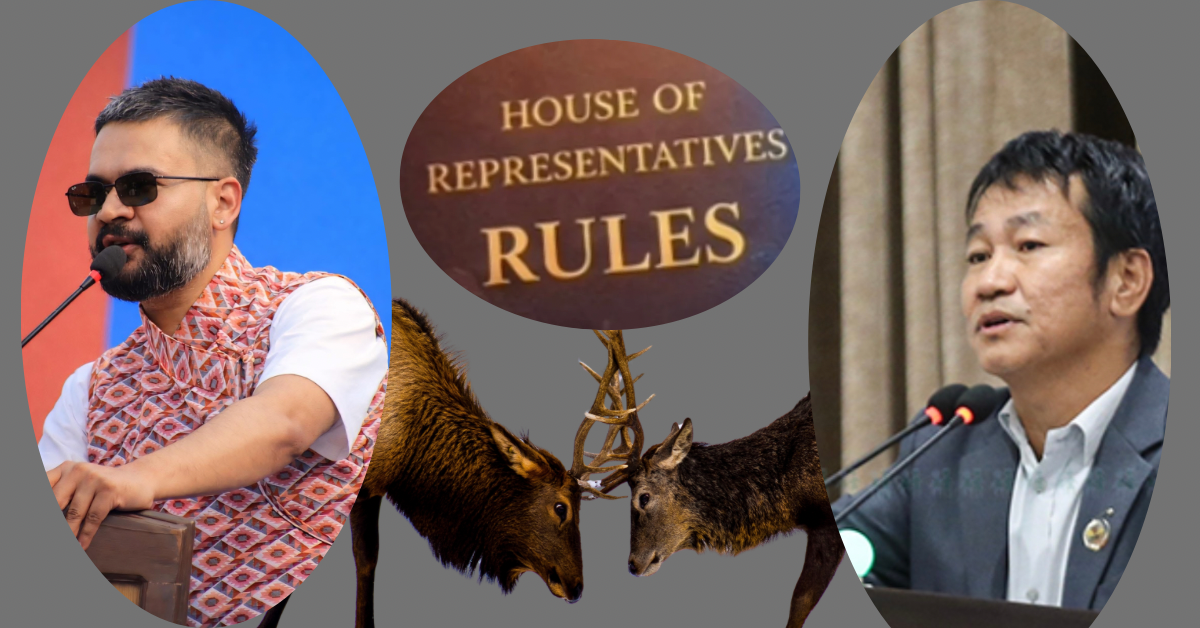
A democracy cannot be saved by selective outrage. It can only be strengthened by consistent accountability — from the government, from the opposition and from every leader who claims to speak for the people.
Nepal’s House of Representatives meeting on Wednesday showed more than a routine dispute between the government and opposition. It exposed the deeper tension now shaping Nepali politics: old parties trying to reclaim moral authority, and new leaders struggling to prove they can govern with democratic discipline.
The immediate flashpoint was Hark Sampang, chair of the Shram Sanskriti Party. He questioned Prime Minister Balen Shah’s ability to lead, demanded answers from the government and eventually walked out of the House. His protest drew attention because it touched a serious democratic issue: whether a prime minister can keep avoiding Parliament while pushing major decisions through executive power.
On that point, Sampang is not entirely wrong. A prime minister in a parliamentary system is not just a national figure. He is answerable to the House. Parliament is not a stage to visit when convenient. It is the institution that gives the government democratic legitimacy.
But the legal position is more careful than the politics around it. According to the House of Representatives Rules , Rule 56(4) requires the prime minister to appear in person and answer questions during the direct prime minister question-and-answer session. That is a clear accountability mechanism. However, in some policy-and-program discussions, Rule 38 allows a minister designated by the prime minister to present or handle matters in the prime minister’s absence. In other words, the rules do not appear to require the prime minister’s personal presence in every House discussion, but they do require it in specific accountability settings.
That distinction matters. The opposition should not distort the rulebook. But the government should not hide behind technical flexibility either. Democratic accountability is not only about what the rule minimally permits. It is also about what responsible leadership demands.
Balen’s government has given its critics enough material. Avoiding Parliament while relying on ordinances, especially on sensitive institutional questions such as the Constitutional Council, sends the wrong signal. It makes a government elected on reform look uncomfortably similar to the old system it promised to challenge. His handling of the squatter issue has also raised serious concerns about sensitivity, consultation and the human cost of state action.
Enforcement may sometimes be necessary. But governance is not just about bulldozers, orders and executive speed. It is also about listening, explaining and carrying public trust through difficult decisions.
The old parties also face a serious credibility problem. Nepali Congress, CPN-UML and Maoist lawmakers are now attacking Balen over ordinances, parliamentary avoidance and the handling of squatters. Some of that criticism is fair. But these same forces have used ordinances, bypassed Parliament and mishandled vulnerable communities when they held power. They have treated state institutions as political instruments. They have also failed, again and again, to resolve the land, housing and livelihood issues now being used to attack Balen.
Their moral voice today is weakened by their conduct yesterday.
That does not mean they have no right to question the government. In a democracy, even flawed opposition parties have the right and duty to challenge executive power. But criticism from parties with long records of convenience politics must come with humility. Otherwise, it sounds less like democratic vigilance and more like selective morality.
Sampang’s own role also deserves examination. His questions about Balen’s accountability are legitimate. But his political history complicates the picture. After the election, he had pushed for Rabi Lamichhane to become prime minister and warned that Parliament would not be allowed to function if Balen was chosen instead. That makes today’s protest look, at least partly, like a continuation of an earlier political grievance.
If Sampang’s fight is truly for parliamentary accountability, he should use Parliament fully. He should stay in the chamber, question the prime minister, press for formal answers and force the government to respond on record. Walking out may create a dramatic moment. It does not always create democratic pressure.
This is the trap Nepal’s politics now faces. The old parties carry the burden of corruption, hypocrisy and failed governance. The new parties carry the burden of immaturity, impatience and performance politics. Citizens are being asked to choose between exhausted power and untested anger.
Balen must understand that electoral popularity is not a substitute for parliamentary accountability. He should face the House, answer direct questions and stop treating criticism as an inconvenience. If his government believes its decisions are right, it should defend them openly.
But the opposition must also understand that Parliament cannot be used only as a weapon against a government it dislikes. Those who weakened democratic norms while in power cannot suddenly claim moral purity from the opposition bench.
Nepal does not need a government that avoids Parliament. It also does not need an opposition that remembers democracy only after losing power.
The country needs a different standard: a prime minister who answers, lawmakers who question honestly and parties that put public justice above the race for the chair.
The bottom line is clear: Balen should face Parliament. But those demanding answers from him must also answer for their own record.