

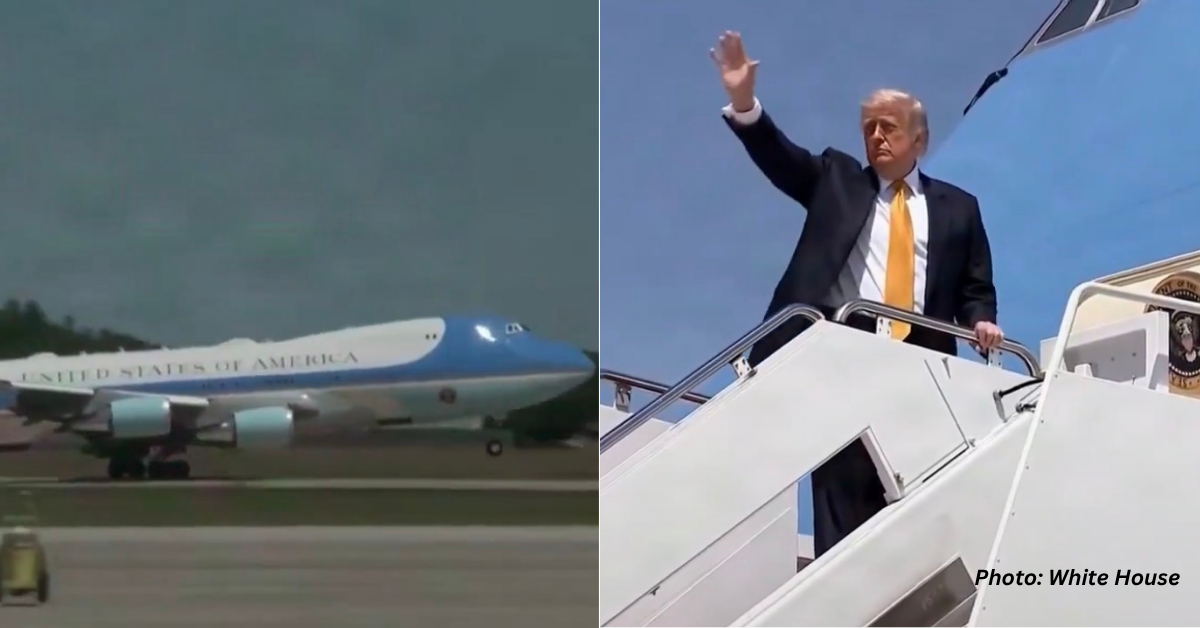
President Donald Trump departed for China on Wednesday, with a group of major U.S. business leaders, including Nvidia CEO Jensen Huang, as he prepared for a state visit and meetings with Chinese President Xi Jinping.
It is the first U.S. presidential state visit to the country since 2017.
Before leaving for China, Trump wrote on Truth Social that Huang was “currently on Air Force One” and pushed back on reporting about whether the Nvidia chief had been invited to join the trip in the first place.
“CNBC incorrectly reported that the Great Jensen Huang, of Nvidia, was not invited,” Trump wrote, calling the report “FAKE NEWS.” He said Huang was traveling with him unless Trump asked him to leave, which he described as “highly unlikely.”
CNBC had reported that Huang joined the trip after earlier signs that he had not been invited. Citing a person familiar with the matter, the outlet said Trump called Huang after media coverage about his absence from the delegation and asked him to join. CNBC reported that Huang flew to Alaska to board Air Force One.
A spokesperson for Nvidia told CNBC that Huang was attending the summit “at the invitation of President Trump to support America and the administration’s goals.” CNBC said Nvidia did not give a further explanation when asked about Huang joining the trip mid-journey in Alaska.
Trump said his major delegation included several prominent business leaders, naming Elon Musk, Apple CEO Tim Cook, BlackRock CEO Larry Fink, Blackstone CEO Stephen Schwarzman, Boeing CEO Kelly Ortberg, Cargill CEO Brian Sikes, Citi CEO Jane Fraser, GE Aerospace CEO Larry Culp, Goldman Sachs CEO David Solomon, Micron CEO Sanjay Mehrotra and Qualcomm CEO Cristiano Amon.
In his Truth Social post, Trump said he planned to ask Xi to “open up” China so U.S. business leaders could expand their work there. Trump said that request would be his first when the two leaders meet.
The trip comes amid heightened U.S.-China tensions over advanced semiconductors and artificial intelligence, with Nvidia at the center of the dispute. CNBC reported that Nvidia’s most advanced chips, which are widely used for training AI models, have been subject to tighter U.S.-China sales restrictions over the past four years.
China has also worked to build domestic chip capacity and AI systems that rely less on Nvidia, according to CNBC. The outlet reported that a recent article in the Chinese Communist Party’s official journal pointed to pressure on local companies from U.S. chip restrictions while also noting Nvidia’s global dominance in graphics processing units.
Carlos Gutierrez, a former U.S. commerce secretary, told CNBC’s “Squawk Box Asia” that he believed the two countries remained far from a deal on export controls. Still, he said Huang’s presence in the delegation was important for both the Nvidia chief and Trump.