

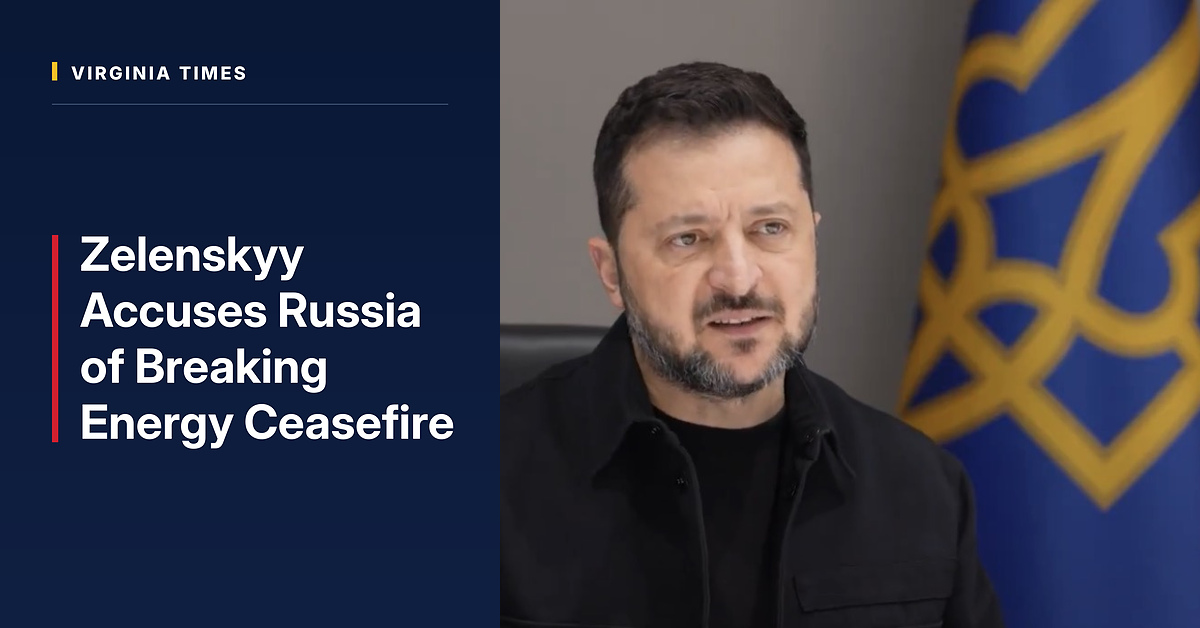
Ukrainian President Volodymyr Zelenskyy said Ukraine had accepted an energy ceasefire announced by President Donald Trump, but accused Russia of breaking it with drone attacks on Ukrainian energy facilities.
A Russian jet-powered Shahed drone struck a gas-production facility at midnight, Zelenskyy said in excerpts from a Warsaw Security Forum speech posted on X. Several drones also attacked a gas station.
Zelenskyy said no Russian refineries burned overnight, presenting that as evidence Ukraine was keeping its commitment. Russian jet-powered Shaheds continued entering Ukrainian airspace throughout the morning, including over Kyiv and other cities, he said.
“So there were Russian violations of the energy ceasefire announced by President Trump.”
The attacks and alleged ceasefire violations were not independently verified.
Zelenskyy said Ukraine immediately supported the proposal and had sought similar arrangements for months. The U.S. team understood what an energy ceasefire meant for Ukraine, he said.
“We agree if they agree,” he said.
If Russia wanted Ukraine to halt long-range attacks on its refineries and oil exports, it would have to stop striking Ukraine’s energy network and critical infrastructure, Zelenskyy said.
Trump announced the ceasefire Sunday on Truth Social, saying both countries had agreed and it took effect immediately. His post did not specify its duration, the facilities covered or arrangements for monitoring compliance.
Before that announcement, Zelenskyy had offered in an earlier statement on X to stop refinery attacks if Russia halted strikes on Ukraine’s energy infrastructure. He called for reciprocal action and guarantees.
In the forum remarks, Zelenskyy said electricity was Ukraine’s chief concern. Russia had targeted its generating facilities and grid for years, intensifying attacks each winter, he said. Ukrainians experienced daily power cuts.
Ukraine had only one refinery, badly damaged by earlier Russian attacks, according to Zelenskyy. He said the country lacked substantial oil reserves and export capacity and imported large quantities of diesel and other petroleum products.
He thanked neighboring countries, especially Poland, for helping supply Ukraine’s energy needs.
Gasoline shortages and refinery fires caused by Ukrainian retaliatory strikes hurt Russia, Zelenskyy said. He described the affected volumes as smaller than those potentially lost because of the crisis in Hormuz.
Zelenskyy also reported Ukrainian attacks on Yandex data centers in response to a Russian operation against Ukraine’s data centers. He claimed social media became less hostile and divisive after Yandex went offline.
He attributed the change to fewer bots and inferred that the affected facilities were their source. That connection was not independently established. Zelenskyy argued that Europe was not responsible for those problems and urged Americans to pay attention to events there.
He described continuing Russian attacks as Putin’s response to Trump. Repair crews were still addressing damage from the previous day, he said, while Ukraine awaited details of U.S.-Russian talks and the steps Washington would take.