

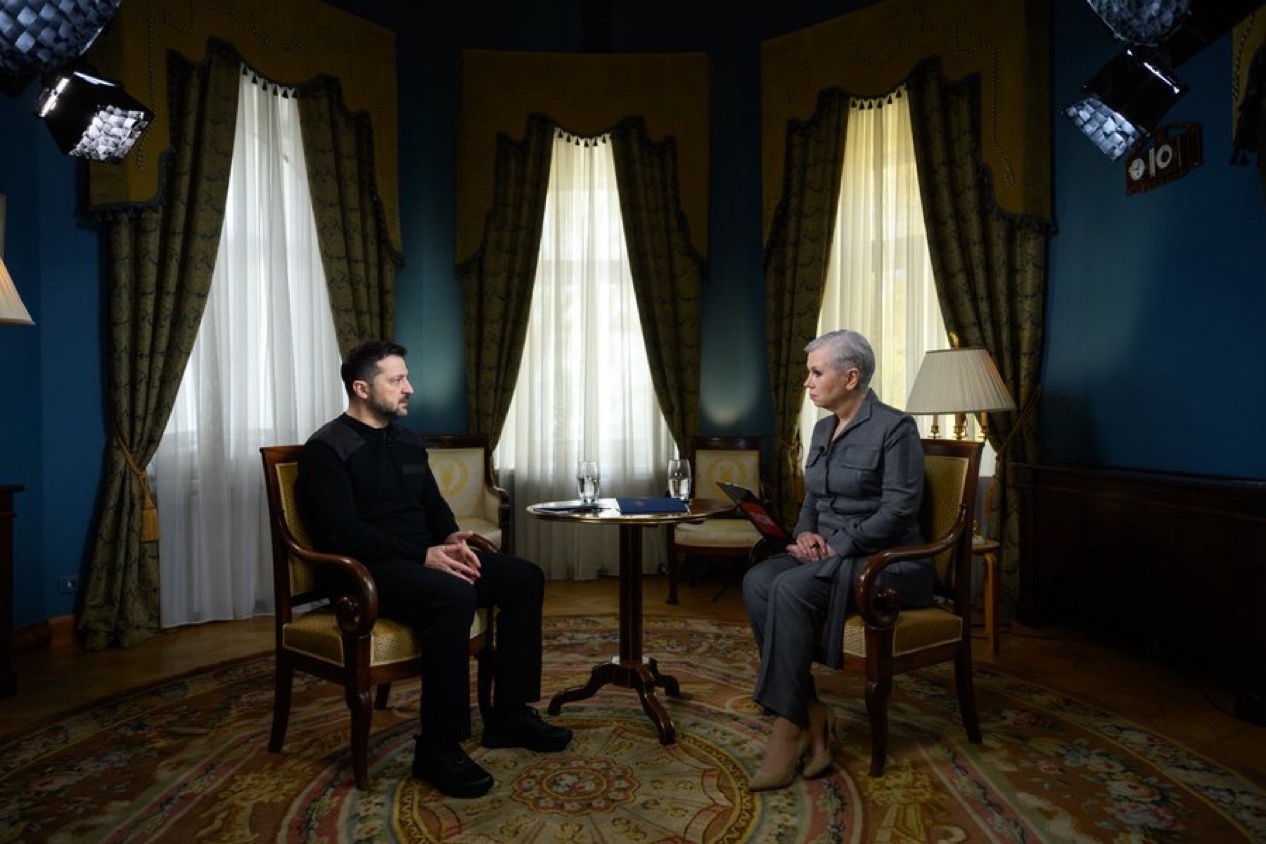
Ukrainian President Volodymyr Zelenskyy said issues involving U.S. intelligence sharing and Starlink/Starshield had been resolved, but Ukraine’s air defense shortage remained a problem and Patriot missile deliveries were moving too slowly.
The three issues had complicated discussions with the American side in Oslo, he said. Zelenskyy thanked the Americans and Ukraine’s team for resolving the intelligence and satellite-service restrictions.
The remarks came in an interview with Alla Mazur for TSN Week on 1+1, part of the United News telethon. Zelenskyy shared excerpts on X.
There was progress on missiles for Patriot systems, he said, but the pace remained too slow.
“You cannot say, ‘Yes, we will give the missiles to you,’ and then not deliver them for a month or two,” Zelenskyy said. “It simply does not work that way.”
His account of the restrictions and missile deliveries was not independently verified in the supplied material.
Territory a ‘red line’
Zelenskyy outlined Ukraine’s positions for possible negotiations in November. Russia could not dictate Ukraine’s security guarantees, he said, and restrictions on the Ukrainian army or Ukrainian neutrality were not open for discussion.
He called territory a red line that only national leaders could discuss. American officials had long raised territorial exchanges, which they called “land swaps,” alongside other proposals, according to Zelenskyy.
“We are not exchanging anything for anything,” he said.
Ukraine remained willing to discuss territory at the leaders’ level, while technical groups could address other matters. All those discussions could take place in November, he said.
Warning on sanctions
Zelenskyy cautioned against lifting sanctions on Russia before a meeting involving the leaders of Ukraine, the United States and Russia.
“Sanctions were imposed for aggression, not for an opportunity to have a chat,” he said.
If negotiations brought an end to the war, sanctions could be lifted in an agreed sequence, he said. Removing them beforehand could leave Ukraine entering talks without knowing what Russia would accept.
Zelenskyy told the American delegation that Russia’s cooperation should not be bought at that price. He questioned whether countries could rebuild the international support that had secured more than 20 sanctions packages worldwide.
He did not want to meet Russian President Vladimir Putin without sanctions, money or frozen assets available as negotiating tools. Echoing a remark by Donald Trump, Zelenskyy said Ukraine would then have few cards left.
Seeking results in November
Ukraine was ready for trilateral talks among technical groups, but those discussions needed to produce a specific result, Zelenskyy said.
When American officials asked what he wanted, he raised whether a technical-group meeting in November could end the war. A full settlement, he said, would require the leaders’ involvement.
Other possible outcomes included an energy ceasefire, arrangements concerning the sea and grain, an all-for-all exchange, or a meeting of leaders.
Ukraine was proposing those steps to the American side, rather than demanding them, he said. An agreement on any of them would demonstrate seriousness about the talks.
Zelenskyy questioned whether Putin’s stated readiness reflected a willingness to negotiate or a political maneuver to avoid escalation with the United States before elections. That would become clear quickly in November, he said.
Proposed Oleshky ceasefire
The American side proposed a ceasefire in the Oleshky area beginning Oct. 27, according to Zelenskyy. It would need to last several days to allow humanitarian missions from the United States, Ukraine and Russia to enter.
Russian forces would have to clear mines from roads, and Ukraine would need to observe that work, he said.
Zelenskyy had given instructions to Ukraine’s ombudsman. He also said Ukrainian officials had spoken with the Security Service and the military.
He accused Russia of planning to clear routes in a way that would direct evacuees toward Russia and keep them there. The supplied material did not independently establish Russia’s evacuation plans.
Some residents would nevertheless reach Ukrainian-controlled territory, Zelenskyy said. His priority was to get people out of the blockade, ideally allowing them to reach areas where Ukraine could provide assistance and support.
Have something to promote?
Bring your business, services or event to our readers.