

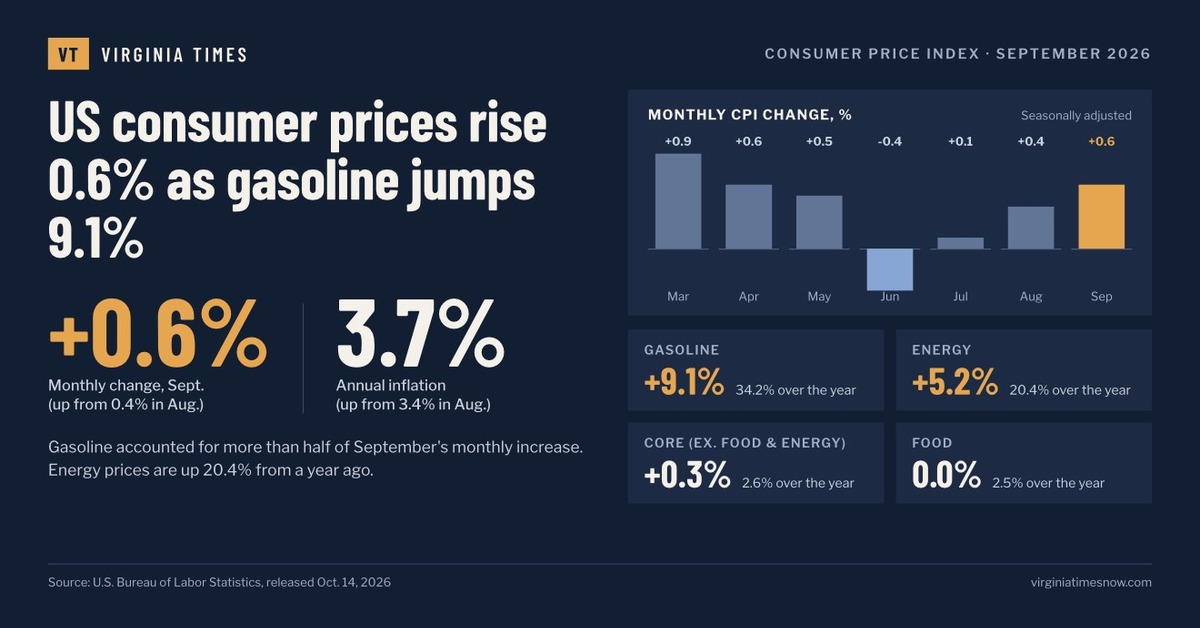
WASHINGTON — Gasoline did most of the damage. U.S. consumer prices climbed 0.6 percent in September, the fastest monthly gain since spring, and the U.S. Bureau of Labor Statistics, which reported the figures Wednesday, said the jump at the pump accounted for more than half of the increase.
The 12-month rate moved up to 3.7 percent, from 3.4 percent in August. A month earlier, the seasonally adjusted Consumer Price Index for All Urban Consumers had risen 0.4 percent.
Gasoline alone rose 9.1 percent in September on a seasonally adjusted basis — 6.5 percent before adjustment — pulling the overall energy index up 5.2 percent. In August, energy had gained 2.1 percent.
The year-on-year energy numbers are starker. Costs are up 20.4 percent over the past year, with gasoline up 34.2 percent and fuel oil up 74.2 percent. Natural gas has risen 5 percent over the same period, electricity 4.4 percent, even though the two moved in opposite directions in September itself: electricity edged up 0.2 percent, while natural gas slipped 0.3 percent.
Strip out food and energy, and prices still rose 0.3 percent — the same pace as in August. Core inflation over 12 months reached 2.6 percent, compared with 2.4 percent through August.
Housing remains the heavyweight in the core index. Shelter costs rose 0.4 percent in September, a step up from the 0.3 percent increase the month before, and are 3.2 percent higher than a year ago. Within shelter, owners’ equivalent rent gained 0.3 percent and rent 0.2 percent, while lodging away from home jumped 2 percent.
Air travel got pricier, too. Airline fares climbed 1.2 percent in September and sit 22.4 percent above last year’s level. Recreation, flat in August, rose 0.5 percent, and used cars and trucks gained 0.7 percent.
Education costs rose 0.6 percent, and apparel 0.3 percent. Prices for new vehicles, personal care and motor vehicle insurance also moved higher.
Medical care inched up 0.1 percent after falling 0.2 percent in August. Hospital services rose 0.7 percent; prescription drugs went the other way, down 1.2 percent, and physicians’ services did not change.
One of the few decliners was communication, down 0.2 percent — a sharp turn from its 2.3 percent jump in August. Household furnishings and operations held steady.
At the grocery store and the restaurant, little changed. Overall food prices were unchanged in September: food away from home rose 0.2 percent, while grocery prices dipped 0.1 percent.
Three of the six major grocery categories fell. The index for meats, poultry, fish and eggs dropped 0.5 percent, with beef down 1 percent; dairy fell 0.9 percent, as milk dropped 2 percent, and other food at home slipped 0.2 percent.
Drinks and produce rose. Nonalcoholic beverages were up 0.9 percent, led by carbonated drinks at 1.5 percent; fruits and vegetables rose 0.5 percent, and cereals and bakery products edged up 0.1 percent.
Over the year, food is up 2.5 percent. Grocery prices have risen 1.8 percent in that time, food away from home 3.5 percent — full-service restaurants are up 3.8 percent.
Before seasonal adjustment, the index for all urban consumers rose 0.6 percent in September, to a level of 336.940.
The index for urban wage earners and clerical workers, known as CPI-W, rose 0.7 percent for the month and 3.9 percent over 12 months. A chained index for all urban consumers increased 3.5 percent over the year, though the agency noted figures for the past 10 to 12 months remain subject to revision.
October’s figures are due Tuesday, Nov. 10, at 8:30 a.m. ET, the bureau said.