

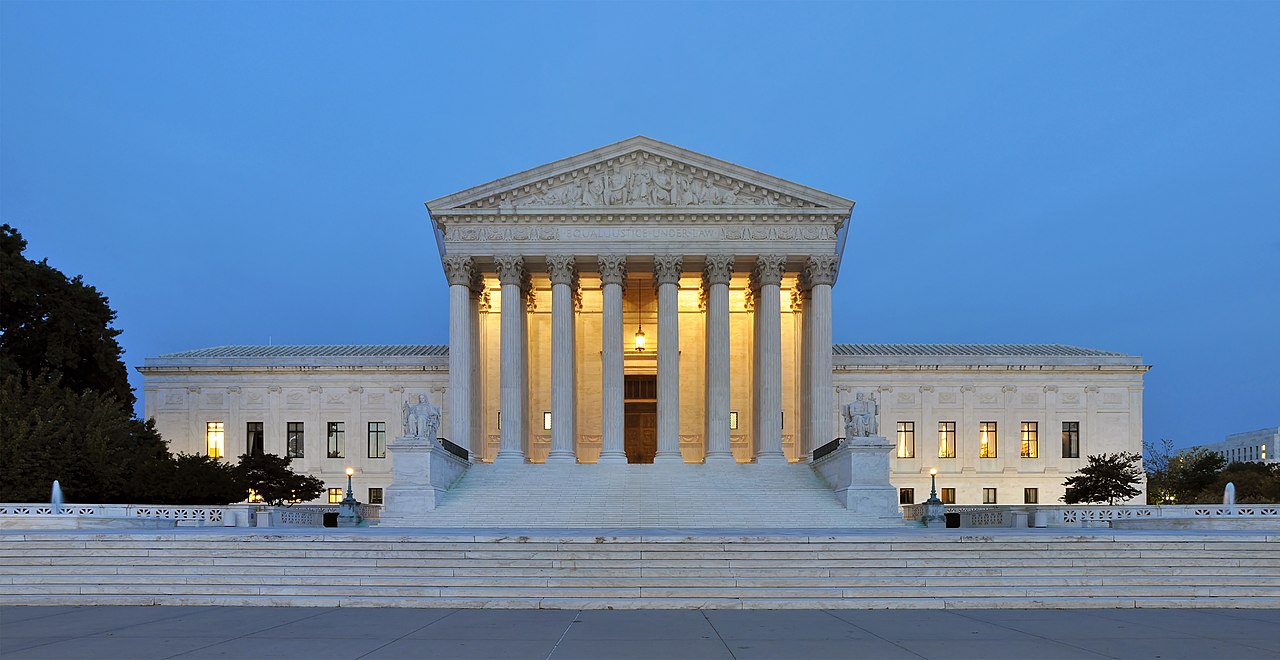
The Supreme Court ruled Wednesday that Louisiana’s congressional map creating a second majority-Black district is an unconstitutional racial gerrymander, finding that the Voting Rights Act did not require the state to draw the district.
The 6-3 decision in Supreme Court, written by Justice Samuel Alito, affirmed a lower court ruling that struck down Louisiana’s SB8 map under the Equal Protection Clause of the 14th Amendment. Chief Justice John Roberts and Justices Clarence Thomas, Neil Gorsuch, Brett Kavanaugh and Amy Coney Barrett joined the majority. Justices Elena Kagan, Sonia Sotomayor and Ketanji Brown Jackson dissented.
The ruling narrows how courts will evaluate some claims under Section 2 of the Voting Rights Act, the federal law used to challenge voting practices that weaken minority voters’ ability to elect candidates of their choice.
The case grew out of Louisiana’s post-2020 redistricting fight. A federal judge had found that the state’s earlier congressional map likely violated Section 2 because it did not include an additional majority-Black district. Louisiana then adopted SB8, a new map that created a second majority-Black district. A separate group of plaintiffs challenged that map as an unconstitutional racial gerrymander, and a three-judge federal panel agreed.
The Supreme Court used the case to answer a question it had left unresolved for more than 30 years: whether compliance with the Voting Rights Act can provide a compelling reason for states to draw race-conscious district lines.
The majority said it can — but only when Section 2, properly interpreted, actually requires that result.
Under the Court’s reading, Section 2 imposes liability only when the evidence supports a strong inference that a state intentionally drew districts to give minority voters less opportunity because of their race. The majority also said the law does not prevent states from drawing maps based on nonracial factors, including partisan advantage.
That standard decided the Louisiana case. The Court found that the plaintiffs who originally sought a second majority-Black district had failed to prove that Section 2 required one. Because Louisiana had no legal obligation to create the district, the majority said the state could not justify drawing SB8 with race as a central factor.
The ruling also changes how future Section 2 redistricting cases will be tested.
The Court said plaintiffs must produce illustrative maps that do not use race as a districting criterion and still meet the state’s legitimate redistricting goals, including traditional mapmaking principles and political objectives. The majority also said plaintiffs must account for party affiliation when trying to prove racially polarized voting, rather than relying only on evidence that Black and white voters support different candidates.
The Court further said historical discrimination and the lingering effects of past racial injustice should carry less weight unless they bear directly on present-day intentional racial discrimination in voting.
In dissent, Kagan said the majority’s approach weakens Section 2 and moves the law closer to an intent-based standard that Congress rejected when it amended the Voting Rights Act in 1982. She warned that the decision would make it easier for states to defend maps that dilute minority voting power by describing their choices as partisan rather than racial.
The decision drew sharp criticism from leading Democrats.
Senate Democratic Leader Chuck Schumer said in a statement posted on X that the Court had “turned its back on one of the most sacred promises in American democracy.” He said the ruling weakens the Voting Rights Act and gives politicians more power to draw maps that silence voters, especially those who have long faced barriers to equal representation.
Schumer connected Wednesday’s ruling to a pattern of erosion he said began with the Court’s 2013 Shelby County decision, which effectively disabled the Voting Rights Act’s preclearance system by striking down its coverage formula. He said Senate Democrats would fight to reverse the ruling.
Former President Barack Obama also criticized the decision in a post on X, saying it “effectively guts a key pillar” of the Voting Rights Act by allowing state legislatures to weaken minority voting power if they frame their maps as partisan rather than racially biased.
Obama said the ruling was another example of what he described as the Court’s retreat from protecting equal political participation. He urged voters to organize and participate in elections at every level, not only in high-profile races.