

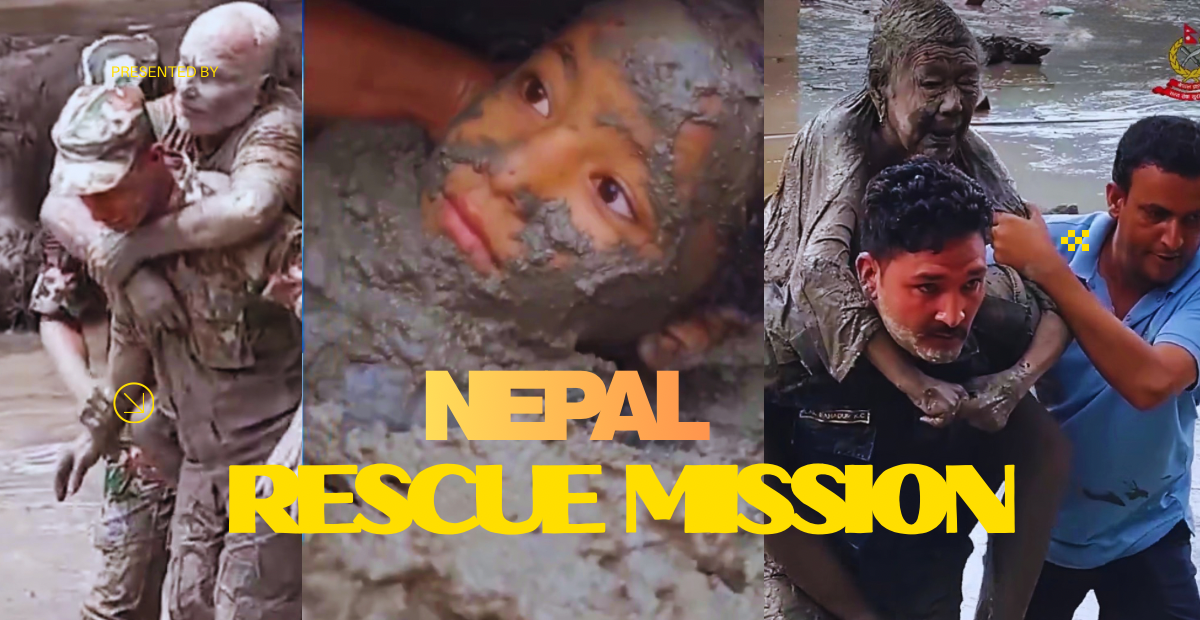
Prime Minister Balen Shah said Monday evening that 939 bodies had been recovered, 11,379 people rescued and 3,925 remained out of contact six days after the Bhote Koshi-Trishuli flood.
Nepal’s National Disaster Risk Reduction and Management Authority reported the same number of recovered bodies as of 6 p.m. local time Monday.
Shah said the number of people out of contact was fluctuating as search operations continued. Hospitals had admitted 279 injured people, of whom 168 had been discharged shortly before the update.
Authorities were managing unidentified bodies under the “Guidelines on the Management of Unidentified and Unclaimed Bodies (First Amendment), 2083,” Shah wrote. DNA and other identifying evidence were being preserved, while identified bodies were being released to relatives.
The Nepal Army, Nepal Police and Armed Police Force were assisting with the process.
Search Continues at Hydropower Sites
Shah said the Nepal Army had rescued 279 people from affected hydropower projects and continued searching project tunnels. Some workers might remain out of contact.
The listed rescues included 254 people at Upper Trishuli-1, nine at Mailung Khola, four each at a solar project and Devighat, three at the Trishuli project in Nuwakot, and two each at Rasuwagadhi and Upper Trishuli-3B.
Those project-level figures add up to 278, one fewer than the overall total in the post. The update did not explain the difference.
Korean and Chinese teams were working alongside the army at Upper Trishuli-1. A joint Chinese-Nepal Army team searched inside the Rasuwagadhi tunnel but returned after finding no one.
A 90-member team from the army, Armed Police Force and Nepal Police was searching the Upper Trishuli-3A tunnel with assistance from the Nepal Electricity Authority.
At Upper Trishuli-3B, a Chinese team conducted reconnaissance before the Nepal Army began its search. A total of 31 army personnel were working at the site.
Nepal Army personnel, an Indian rescue team and Nepali helpers were also working to open tunnel entrances at the Langtang Khola and Chilime projects in Rasuwa.
The chiefs of the Nepal Army, Nepal Police and Armed Police Force briefed Shah on search, rescue, treatment, relief and rehabilitation efforts Monday. The prime minister said he was also receiving updates from Cabinet members and federal lawmakers in affected districts.
Relief and Financial Support
Security forces delivered supplies by air and road through four collection centers in Rasuwa, Nuwakot and Dhading and 27 distribution centers in Rasuwa and Nuwakot. The deliveries reached 3,696 affected people, according to Shah.
Provincial and local governments were helping manage shelters and relief operations in coordination with the federal government.
Shah listed India, China, the United States, the United Arab Emirates, Qatar, Japan, Switzerland and Australia among the countries that had provided assistance.
By midday Monday, 5,879,223,842 Nepali rupees had been deposited across nine commercial-bank accounts in the Prime Minister’s Relief Fund. Another $3,193,238 had been deposited at Himalayan and Laxmi banks, according to the post.
The Office of the Prime Minister and Council of Ministers was publishing fund totals through its Rescue Request Portal. Shah said countries and organizations had made additional financial commitments but provided no combined amount.
Roads, Bridges and Power
A section of the Galchhi-Trishuli Highway along the right bank of the Trishuli River had reopened, Shah reported.
The route runs through Kalleritar, Koshikhola, Pipaltar, Darshantar, Chhatrekhola and Gauribesi to Trishuli Bazaar. It restored direct access to the district headquarters for residents across the river in Nuwakot.
Shah said the reopening would make rescue operations and deliveries of relief and essential goods easier.
Bridges had collapsed at many locations across Rasuwa, Nuwakot and Dhading, disrupting travel, according to the post. The government was prioritizing temporary crossings.
Nepal had six 48-meter Bailey bridges and one 70-meter bridge available. Studies had been completed for possible installations at the Tadi River in Devighat, Trishuli Bazaar and Betrawati Bazaar.
India had supplied a 230-foot single-lane modular steel bridge and committed to sending seven more Bailey bridges, Shah wrote. He said China was expected to provide 30 Bailey bridges soon.
About 30% of households in Rasuwa had electricity restored, including Dhunche and parts of Kalikasthan, Naukunda and Gosaikunda.
A separate power supply from the Sanjen hydropower project was being prepared for parts of Aamachhodingmo. The government had also sent 500 portable solar units to serve other areas.
Electricity had returned to 85% of Nuwakot, with the remaining service expected to be restored within five days. Dhading had reached 98%, with full restoration targeted within two days.
Nepal Telecom had returned 110 of its 120 sites to service, while 75 of Ncell’s 78 towers were operating.
Rehabilitation Planning Begins
The flash flood struck the Bhote Koshi-Trishuli region on Aug. 26. The U.S. Geological Survey attributed it to a glacier collapse involving falling rocks and ice.
Shah described the flood as a major disaster in the Himalayan region. He said it pointed to increasing climate-related risks and called for Nepal to raise climate-related disaster impacts with the international community.
Federal officials had begun working with local governments to count affected residents and document physical damage.
Shah said thousands had lost homes, relatives and property. The government was continuing to seek the financial resources needed for rehabilitation.
Have something to promote?
Bring your business, services or event to our readers.