

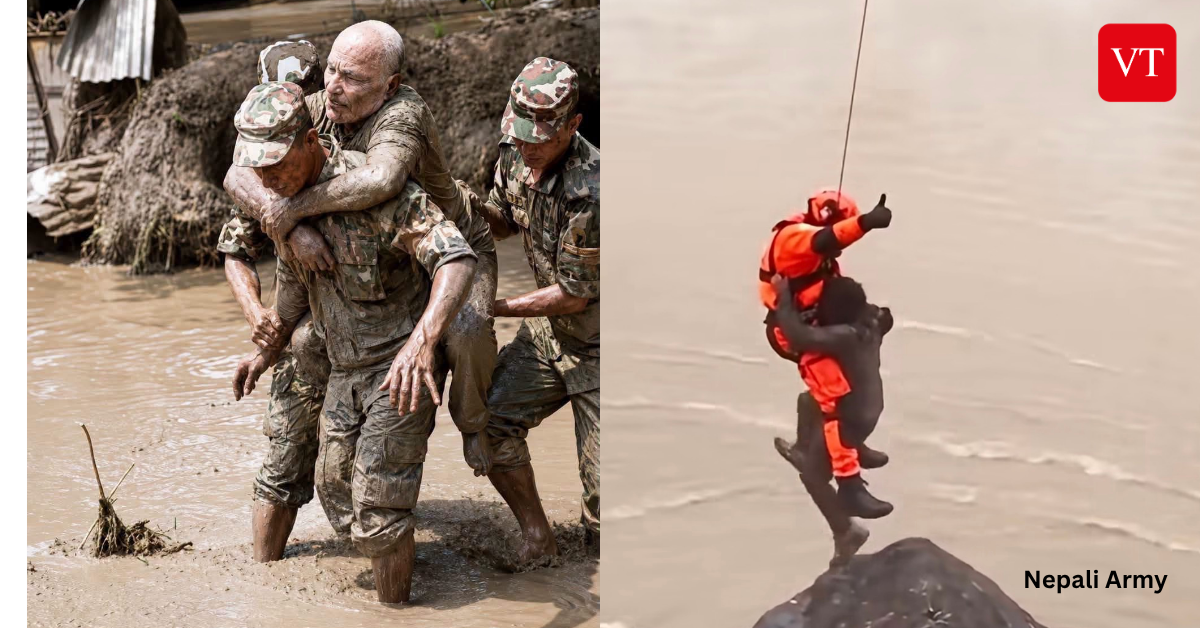
Nepal’s prime minister Balen Shah pledged to continue relief, reconstruction and rehabilitation until the recovery work was complete following severe flooding along the Bhote Koshi River in Rasuwa.
The prime minister reported that 781 bodies had been found and 9,435 people rescued five days into the response.
The government deployed 20,618 Nepal Army, Nepal Police and Armed Police Force personnel. Relief and rescue aircraft completed 394 flights, including 72 on Sunday. Volunteers also assisted the response.
According to the U.S. Geological Survey, the flood resulted from a glacier collapse involving falling rock and ice. The prime minister said weather, difficult terrain and continuing dangers had prevented a full assessment of the damage.
Flood Recovery Funding
Nepal reports $36.42 million received for flood recovery, while listed international support and commitments total approximately $174.89 million.
Search and Rescue Operations
Nepal Army helicopters evacuated 279 people from affected hydropower project areas, according to the statement. The update separately reported that 250 people were rescued over two days from the Upper Trishuli-1 area in Rasuwa.
Chinese and Korean specialists continued rescue efforts there with the Nepal Army. A Chinese team searched as far as 3 kilometers inside a tunnel but had not found anyone.
At the Upper Trishuli 3A project in Nuwakot, Army engineers were using blasting equipment to reach the tunnel. A 90-member joint team included Army personnel, Armed Police Force members with trained dogs and Nepal Police specialists.
The team reached the tunnel’s main section Sunday afternoon and created a 2-by-3-foot opening. Members descended by rope and called out but received no response. Heavy equipment, blasting and work to widen the opening continued.
At Upper Trishuli 3B, personnel from Bhairavnath Battalion and the Nepal Electricity Authority were conducting rescue work. Chinese specialists were assisting in coordination with the Army.
At the Chilime project in Rasuwa, an Indian team conducted reconnaissance with the Army and deployed pumps and excavators.
Army personnel were carrying out search-and-rescue patrols at the Langtang Khola project. An Indian team also completed reconnaissance and began using pumps and excavators there.
Korean specialists completed aerial reconnaissance and began work at the Mailung Khola project with the Nepal Army.
Medical Care and Relief
The government reported that 267 injured people had been evacuated for treatment locally and in Kathmandu. Hospitals had discharged 156 patients, while the condition of the others was improving.
Medical teams from Kathmandu were providing treatment and psychological counseling in affected areas. Work continued to restore services at health facilities disrupted by the flood.
The government established 26 temporary shelters and relief distribution centers in Rasuwa and Nuwakot. The centers provided temporary shelter or assistance to 3,454 people Sunday.
Supplies collected at the Tribhuvan Airport warehouse, Kathmandu District Administration Office and Nepal Police disaster training center in Samakhushi were transported to Battar in Nuwakot and Uttargaya in Rasuwa.
Some supplies from the Nepal Army’s Maithil Barracks in Battar were moved to the Baireni Police Office in Dhading and the Army’s Brabel Barracks in Dhunche.
Further distribution was being organized with district disaster management authorities, the Bagmati provincial government and the Office of the Chief Minister and Council of Ministers.
Financial and International Assistance
The government was collecting assistance through the Prime Minister Natural Disaster Fund and Prime Minister’s Fund. The Prime Minister’s Office established a Rescue Request Portal that publicly lists domestic and overseas contributions.
By midday, 5,247,944,585 Nepali rupees had been deposited in nine commercial bank accounts. Another $2,100,232 had been deposited at Himalayan and Laxmi banks.
Using the Aug. 30 selling rate of 152.91 Nepali rupees per U.S. dollar published by Nepal Rastra Bank, the rupee deposits were worth approximately $34.32 million. Combined with the dollar deposits, the reported cash received totaled approximately $36.42 million.
The prime minister said the government was discussing how to use the money effectively.
The Asian Development Bank committed $5 million in grant budget support and $150,000 in technical assistance. The World Bank committed a $167 million concessional loan.
The U.S. government committed $500,000, while the Australian government committed $1 million in cash assistance. Together, the listed U.S. dollar commitments totaled $173.65 million.
Separately, Switzerland provided 1 million Swiss francs for use through the United Nations. At the same Nepal Rastra Bank exchange rates, the Swiss contribution was worth approximately $1.24 million.
Combined with the Swiss contribution, the listed international support and commitments totaled approximately $174.89 million.
India delivered 68.5 metric tons of humanitarian supplies and essential medicines in four shipments. The statement said similar assistance was expected from China and the United States.
Nepal requested 30 Bailey bridges from China. India sent a 230-foot single-lane modular steel bridge Sunday and committed to providing seven more Bailey bridges.
Communications and Roads
Communication services had resumed in most affected locations. With assistance from the Nepal Telecommunications Authority, 20 donated satellite phones were sent to affected areas Sunday.
The flood disrupted 38 of Nepal Telecom’s 120 operating towers and 27 of Ncell’s 78 towers. The statement reported that 106 Nepal Telecom towers and 75 Ncell towers were operating again.
Authorities were using alternative roads to reconnect affected areas after damage to major routes. Rising water and landslides along the Bhote Koshi affected alternative roads overnight, while erosion at Krishna Bhir stopped traffic.
The prime minister said government agencies were working to reopen the roads as quickly as possible.
Management of Recovered Bodies
Identified bodies were being handed over to relatives with help from the Nepal Army, Nepal Police and Armed Police Force. Burial of unidentified bodies had begun after completion of the required legal procedures.
The government was following the Unidentified and Unclaimed Bodies Management (First Amendment) Directive, 2083. For bodies that could not be identified, authorities were preserving DNA and other identifying evidence before burial.
Have something to promote?
Bring your business, services or event to our readers.