

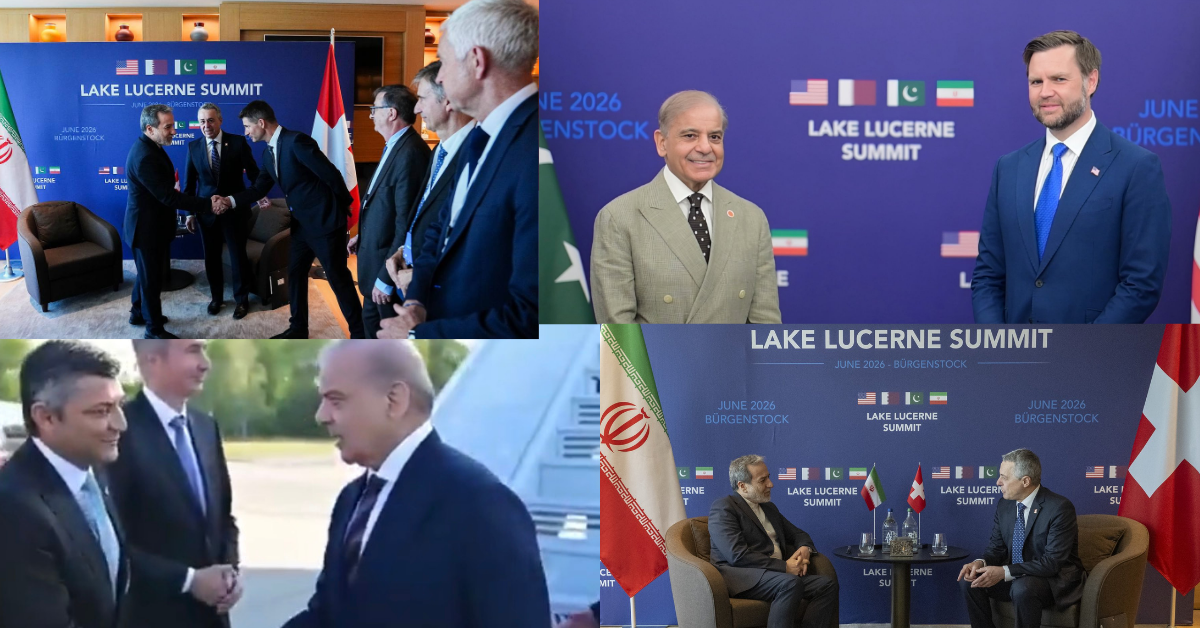
Delegations from the United States, Iran, Qatar and Pakistan gathered in Switzerland on June 21 for talks aimed at advancing a fragile U.S.-Iran memorandum into a wider political deal.
The meetings at the Burgenstock resort, above Lake Lucerne, followed a brief disruption over Iran’s participation, according to RFE/RL.
Swiss and Qatari officials moved to keep the process alive after uncertainty over the schedule. Swiss Federal Councilor Ignazio Cassis held consultations with Qatari Prime Minister Muhammad bin Abdulrahman bin Jassim al-Thani in Burgenstock, while Pakistani intermediaries and senior aides from Washington and Tehran also took part in efforts to preserve the talks, RFE/RL reported.
By June 20, technical experts had resumed preparatory meetings at the Swiss resort. The Swiss government said it continued to offer a low-key, dependable venue for discussions on implementing the U.S.-Iran memorandum of understanding.
Iran’s high-level delegation arrived in Zurich by the evening of June 20 ahead of talks expected to begin June 21. The delegation is led by Parliament Speaker Mohammad Baqer Qalibaf and includes Foreign Minister Abbas Araqchi, Foreign Ministry spokesman Esmail Baqaei and senior banking and oil officials.
On the U.S. side, Vice President JD Vance was expected to join special envoy Steve Witkoff and Jared Kushner, President Donald Trump’s son-in-law, who were already working through technical details.
Speaking to reporters before leaving Joint Base Andrews on June 20, Vance said the talks would focus on Iran’s nuclear program and the Lebanon cease-fire, and that he hoped to make progress on both. He expected “a couple days of talks.”
The Lebanon conflict remains one of the main pressure points. Victor J. Willi, executive director of the Middle East Institute Switzerland, told RFE/RL that both Washington and Tehran appear to want a way out of the war, but he warned that Lebanon and Israel remain the biggest obstacles.
The sticking point is Lebanon, the sticking point is Israel. — Victor J. Willi, Middle East Institute Switzerland
Israeli airstrikes on Lebanese targets in recent days have killed dozens of people, according to Lebanese health authorities.
The talks are also expected to cover a possible return of International Atomic Energy Agency inspections at Iranian nuclear facilities, including Fordow, Natanz and Isfahan. It would be the first time inspectors have returned since the 12-day war of June 2025, according to RFE/RL.
In exchange, Washington is prepared to release several billion dollars in Iranian assets held in Qatar for humanitarian purchases, including food and medicine, RFE/RL reported.
Willi said a credible inspection regime would be central to any lasting limit on the nuclear program. He also warned that sanctions relief could prove difficult because meaningful Western investment may require legal changes and congressional action, not only presidential action.
The Strait of Hormuz has become another test for the talks after Tehran again moved to restrict maritime traffic through the strategic waterway. Trump said Iran should not impose tolls on commercial shipping and warned that Washington could respond if no final settlement is reached.
Willi said the waterway may offer one of the clearest signs of whether diplomacy is changing Iran’s behavior. “The most measurable change in behavior is the Strait of Hormuz,” he said.
The talks place Switzerland in the role of host, with Qatar and Pakistan carrying much of the mediation effort. Willi described Bern’s role as one of good offices, focused on supplying the venue, logistics and security.
Diplomats in Burgenstock now face a narrow question: Can the next 60 days turn a wartime memorandum into a durable agreement?