

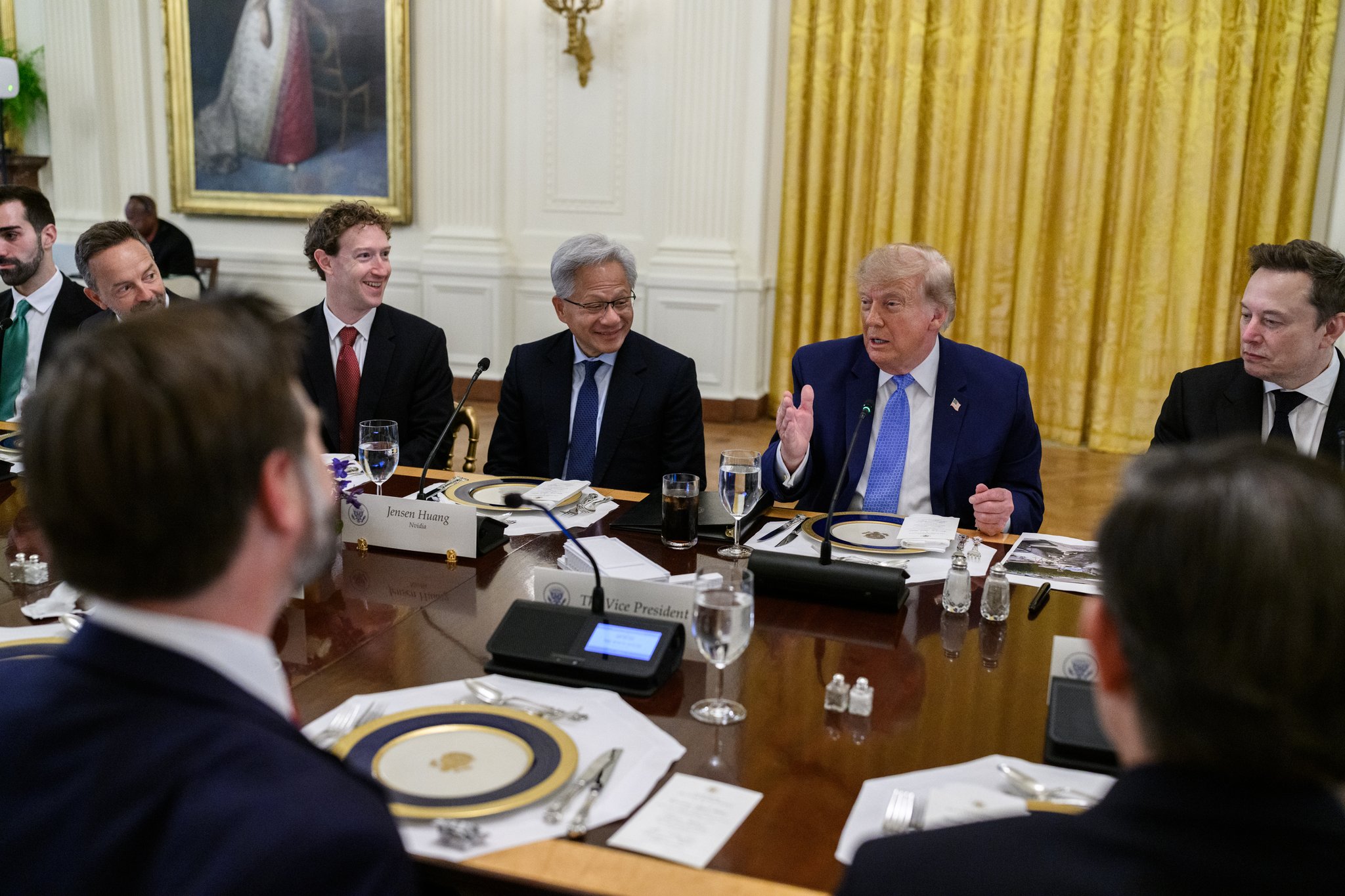
President Donald Trump and the leaders of six technology companies signed a White House accord that calls on companies building frontier models to adopt four layers of safety controls and audits, according to the signed document.
A signature page attached to the accord lists Sundar Pichai of Google, Dario Amodei of Anthropic, Mark Zuckerberg of Meta, Greg Brockman of OpenAI, Elon Musk of xAI and Jensen Huang of Nvidia alongside Trump.
The document, titled the White House Accord on Super Intelligence and subtitled a Joint Commitment on Frontier Responsibilities, says each company is responsible for developing its technology safely and in a way that builds public trust.
Under the first layer, companies would use internal controls to monitor their models’ capabilities and alignment during training and deployment. The accord names cybersecurity, biosecurity and chemical threats as focus areas. The controls are also meant to prevent models from hacking or accessing technical systems in unintended ways.
The second layer calls for an internal team to make sure the controls, monitoring and detection work as intended and that problems get fixed. Under the third, companies would hire an independent external auditor or evaluator to assess those same systems.
The fourth layer calls for an independent board committee to oversee the effort. The committee would receive reports from the teams running the controls and from internal and external auditors, and it would ensure identified issues are remediated.
The participating companies will meet regularly to set standards and best practices for the safety of their systems, according to the accord.
The document leaves open whether the steps will become legal requirements. It says it “may make sense” over time to codify them into laws or regulations. Regardless, the signers state that each of their companies is committed to carrying out the controls and audits.
Pichai confirmed Google’s participation in a post on X. He wrote that he met with Trump, Vice President JD Vance, the House speaker and other administration and tech leaders before signing. He called the accord a “solid basis for moving forward.”
In the same post, Pichai said Google has invested hundreds of billions of dollars over the past two years. He described the company’s approach as including testing, evaluations, red-teaming and other safeguards, and said it releases models or products only after thorough review.
Separately, the White House said in a fact sheet that Trump signed an executive order Sept. 29 replacing the term “Artificial Intelligence” with “Super Intelligence” across the executive branch. The fact sheet does not mention the accord.
The order directs departments and agencies to use “Super Intelligence” and “SI” in official correspondence, public communications and non-statutory documents. It also directs them to stop acknowledging the terms “Artificial Intelligence” and “AI.”
The White House argued that the new name better reflects the technology’s capabilities. According to the fact sheet, the term “Artificial Intelligence” implies simply imitating or automating human intelligence.
The fact sheet also cites earlier administration actions. They include more than $5 billion announced for the Genesis Mission and the AI Action Plan, released in July 2025, which identified more than 90 federal actions. It also lists a National Super Intelligence Policy Framework unveiled in March 2026.
Under the order, the Assistant to the President for Science and Technology must propose a federal definition of “Super Intelligence.” That official must also identify any further executive action needed to put the definition into effect.