











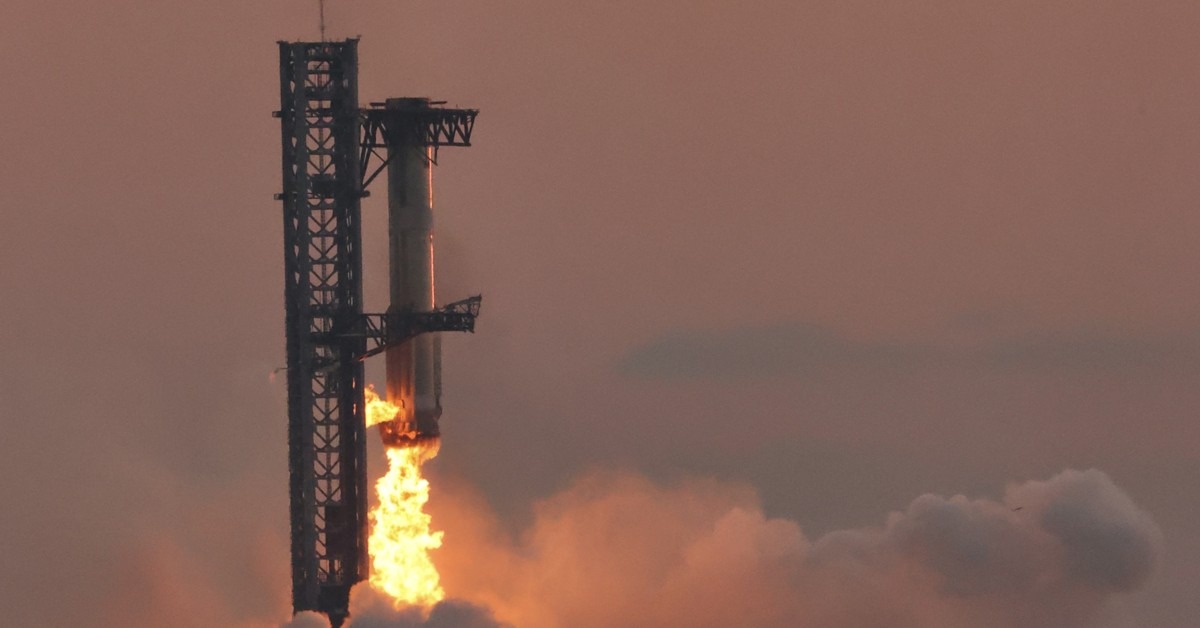
STARBASE, Texas — SpaceX said its launch tower caught Starship’s Ship 42 upper stage on Saturday after more than 22 hours in orbit, the first tower catch of a Starship ship.
Arms of the launch tower at Starbase captured the spacecraft at around 4:20 p.m. ET, 22 hours and 32 minutes after lift-off. SpaceX celebrated the achievement on its X account.
“Mechazilla catches Starship! Congratulations to the entire SpaceX team on this incredible achievement!”
Ship 42 flew on Flight 15, the 15th test flight of the Starship system, from Pad 2 at Starbase on Friday evening at 5:47 p.m. ET. It reached an orbit 170 miles up and deployed all 26 Starlink V3 satellites it was carrying. Three of these satellites contained cameras to monitor the ship’s heat shield as it coasted.
The spacecraft stayed in orbit for about 14 orbits. SpaceX retained splashdown options near Hawaii, off the coast of Chile and in the Gulf of Mexico in case the return had to be called off during one of the three health checks.
A first for the upper stage
On Saturday, the teams decided to continue with the plan, and the ship fired its one Raptor engine for about 10 seconds at 3:23 p.m. ET to leave orbit, returned into Earth’s atmosphere, made a banking turn on approach, flipped upright and started its engines for the last descent toward the tower’s arms.
Prior to Saturday, SpaceX had never managed to capture a ship after a mission. Ships that survived re-entry on previous flights ended up in the ocean, but the launch tower had managed to capture three boosters. Unlike the ship, a booster does not stay in orbit for long — it returns to the launch pad several minutes after lift-off. Ship 42 flew at orbital velocity, hot from re-entry, and had to make its way down to the capture point.
The company was happy with its performance before the descent. Overnight, the company posted that the ship and its heat shield were healthy, and on the webcast Dan Huot explained how the decision was made: engineers had analyzed images from tracking cameras and from cameras mounted on some of the newly deployed Starlink satellites, and they felt the tiles would withstand re-entry. What the tiles look like after re-entry, SpaceX has not disclosed yet.
Booster 22 did not make it back
According to the initial plan, both stages were supposed to be captured. However, Booster 22 broke away from its run at the tower six and a half minutes after launch, went through the offshore divert and exploded above the Gulf.
Dan Huot went over the sequence once again on Saturday. According to him, the guidance recognized that the booster was out of position for a capture, automatically aborted the approach and guided the vehicle to the splashdown zone. Kate Tice provided the first information about what happened during the boostback burn: apparently, it ended prematurely due to a low fuel mass alarm. At the same time, nobody at SpaceX calls it the reason yet — Musk himself warns that early conclusions are usually wrong in part, and the analysis is still ongoing.
One catch out of two, then. Whether Ship 42 will fly another time, and when Flight 16 will fly, SpaceX has not announced.