

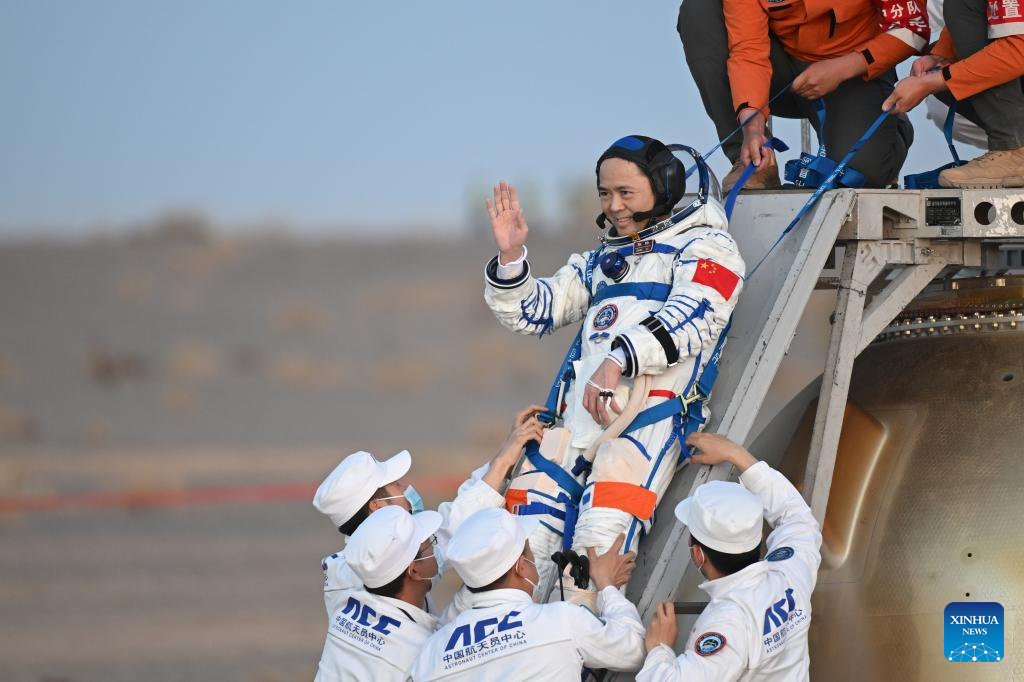
Three Chinese astronauts returned to Earth on Friday evening, closing out the longest single-crew mission aboard China’s space station, state news agency Xinhua reported.
Commander Zhang Lu, spaceflight engineer Wu Fei and payload specialist Zhang Hongzhang touched down at 8:11 p.m. Beijing time at the Dongfeng landing site in Inner Mongolia, according to Xinhua, citing the China Manned Space Agency. All three were in good health, the agency said, calling the Shenzhou-21 mission a complete success.
Zhang Lu now holds the record for the most spacewalks by a Chinese astronaut, having completed seven extravehicular activities across his two spaceflights, Xinhua reported. Wu Fei, on his first mission, conducted three spacewalks and became the youngest Chinese astronaut to perform one.
The crew’s return followed an unusual spacecraft handover after concerns emerged over the Shenzhou-20 return capsule. China launched Shenzhou-21 on Oct. 31, 2025, to send the crew to the space station for a rotation with the Shenzhou-20 crew. The Shenzhou-20 crew later found that its return capsule viewport window had suffered a suspected impact from space debris and was unfit for the crew return mission, according to Xinhua.
The Shenzhou-20 crew returned safely aboard the Shenzhou-21 spacecraft on Nov. 14, 2025. China launched Shenzhou-22 on Nov. 25 to serve as an emergency return vessel for the Shenzhou-21 crew.
During their time aboard the station, the Shenzhou-21 crew conducted three spacewalks, inspected and photographed the Shenzhou-20 return capsule’s viewport window, installed space debris shielding devices on the station and carried out multiple cargo operations.
Payload specialist Zhang Hongzhang oversaw a range of scientific experiments, including projects he helped design.
“Moving from a ground-based laboratory to the space station, it is our great motherland that has allowed me to realize the perfect integration of my scientific aspirations and spaceflight dream,” Zhang Hongzhang said, as quoted by Xinhua.
The crew recorded several firsts for China’s space program, including closed-environment breeding of mice aboard the station and aeroponic cultivation of cherry tomatoes and wheat in orbit. Xinhua also reported that the crew tested a non-contact method for monitoring astronaut health through facial micro-movement recognition.
Zhang Lu returned with a carefully preserved apple that had been given to the crew at launch as a good-luck gesture. He said the crew brought it back as a tribute to China’s science and technology workers.
“So when we departed the Tiangong space station, we deliberately brought an apple back to give to all sci-tech workers, and say to them: thank you for your tireless hard work,” Zhang Lu said, as quoted by Xinhua.
The landing came ahead of China’s National Science and Technology Workers Day on May 30.