

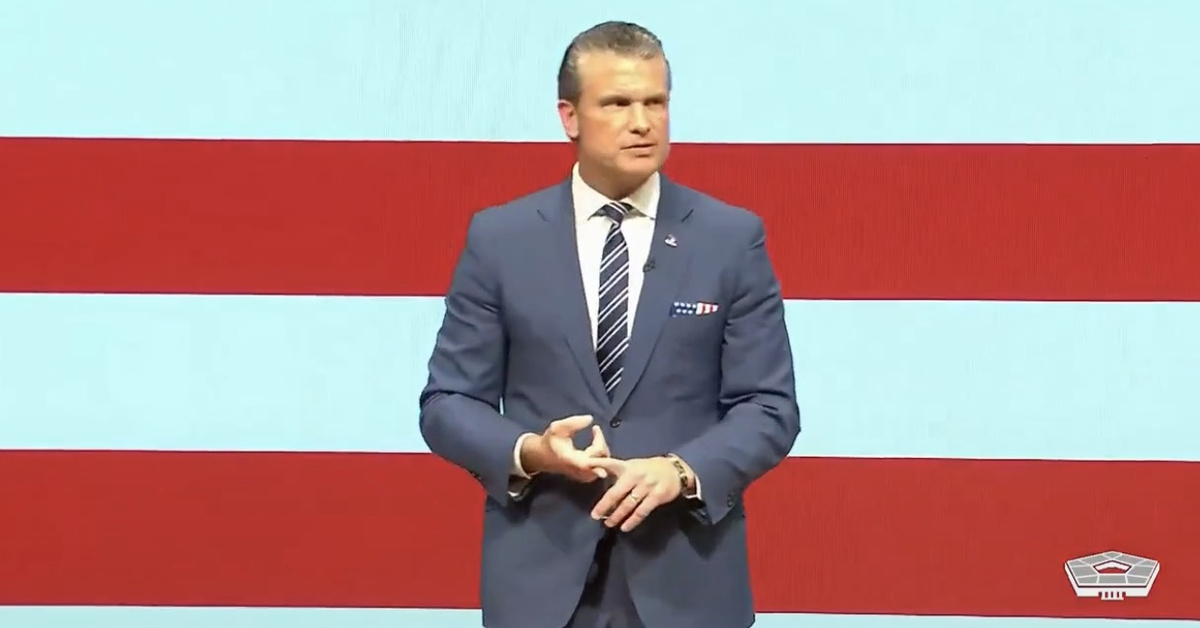
Secretary of War Pete Hegseth announced six strategic initiatives during a speech at Marine Corps Base Quantico, including a new command for autonomous warfare and a 120-day technology review to be co-directed by Elon Musk.
Hegseth delivered the plans directly to active-duty E-6s and O-3s, according to a Department of War news release. The department said he bypassed Pentagon bureaucracy to brief the tactical-level officers and noncommissioned officers who will carry out the reforms.
The initiatives create the Autonomous Warfare Command, a new Corps of Cadets program, the FORTRESS America readiness program, the Next Great American Base project, the Office of Religious Affairs and Project Meridian. The department described them as continuing a two-year effort under Hegseth to focus on lethality, warfighters and rapid modernization.
Autonomous Warfare Command
The new command is intended to scale autonomous warfare across the Joint Force as a four-star functional combatant command by Oct. 1, 2027. The department called it the fastest peacetime operational shift in modern military history.
The effort builds on the department’s Drone Dominance program, which the release said has delivered thousands of robotic systems to the Middle East in support of Operation Epic Fury. Hegseth directed DRPM UxS to lead a related effort, Project Agincourt.
Owen West, the current director of DIU, and Navy SEAL Senior Chief Max Strasiser will direct DRPM UxS under what the department called a CEO-COO partnership. The release identified Strasiser as the first enlisted SEAL to graduate from Navy Test Pilot School.
Project Meridian
Project Meridian will identify the capabilities the department says are needed for technological dominance on the next-generation battlefield. Its review will span warfighting domains from subterranean depths to cislunar space.
Musk, Palmer Luckey and Newt Gingrich will co-direct the project, supported by academic, policy and industry experts. Emil Michael, the department’s chief technology officer, is facilitating its commissioning.
Hegseth directed that the project be completed within 120 days of its establishment. It is to produce an unclassified final report for public release, along with a classified annex.
FORTRESS America
FORTRESS stands for Federal Operations for Resilience, Troop Resources, Energy, Supply, and Survivability. The department called the program a national insurance policy for the homeland, aimed at ending the military’s reliance on foreign sources and the civilian power grid.
Under the program, every major U.S. military installation is to generate its own independent power so operations can continue if the civilian grid is disabled by cyberattack or sabotage. The program also seeks to bring home supply chains for rare earths, specialty metals, semiconductors and propellants.
The department said the program will also build strategic reserves of munitions, fuel, medicine and blood. It will harden installations on U.S. soil against cyber intrusion, sabotage and drones, and protect satellites, spectrum, navigation and communications.
Next Great American Base
The department plans to build a new installation from the ground up to serve as a power projection platform. It would host troops across hundreds of thousands of acres and operate entirely off the commercial grid, with independent power generation, autonomous systems and advanced air defenses.
The base will use classical designs in line with the president’s executive orders on Beautiful Civic Architecture, according to the release. Governors and adjutants general are invited to pitch their plans to senior leadership in what the department described as a merit-based competition.
The state that cuts the most red tape and offers the best package of land and support will host the base, the department said.
America’s Corps of Cadets
The new cadet program aims to expand the pipeline of officers commissioning into the Joint Force. It builds on existing Corps of Cadets programs at the nation’s six Senior Military Colleges.
Louisiana State University, Liberty University, Tuskegee University, Mississippi State University and Hillsdale College will create full-time Corps of Cadets programs. Each will be designated a “Distinguished Military College,” a revived category requiring high standards of discipline, tactical instruction and military organization.
The schools will also receive “Honor School” status, which gives priority in officer commissioning. The department said the program addresses a need for officers grounded in the Constitution, Western civilization, American heritage and the warrior ethos, contending that many traditional commissioning sources have drifted from those foundations.
Office of Religious Affairs
The Office of Religious Affairs will report directly to the secretary and drive departmentwide policy, resource advocacy and action on religious matters. The department said the office will protect free exercise, remove policy barriers, identify unmet requirements and secure support for the service chaplaincies.
The chaplaincies will remain the department’s primary providers of religious support. According to the release, the office will not compel religious participation, favor one faith or diminish the rights of personnel of any faith or none.
The release referred readers to a separate memo for each of the six initiatives.