

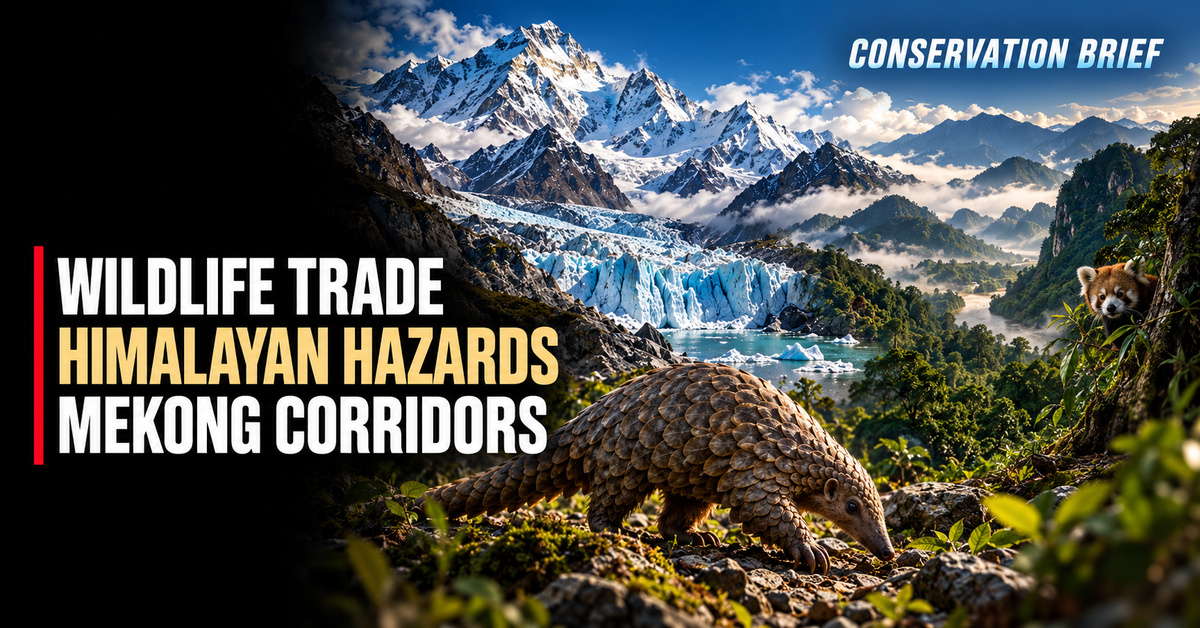
The September 18 conservation briefing covers new research and analysis from the Eastern Himalayas and Greater Mekong, led by findings on wildlife trafficking in Kathmandu, Himalayan geohazards and wildlife mortality in Chitwan National Park. The main publication window is September 11–17, 2026.
In This Roundup
- Illegal Wildlife Trade in Kathmandu Valley: A Hub of Biodiversity Crime
- Rapid Warming in the Himalaya Exacerbates Geohazard Cascades Beyond Adaptation Limits
- A Decade Under Lens: Wildlife Mortality in Chitwan National Park
- Orangutan Babies in India Spotlight Primate Trafficking
- Biodiversity Corridor Payments in Vietnam’s Annamite Mountains
- Asiatic Black Bear Conservation in Mustang, Nepal
- Regional Biodiversity Loss and Himalayan Medicinal Plants
- Key Watchpoints and Coverage Gaps
1 Illegal Wildlife Trade in Kathmandu Valley: A Hub of Biodiversity Crime
Narayan Prasad Koju and Bhim Maya Tamang report in Ecology and Evolution that records for 2017–2022 document 306 wildlife crime cases involving 36 species and 740 detainees in Kathmandu Valley. Pangolin scales and leopard skins dominated seizures; Chinese pangolin, leopard, red panda, Himalayan black bear and musk deer were the most recurrent species. Cases did not show a significant sustained decline.
The findings provide detailed evidence that Kathmandu functions as a consolidation and trading hub. They support joint intelligence work among Nepal’s forest, customs and police agencies, and with India and China, focused on organizers and buyers rather than seizure counts alone.
2 Rapid Warming in the Himalaya Exacerbates Geohazard Cascades Beyond Adaptation Limits
World Weather Attribution and Imperial College London assess the August Nepal–China border rock-ice avalanche, which reached Rasuwagadhi in roughly seven minutes. The authors do not attribute the collapse solely to climate change, but find that glacier retreat, permafrost degradation and human-caused warming likely increased slope instability. The full report is available from Imperial College London.
Existing warning systems could not provide useful lead time close to the source.— World Weather Attribution and Imperial College London
Himalayan conservation and infrastructure planning must account for cascading slope–glacier–river hazards, including events beyond conventional early-warning design limits. The report makes a case for shared Nepal–China monitoring, satellite data and downstream risk planning.
3 A Decade Under Lens: Wildlife Mortality in Chitwan National Park
Prabin Poudel and colleagues report in Ecosphere that, among 525 recorded wildlife deaths during 2010–2019, anthropogenic causes accounted for 33.1%, natural causes 23.6% and disease or infection 13.3%. Recorded disease-related mortality increased an estimated 25.8% annually; rhinoceroses had the largest share of recorded deaths.
The findings put disease surveillance alongside anti-poaching and conflict mitigation in Chitwan’s core management program. Priorities include wildlife diagnostics, livestock vaccination around the park and better mortality investigation. The increases may partly reflect changing surveillance effort, and the series ends in 2019.
4 Orangutan Babies in India Spotlight Primate Trafficking
Sahana Ghosh and Subhra Priyadarshini report in Nature India that five infant orangutans discovered in Odisha have renewed concern that India is becoming a destination for exotic primates smuggled from Southeast Asia, particularly for private collections and zoos.
The case points to a Southeast Asia–India demand route that overlaps Greater Mekong trafficking networks. Verified source routes, mortality in transit, end buyers and prosecution outcomes remain evidence gaps; the broader network is suspected rather than fully mapped.
5 Biodiversity Corridor Payments in Vietnam’s Annamite Mountains
An open-access February study, examined in new analysis by Carolyn Cowan for Mongabay, found that surveyed households inside two Central Annamite corridors earned about US$412 per hectare annually, versus $330 outside, largely because of forest-protection payments. The corridors connect protected areas toward Laos’s Xe Sap landscape.
Payments can support transboundary habitat connectivity for saola, elephants, muntjac and primates. Benefits may favor households with larger landholdings, while the cross-sectional study cannot establish long-term ecological gains.
6 Asiatic Black Bear Conservation in Mustang, Nepal
Sangam Poudel and colleagues report in Conservation Science and Practice that, in Kunjo, crop foraging—especially of maize and buckwheat—and dissatisfaction with government response were associated with negative attitudes toward Asiatic black bears. Residents identified forest fires as the leading perceived threat.
Faster conflict response and locally credible crop-loss measures may be as important as ecological interventions. Findings come from one community and should not be generalized across the Himalayan bear range without further sampling.
7 Regional Biodiversity Loss and Himalayan Medicinal Plants
Kamana Shandalya, Mukhtar Ahmed and Susheel Verma argue in Biodiversity and Conservation that several Himalayan medicinal plants face severe regional decline despite being globally listed as Least Concern, Data Deficient or not assessed.
Indian Himalayan development and harvest decisions should use regional threat assessments rather than waiting for global Red List changes. This is a policy-focused letter, not a new field dataset.
8 Key Watchpoints and Coverage Gaps
Seizures and arrests reveal enforcement activity, not total trafficking. Financial flows, online sales, buyer networks and court outcomes remain poorly documented. Kathmandu trafficking, Southeast Asian primates reaching India, and Nepal–China geohazards all point toward a need for operational data sharing.
This week’s strongest conservation policy shift is toward integrating wildlife health and climate-driven cascading hazards into protected-area management. No substantive new Bhutan-specific primary publication or fresh Laos-specific empirical paper qualified in this window. Laos appears mainly through the Annamite transboundary-corridor analysis.
Editor’s Note: Virginia Times uses artificial intelligence to collect and verify information. All content is thoroughly reviewed before publication.

A global media for the latest news, entertainment, music fashion, and more.