











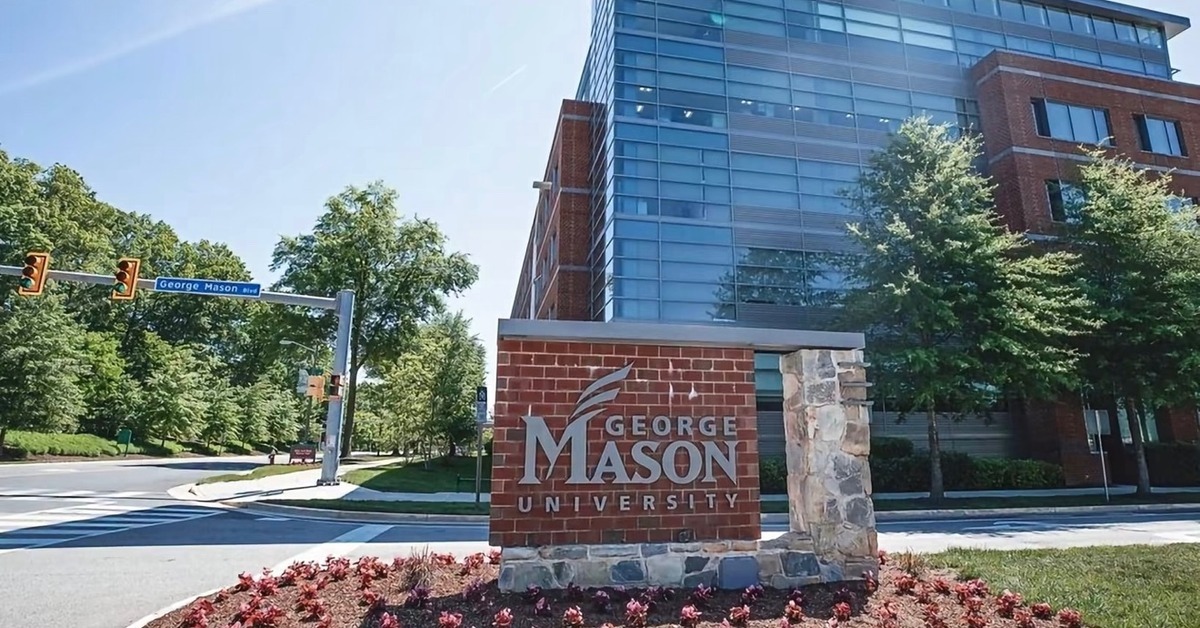
FAIRFAX, Va. — Dwight Schar, the philanthropist who founded homebuilder NVR Inc., has given $30 million to George Mason University, the university announced, creating two new institutes at the Schar School of Policy and Government.
The Institute for Security, Intelligence, and Defense and the Institute for Economic Statecraft will both sit in the Schar School. They enhance the scope of the school’s engagement in the fields of national security, intelligence, and economic statecraft. Their goal is to provide greater opportunities for both students and the general public to engage directly with experts and practitioners who have real-world experience in their areas.
In recognition of Schar’s longstanding support, the university will name the plaza at the heart of Mason Square the Dwight Schar Plaza at Mason Square. The plaza is a gathering place for students, faculty, staff and visitors. It hosts regular programming and special events open to the university and to the Arlington community.
“Dwight Schar has long understood that investing in George Mason University students and faculty is investing in the future prosperity and thought leadership of our region and the Commonwealth of Virginia,” George Mason President Gregory Washington said. “Dwight’s support of these new institutes deepens the Schar legacy of impact and opportunity at the university that he so proudly and generously supports.”
Security, Intelligence and Defense
The security institute draws upon the strength that the Schar School has in these fields. National security and intelligence are the existing core competencies of the school, and the new institute will address security issues related to the Indo-Pacific region, nuclear, biological and chemical threats, as well as emerging technologies. It will also address the growing role of major technology companies in the national security sphere.
One piece is already in place. The institute will expand the public programming of the Michael V. Hayden Center for Intelligence, Policy, and International Security, which the university described as a featured component of the new institute.
“People should have the opportunity to understand how national security decisions are made, who makes them, and the responsibilities those public servants carry,” said retired Air Force Gen. Michael V. Hayden, founder of the Hayden Center and former director of the CIA and NSA. “Bringing these conversations into the open can help people ask better questions, understand the work more fully, and perhaps even see a place for themselves in public service.”
Economic Statecraft
The other institute poses a different question: how do governments use economic instruments to achieve their goals overseas? The Institute for Economic Statecraft will examine how governments use such tools to advance foreign policy and national security objectives.
The tools are familiar ones. Export controls. Financial sanctions. Tariffs, and restrictions on critical technologies. This institute will also investigate the trade-offs that arise from those choices for businesses, markets, and international relations.
Money from the gift lets the Schar School recruit faculty with senior government experience. It will develop a research initiative on illicit financial flows, host an annual summit, and produce research in the field of economic statecraft.
“I have believed for a long time in what this school can become,” Schar said.
“My hope is that these institutes will help prepare the next generation to take on the difficult questions facing our country and give students the judgment, experience, and perspective to do that work well.”
“I’m proud to continue supporting the Schar School as it builds for the future,” Schar said.
A Name Already on the School
None of this is Schar’s first gift to the school that bears his name. His support goes back more than a decade.
In 2016, the university announced a $10 million gift from Schar to what was then the School of Policy, Government, and International Affairs. Since then, his donations have enabled the school to increase its national reputation. It established the Washington Post-Schar School polls, recruited leading academics and policy experts, and expanded its research and programs.
“Philanthropy expands what a university can accomplish, creating opportunities to address some of the most pressing challenges facing our communities and the world,” said Trishana E. Bowden, vice president for advancement and alumni relations and president of the George Mason University Foundation. “Dwight Schar’s investment reflects a belief in the Schar School’s potential and in George Mason’s ability to contribute to the public good.”
Launch Expected in Fall 2027
Both institutes are expected to launch in fall 2027. Research initiatives, public events and opportunities for engagement will take shape in the months ahead, the university said, and further details on the institutes and the school’s strategic priorities will be announced as plans advance.
“This gift allows us to put our vision for the next chapter of the school into practice,” said Mark J. Rozell, dean of the Schar School. “By establishing these two institutes focused on critical, global issues and bringing in additional academic and practitioner expertise, we can expand the research we undertake and the opportunities we offer students. Just as important, we can bring those ideas and conversations to a broader public at a time when they are needed most.”
The gift is part of Mason Now: Power the Possible, George Mason’s $1 billion comprehensive campaign. The university said it advances the campaign’s commitment to research and student success, and strengthens George Mason’s contributions to the region and the nation.