

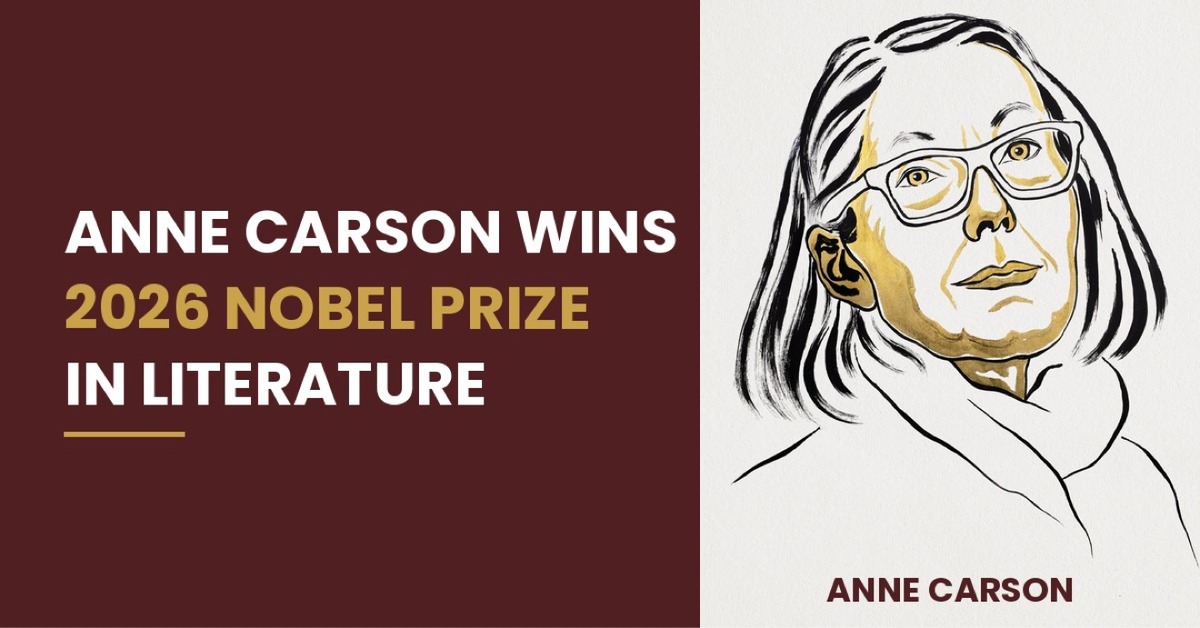
Anne Carson won the 2026 Nobel Prize in Literature on Thursday. The Canadian author’s work spans poetry, essays, fiction and translations of ancient Greek literature.
The Nobel Prize announcement honored Carson:
“for her bold and inventive oeuvre that, in playful dialogue with the classical tradition, has created new forms for contemporary literature”
Alongside her own writing, Carson has translated classical texts and taught at universities throughout her career. Ancient writers often appear in her books beside modern authors.
In the accompanying Nobel biography, Nobel Committee Chair Anders Olsson traced that approach through her essays, verse narratives, translations and collaborations with other artists.
Born in Toronto in 1950, Carson published her doctoral thesis in classics, “Odi et Amo Ergo Sum,” in 1981. She has identified the origins of words as the starting point for her work.
Carson translated Sappho’s surviving fragments in “If Not, Winter,” published in 2002. She also translated Sophocles’ “Electra” in 2001 and “Antigone” in 2015. Her version of Euripides’ “Bakkhai” appeared in 2015.
Olsson described “Eros the Bittersweet” (1986) as a foundation for Carson’s later writing. The essay examines desire through Sappho’s pairing of sweetness and pain, exploring the distance between a lover and the beloved.
Carson brings contrasting voices together in “Economy of the Unlost” (1999), which pairs the ancient Greek poet Simonides with Paul Celan. In “Men in the Off Hours” (2000), she places Thucydides alongside Virginia Woolf.
In “Autobiography of Red: A Novel in Verse” (1998), Carson returns to the Greek myth of Geryon, a red monster with wings. Heracles kills him in the ancient story and steals his cattle.
Carson recasts Geryon as a tender young figure devoted to his mother who falls in love with Heracles. The story explores love for someone who will ultimately destroy him.
Loss also runs through “The Glass Essay,” published in “Glass, Irony, and God” (1995). Its narrator, abandoned by her husband, visits her mother and reads Emily Brontë, whose writing becomes woven into the poem.
“The Beauty of the Husband: A Fictional Essay in 29 Tangos” (2001) examines a marriage to a deceitful husband. Each of its 29 episodes opens with verse by John Keats.
“Nox” (2010), written in memory of Carson’s brother Michael, who died in Denmark in 2000, gives grief a physical form. A box holds an accordion-folded collection of photographs, letters and texts.
The work also includes Carson’s translation of Catullus’ elegy for his own brother, who likewise died abroad.
Her later books continue those experiments. “Float” (2016) contains 22 chapbooks that readers can approach in any order. “Wrong Norma” (2024) combines texts that cross artistic and academic fields and incorporate elements of performance.
Carson has also collaborated with visual artists, choreographers, and opera and theater directors. Olsson linked that freedom from conventional literary rules to her influence on international literature and art since the 1990s.