


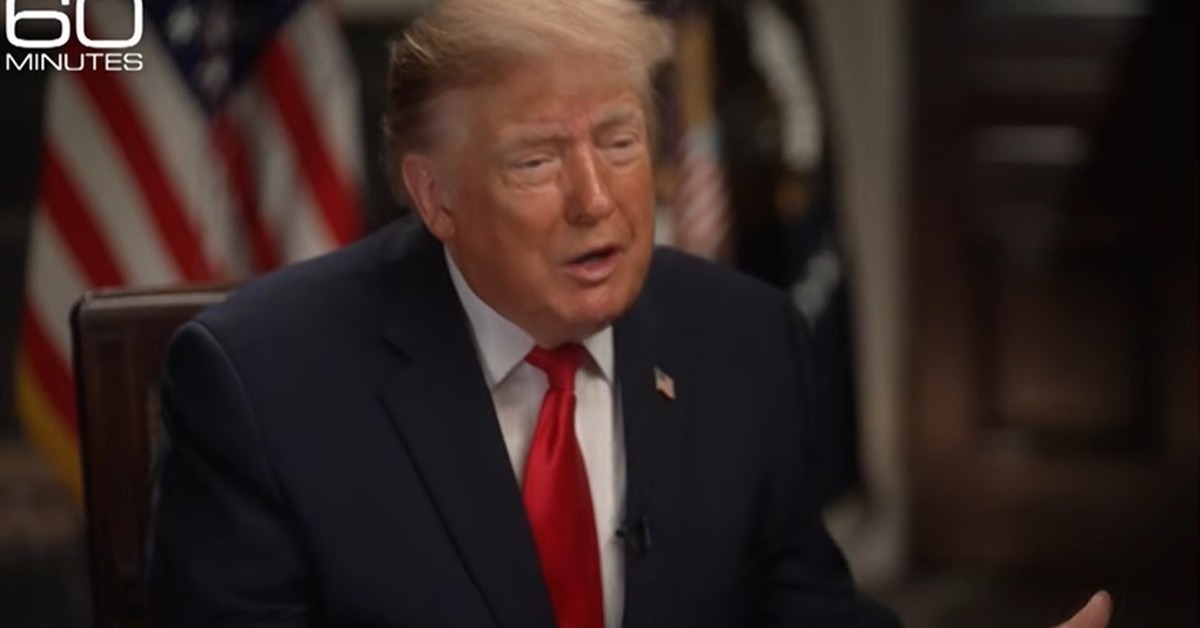
WASHINGTON — Republicans lost the House and the Senate on Tuesday. In his first sit-down interview since then, President Donald Trump told CBS’s “60 Minutes” the reasons were plain: voters did not like the war with Iran, they did not like gasoline prices going up because of it, and they hold a deep dislike for Israel.
He spoke with correspondent Ross Douthat at the White House on Friday, in an interview that aired Sunday. CBS said it found him in a reflective mood and seemingly accepting of a defeat that also cost Republicans statewide offices in red states from Texas to Kansas to South Carolina.
The president started with himself. He was not on the ballot, he said, and he had campaigned hard. His voters did not transfer to candidates they did not like, and in some cases, he suggested, they did not vote at all.
Douthat pressed him on those candidates. Trump picked many of them. He endorsed Ken Paxton in Texas and Darline Graham in South Carolina, and both struggled. Trump said Sen. John Cornyn would have lost in Texas too. Graham, he said, fought hard, and he had backed her in honor of a man named Lindsey, a friend of his. He won Texas, South Carolina and Florida by the most votes in history, he said. That support did not carry over.
The war came first in his own list of reasons.
“They didn’t like the war. They didn’t like the fact that gasoline went up, ’cause I had it down at a low, and there’s a great dislike, incredibly, for Israel.”
‘The Reason We Lost Is the War’
Vice President JD Vance reached a blunter conclusion a day after the election. “The reason we lost is the war,” Vance wrote in a post on X. He reported what a pollster had heard from voters who backed the Trump-Vance ticket in 2024 but voted Democratic this year. Those voters named four things that would bring them back: end the war, focus on the cost of living, put America first and change the U.S. relationship with Israel.
Asked whether he agreed with that analysis, Trump said, “I don’t disagree with it.” He said Vance had asked him first, and he told his vice president to write what he felt. His one regret was what Vance left out. Asked whether he would attack Iran again, Trump called his own answer “an emphatic yes.”
“You can’t let Iran have a nuclear weapon,” he said. History would judge the decision well, he argued, even if it did not help today or tomorrow. “I’ve stopped them from having a nuclear weapon. That’s a big thing.”
The exit polls back up the war’s unpopularity, if not Trump’s defense of it. About 6 in 10 voters in the AP Voter Poll said the United States made the wrong decision in taking military action against Iran. NBC News put the figure at 63%. CBS News said most voters took that view, including about a quarter of Republicans.
Gas Prices, and a Number That Does Not Hold Up
Gas prices did the war’s damage at home. Trump said gasoline in Iowa had been $1.85 a gallon and rose to $3.50 or $4 after the war began. He said prices were still lower than under Presidents Joe Biden and Barack Obama, and that the war took the blame for the increase.
That $1.85 figure does not hold up as an average. The U.S. Energy Information Administration put the Midwest average at $2.76 a gallon in the last week before the war began, and AAA put Iowa’s average at $4 a gallon on Nov. 2. Measured across whole terms, gasoline averaged $3.47 a gallon under Biden and $2.97 under Obama, while the average for Trump’s second term has moved slightly above the Biden figure.
‘Bad Messaging’ on the Economy
Douthat then turned to the economy. Poll after poll showed voters unhappy in a way they were not in Trump’s first term, he said, naming the cost of living and inflation. Was that all the war?
Trump said no, and then he did not blame the economy itself. “The numbers are phenomenal,” he said. “We have historically good numbers. We have the highest stock market in history.” The failure, he said, was his own side’s explanation of those numbers. “I think it was bad messaging, maybe by me,” he said. “We couldn’t get the word across.” He pointed to the jobs report released a day after the election, which he said added 165,000 jobs, far past expectations, and to 401(k) balances at record highs.
Voters saw it differently. In the AP Voter Poll, roughly three-quarters of voters rated the economy “not so good” or “poor.” About 9 in 10 said the cost of living was a crucial or major factor in their vote, and about two-thirds said Trump’s own policies had fueled inflation. CBS’s exit poll put Trump’s approval rating at 38%.
Immigration: ‘It Might Be Too Tough’
Immigration gave Trump his most direct concession of the interview.
He had congratulated the Democrats after the election and said he was open to working with their new majorities. Asked to name one thing first, he chose immigration. The crackdown, he said, “both helped and hurt.” He gave himself an “A+ for closing up the border” and very high marks for “getting the bad ones out.” The hurt came from the rest of the policy.
“I get hurt because we also took people that had good jobs, that created one violation, or breaking of the law, and that was that they came into the country illegally,” he said. Many of those people work in landscaping or in hotels, he said, and some pay taxes. Asked directly whether the deportation policy was too tough, he answered, “I think it might be too tough, yeah.” He added later, “I think ultimately that hurt me.”
A deal, he said, is doable. Get the killers, the rapists and the drug dealers out, he said, but “let the people that are here, and in some cases here for ten and 15 years, work a deal for them.” Democrats had already called him, he said, and he named Sen. James Talarico of Texas, who won Tuesday, as one who wants to work on immigration. Could he go six months without insulting Democrats to get a deal done? “Very easily,” he said.
Changes at the White House, and No Escalation in Iran
An hour after the interview ended, the first personnel change landed. Trump replaced his chief of staff, Susie Wiles, with Deputy Chief of Staff Stephen Miller, the architect of the mass deportation policy. The timing sat oddly with the talk of an immigration deal, a point CBS itself noted. Trump had told Douthat to expect “maybe a few changes” to his team, without naming anyone. He said he has confidence in Defense Secretary Pete Hegseth, whose resignation some have demanded, crediting him as part of a team he said won two wars, Venezuela and Iran.
On Iran, Trump said he is not looking to escalate now that the midterms are over. “I don’t think there’s any reason to,” he said. The Strait of Hormuz is open, he said, with ships moving under a large U.S. military presence, and the countries the United States protected will repay the full cost of the war. “Without us, Israel would not exist,” he said. He also said he had no regrets about helping Israel carry out decapitation strikes on Iran.
Succession, Pardons and Ukraine
The conversation ranged well past the election. Trump said he may or may not endorse a successor for 2028. He praised Secretary of State Marco Rubio and said the MAGA movement can survive without him because, in his words, “MAGA is basically common sense.” He said he expects to issue many pardons when he leaves office. He believes he has the power to pardon himself, though he does not expect to need it. Pressed on a Forbes estimate that his net worth rose by $3 billion after he returned to office, he said his son manages the money. He said he knows nothing about the foreign investors in the family’s cryptocurrency company, World Liberty Financial.
On Ukraine, he said the biggest obstacle to peace is the hatred between President Volodymyr Zelenskyy and President Vladimir Putin, and that a deal is very close. He said 18 people had been killed across the Iran and Venezuela operations over seven or eight months, a figure he contrasted with far larger tolls in earlier wars.
Douthat closed by asking how he wants his presidency remembered in a single line, a hundred years from now. Trump did not hesitate. “That I made America great again,” he said.
Have something to promote?
Bring your business, services or event to our readers.