

Tesla earned $787 million in the third quarter, down 43% from a year earlier, even though revenue barely changed at $28.05 billion, according to Tesla’s third-quarter update.
Most of the decline showed up in operating results. Operating income fell 56% to $718 million as operating expenses rose 39% to $4.78 billion. That squeezed the operating margin to 2.6%, down from 5.8% a year ago.
Per-share profit fell to 22 cents from 39 cents. Excluding certain items, Tesla earned $1.70 billion, or 48 cents a share, a 4% drop. The company’s figures are unaudited.
Gross margin moved the other way and rose to 19.6% from 18%. Gross profit grew 9% to $5.49 billion.
Car sales brought in $20.56 billion, 3% less than a year earlier. Energy generation and storage revenue fell 16% to $2.88 billion.
Services and other revenue was the fastest-growing line, up 33% to $4.61 billion. Gross profit in that unit reached a record $734 million, and Tesla said charging, insurance and parts sales drove the gain. Revenue over the past 12 months topped $100 billion for the second quarter in a row.
Spending weighed on cash. Capital expenditures more than doubled to $4.73 billion, and free cash flow dropped 62% to $1.53 billion. Operating cash flow was $6.26 billion, about the same as last year. Tesla finished the quarter with $45.45 billion in cash and short-term investments, $1.9 billion more than at the end of June.
Deliveries and production
Deliveries slipped 2% to 486,532 vehicles, while production rose 4% to 464,391. Model 3 and Model Y made up nearly all of the deliveries at 478,237. Deliveries of Tesla’s other models fell by almost half, to 8,295.
Tesla said batteries remained the main limit on how fast it can build cars, although it has lined up more supply for the future. It ended the quarter with its biggest backlog of passenger vehicle orders in four years.
The company set delivery records in Canada, Australia, Japan and Taiwan and reached record output at its Berlin plant. It also built and delivered its 10 millionth vehicle.
Robotaxi and self-driving
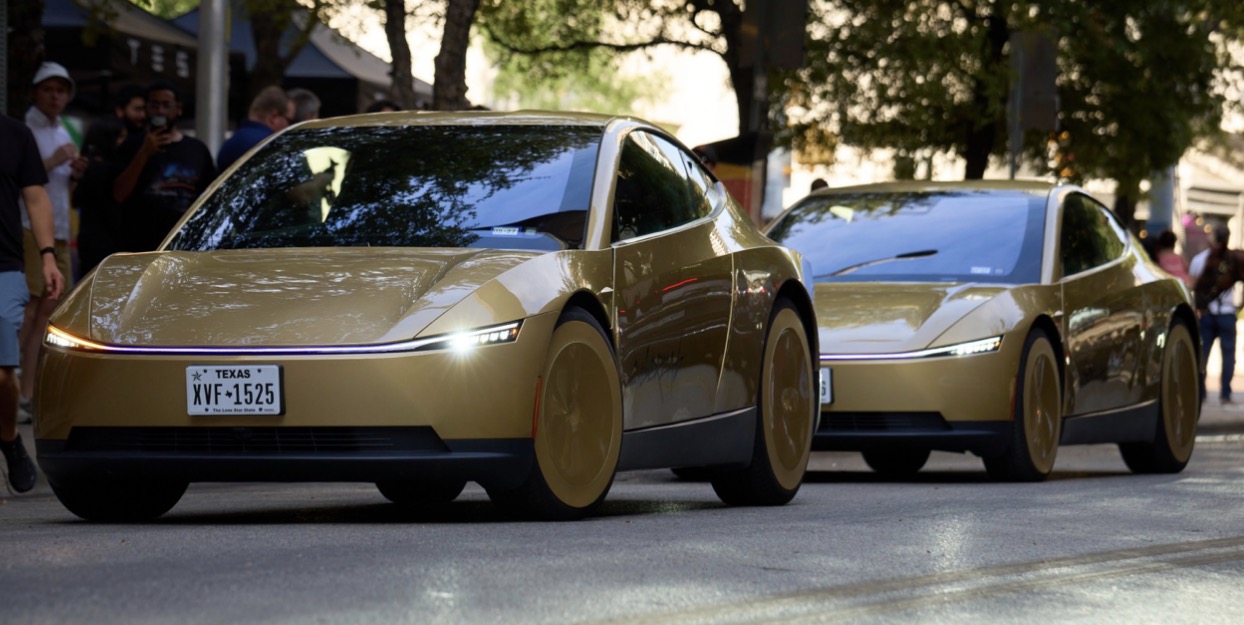
Cybercabs started giving Robotaxi rides in Austin, Texas, on Sept. 3. By the end of September, the service had logged nearly 2 million unsupervised miles in total, eight times the cumulative figure from a quarter earlier. Rides now run from 6 a.m. to midnight.
Tesla’s FSD (Supervised) software still requires a driver to pay attention and does not make a car autonomous. More than 75% of new vehicles delivered in North America included it, up nearly 20 percentage points from the second quarter. Active subscriptions rose 67% to 1.74 million.
Croatia, Slovenia, the Czech Republic and Slovakia have approved the software since June, bringing the total to nine European Union countries. According to Tesla, more than 100,000 drivers there have used it for over 160 million kilometers. The company believes the software is helping sales where it is available.
Energy, Semi and Optimus
Tesla deployed 13.7 gigawatt-hours of energy storage, up 10%. Orders and backlog in the storage business hit record highs, the company said.
Its Texas Megafactory began production and is designed to produce 50 gigawatt-hours a year. Tesla also shipped its first Megapacks built entirely with LFP cells from its own Nevada factory.
Volume production of the Tesla Semi started in Nevada. The company says the top version of the heavy-duty truck can go 500 miles fully loaded at 82,000 pounds. Tesla showed off its Next Gen Roadster on Oct. 15.
In Fremont, Calif., Optimus humanoid robots began rolling off high-volume lines. Tesla called them the first production-quality bots it has made.
Tesla’s outlook did not include numeric targets. The company said it wants to run its factories at full capacity and expects Super Intelligence, software and fleet profits to grow faster over time alongside hardware profits. It plans to reach 400 megawatts of Super Intelligence training compute by year’s end and to start commissioning equipment at its Austin Fab in 2027.
Have something to promote?
Bring your business, services or event to our readers.