

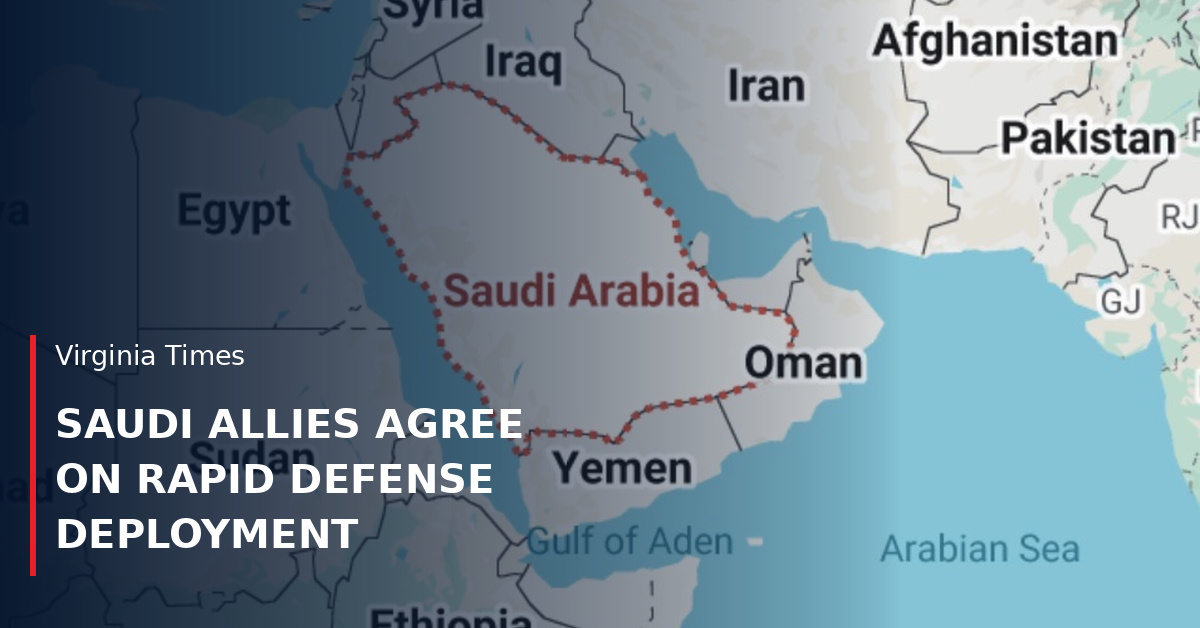
Saudi Arabia, Pakistan and Turkey agreed Oct. 5 to provide forces and military capabilities for rapid deployment in the kingdom, according to a joint statement issued after emergency talks in Riyadh.
The decision calls for the three countries to put their collective defense commitments into effect under agreed arrangements and their national laws, according to the Saudi Foreign Ministry.
Meeting through the Makkah Alliance for Defense, the governments condemned what they described as attempts to target Mecca and Medina and continuing attacks on Saudi cities and civilian and economic facilities.
Pakistan and Turkey praised the Saudi armed forces’ handling of the threats. All three countries said an attack or threat against Saudi security and territory was unacceptable, and that their security was shared.
Saudi Arabia issued a separate condemnation that evening. In the statement published by the Saudi Press Agency, its Foreign Ministry accused the Houthis of repeatedly targeting Riyadh, Abha, Khamis Mushait, Jazan, Najran, Taif and Yanbu, along with Mecca and Medina.
The ministry’s account also included attacks on Saudi vessels in the southern Red Sea and Bab al-Mandeb Strait. Riyadh said it had the right under international law to defend its territory, resources and sovereignty and protect citizens and residents.
Houthi spokesman Yahya Saree claimed a ballistic missile had hit Abha International Airport and disrupted flights. Neither a direct hit nor the claimed disruption was independently verified.
His post warned international airlines against flying through Saudi airspace. Saree described it as an area for Houthi military operations, with exceptions over Mecca and Medina.
Other Houthi statements claimed strikes on Al-Dughayrir camp in Jizan and opposing forces in Yemen’s Taiz, Al-Jawf and Marib governorates. Their accounts of casualties and destroyed vehicles were not independently verified. Neither Saudi statement addressed those claims.
Riyadh pledged political and military support for Yemen’s Presidential Leadership Council and government to restore state institutions under Houthi control.
The Foreign Ministry said Saudi Arabia had sought a lasting political settlement since what it called the Houthis’ 2014 coup. It accused the group of choosing further fighting, bringing more suffering to Yemen’s people and economy while pursuing outside agendas.
Riyadh called for international support for Yemen’s government against the Houthis. It singled out the U.N. Security Council’s permanent members, urging them to act on the council’s relevant resolutions.
The defense committee also chose retired Pakistani Lt. Gen. Nauman Mahmood as the alliance’s first secretary-general. His term will run for three years.
European Commission President Ursula von der Leyen said the Iran-backed Houthis had again targeted Saudi infrastructure, including a refinery and airports. Her post did not identify the refinery or describe the damage.
Von der Leyen described the attacks as a threat to regional stability and global energy security, saying they were fueling further violence.
“We stand in solidarity with Saudi Arabia and our Gulf partners,”
Regional security would be central to discussions with the Gulf Cooperation Council later this month, von der Leyen said.