

Canada will impose counter-tariffs on $27.6 billion in U.S. goods beginning Sept. 8 and introduce a $7.5 billion support package for affected workers and businesses, the federal government announced Tuesday.
The duties will be set at 15%, 25% and 50%, with the rate on each product matching the corresponding U.S. rate, according to Department of Finance Canada.
The products are drawn from those targeted by U.S. Section 338 and Section 232 tariffs. Canada’s response focuses on steel, dairy, appliances, agricultural equipment, pulp and paper, and electronics.
Steel and aluminum products previously carrying a 25% Canadian counter-tariff will move to 50%, along with furniture, clothing and apparel. Appliances, dairy products including cheese, fish and seafood, and certain steel and aluminum derivatives will face 25% tariffs.
The release did not identify which products will face the 15% rate. Existing counter-tariffs, including those on automobiles, will remain in place, while Canada’s tariff-remission process will continue accepting requests for exceptional relief.
Finance Minister François-Philippe Champagne described the action as a dollar-for-dollar and rate-for-rate response to the U.S. tariffs. The government said the measures are intended to protect Canadian producers and improve their competitive position against U.S. products.
The $7.5 billion support package follows nearly $25 billion in earlier assistance reported by the Canadian government. Its largest component is $3.5 billion in Rapid Response Supports for Workers and Employers.
That funding covers temporary employment insurance changes, workplace training, JobBank.gc.ca enhancements and a new Worker Retention and Retraining Program.
Another $2 billion will go to the Canada Strong Diversification Fund for tariff-affected businesses with projects ready to proceed. The fund will be administered through the Strategic Response Fund.
The Regional Tariff Response Initiative will receive an additional $1.5 billion for small and medium-sized businesses. A new $500 million liquidity stream will be offered through the Business Development Bank of Canada’s Pivot to Grow program.
The bank will also lower the minimum revenue requirement for its tariff-related programs to $1 million. The government plans additional flexibility for the Large Enterprise Tariff Loan facility.
Champagne announced the measures with Industry Minister Mélanie Joly, Artificial Intelligence and Digital Innovation Minister Evan Solomon, and Jobs and Families Minister Patty Hajdu.
Trade Talks Ended Days Earlier
The Canadian government said the United States proposed terms that asked too much of Canada and offered too little in return. Ottawa suspended negotiations rather than accept what it characterized as a bad deal.
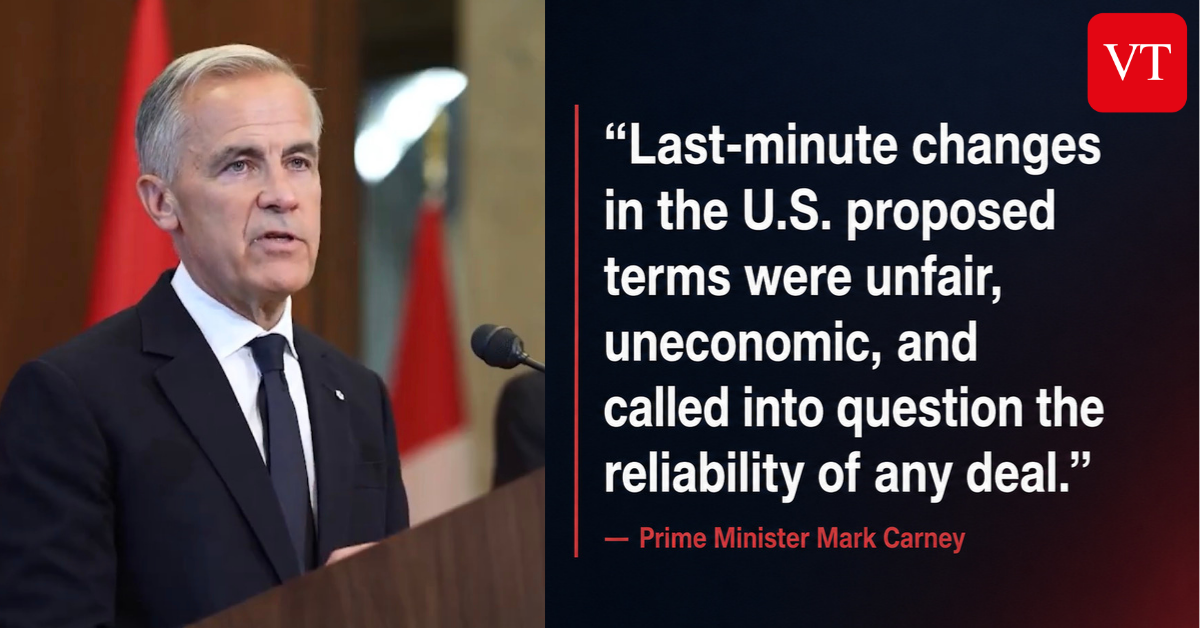
Prime Minister Mark Carney ended the talks Friday and ordered Canadian negotiators back to Ottawa. In a Prime Minister’s Office statement, he called last-minute changes to the U.S. terms unfair and uneconomic.
The U.S. tariffs took effect Aug. 22 on $27.6 billion in Canadian goods, according to Tuesday’s release. Carney had previously described the affected trade as roughly $28 billion.
The Office of the U.S. Trade Representative offered a competing account, accusing Canada of introducing new demands and reversing earlier commitments. Washington had offered tariff reductions on steel, aluminum, automobiles and lumber, the office said.
The supplied material does not include the proposed agreement or identify the specific terms that either government says changed.
President Donald Trump said Monday that tariffs on all cars, trucks, automotive parts and steel would rise to 50% on Jan. 1, 2027. His Truth Social post focused on Canada but did not clearly state whether the planned increase would apply only to Canadian imports.
Ottawa said it will continue reviewing its support programs and could extend existing measures to newly affected sectors.