

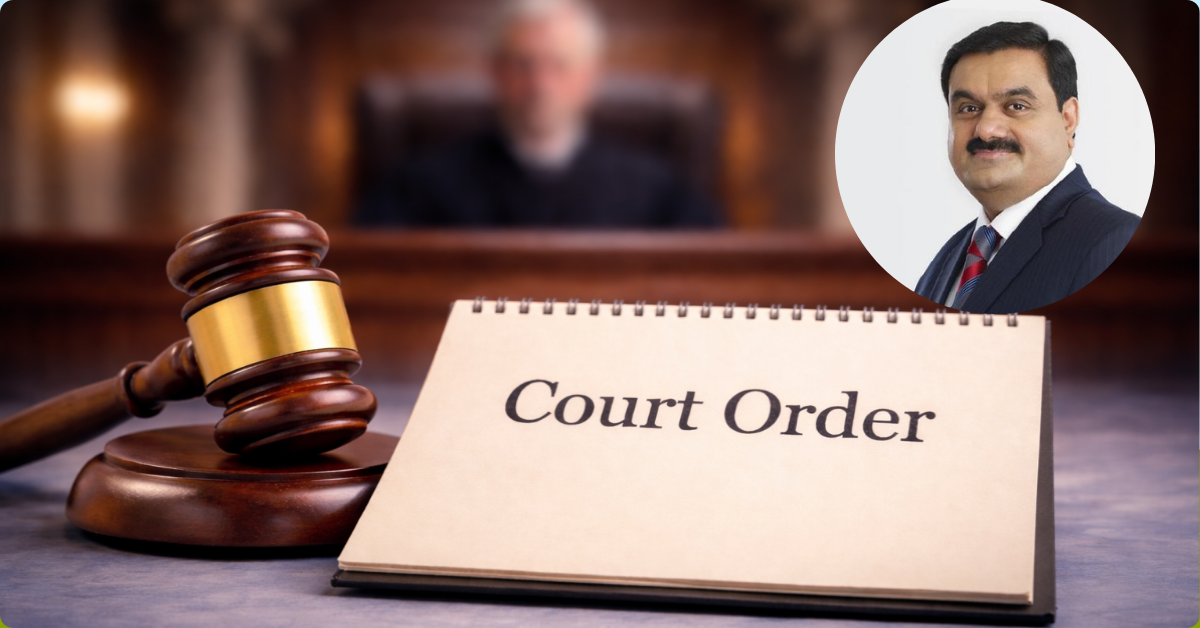
A U.S. federal judge dismissed three fraud counts with prejudice Monday against Indian billionaire Gautam Adani and two co-defendants while reserving judgment on two counts involving other defendants.
U.S. District Judge Nicholas G. Garaufis of the U.S. District Court for the Eastern District of New York granted part of the Justice Department’s dismissal motion in a 47-page order dated Aug. 10.
Garaufis dismissed Count Two, securities fraud conspiracy; Count Three, wire fraud conspiracy; and Count Four, securities fraud. The indictment alleged those counts against Gautam Adani, Sagar Adani and Vneet S. Jaain.
The judge said the dismissal did not signal approval of the Justice Department’s decision or a judgment on the merits of the case.
Gautam Adani said he welcomed the court’s decision “with humility and deep respect for the judicial process.”
In a post on X, Adani wrote, “I welcome the US court’s decision with humility and deep respect for the judicial process. Throughout this challenging period, our faith in truth, fairness and the rule of law remained unwavering. My deepest gratitude to those who never lost faith in us, in the system and in India’s capacity for justice. We will continue doing what matters: building for our nation, creating value that outlasts us and serving a purpose larger than ourselves. That is our commitment. Jai Hind.”
Court Accepts Legal Risk From Puffery Argument
Principal Associate Deputy Attorney General R. Trent McCotter filed a one-paragraph motion May 18 asking Garaufis to dismiss the five-count indictment with prejudice against all eight defendants.
The motion said only that the Justice Department had reviewed the case and decided not to devote more resources to the prosecution. Garaufis ordered the department on June 26 to provide its reasons and supporting facts.
On July 4, McCotter submitted an unsworn letter outlining six reasons for dismissing the entire case, along with separate arguments for individual counts.
The order said Robert J. Giuffra, Gautam Adani’s lawyer, and his team submitted about 600 pages of legal arguments, expert reports and presentation materials to the Justice Department between Feb. 3 and April 17. McCotter said he spent well over 100 hours reviewing and debating the materials.
Garaufis found that one charge-specific argument provided enough factual and legal support to dismiss Counts Two, Three and Four. McCotter argued that the financial statements cited in the indictment could amount to “non-actionable puffery” rather than material misrepresentations.
According to the indictment, financing documents contained allegedly false or misleading assurances about Adani Green Energy’s anti-bribery policies, internal compliance measures, corporate governance and “zero tolerance” for bribery and corruption.
Garaufis said those statements could be viewed as broad expressions about integrity, legal compliance and corporate responsibility rather than specific representations on which investors would reasonably rely. He concluded that the possibility created a substantial legal risk for the prosecution.
The judge found insufficient support for McCotter’s separate argument that the transactions fell outside the geographic reach of U.S. securities laws. The indictment alleged that investors committed themselves to the transactions in the United States and that the defendants used the U.S. financial system.
Garaufis did not rule on McCotter’s argument concerning sophisticated investors after finding the puffery argument sufficient. Because Adani, Sagar Adani and Jaain consented to dismissal and the record raised no concern about prosecutorial harassment, the judge dismissed the three counts with prejudice.
Judge Finds Six Broad Grounds Unsupported
McCotter called the prosecution a foreign case and said Indian authorities had found no actionable conduct and investors had lost no money. He also questioned the indictment’s timing, cited proof problems and said the defendants probably would never appear.
Garaufis found that none of those six broad grounds satisfied Rule 48(a)’s procedural requirements.
On McCotter’s claim that the prosecution was a foreign case, the judge noted that “India” appeared 226 times in the indictment but that “United States” appeared 108 times and “U.S. Issuer” appeared another 110 times. The order also cited alleged conduct in the United States, including statements made to federal investigators in New York.
Garaufis found that three Indian decisions McCotter submitted did not establish that Indian authorities had investigated the indictment’s allegations and found no actionable misconduct. The judge said the documents reflected decisions not to investigate separate complaints brought by private individuals.
McCotter’s assertion that investors had not lost money lacked supporting evidence, Garaufis found. The judge also said financial loss did not address the FCPA and obstruction allegations in Counts One and Five.
McCotter alleged that officials in the previous administration may have unsealed the indictment as a “name and shame” action intended to burden the incoming administration. Garaufis said McCotter provided no evidence of a political motive and called the assertion “unbecoming of his office.”
The court also found that McCotter’s claim of extraordinary proof problems was speculative. His assertion that the defendants probably would never appear lacked information about their whereabouts or prospects for a future court appearance, the judge wrote.
$10 Billion Pledge Did Not Drive Decision
Gautam Adani announced on Nov. 13, 2024, that the Adani Group planned to invest $10 billion in U.S. energy and infrastructure projects and create up to 15,000 jobs. A grand jury returned a sealed indictment on Oct. 24, and it was unsealed Nov. 20.
In an affidavit ordered by the court, Adani said he knew of no offer or agreement made in exchange for dismissing the charges.
He disclosed that his lawyers had suggested during settlement discussions that his previously announced investment might form part of a resolution if the Justice Department or the Securities and Exchange Commission wanted it.
Adani said he understood that the Justice Department later told his lawyers it would not consider the potential investment when deciding whether to dismiss the indictment.
Giuffra said he raised the investment possibility twice during discussions with the Justice Department. The order noted that Giuffra also serves as a personal attorney to President Donald Trump.
U.S. Attorney Joseph Nocella Jr. wrote in a May 11 email that his office categorically rejected any proposal to resolve the criminal charges partly through an investment commitment.
Nocella later told the court under oath that McCotter, his direct supervisor, made the dismissal decision. Nocella said he did not help draft McCotter’s July 4 letter and had no basis to believe McCotter’s stated reasons were not the real grounds for seeking dismissal.
Garaufis ultimately found that Adani’s investment proposal was a “non-consideration” and that McCotter’s stated grounds were the actual reasons for the decision.
The judge nevertheless criticized the process. He said McCotter appeared to have replaced the professional opinions of officials from several federal offices with his own judgment.
Garaufis described McCotter’s decision-making, conducted largely with defense lawyers and seemingly without input from the investigators and prosecutors who brought the case, as “highly unusual.” He said McCotter’s failure to meet Rule 48(a)’s procedural requirements showed a lack of respect for the judiciary’s role as a coequal branch.
Two Counts Await Further Submissions
Garaufis reserved judgment on Count One, conspiracy to violate the Foreign Corrupt Practices Act, and Count Five, conspiracy to obstruct justice.
Count One names Ranjit Gupta, Cyril Cabanes, Saurabh Agarwal, Deepak Malhotra and Rupesh Agarwal. Count Five names Cabanes, Saurabh Agarwal, Malhotra and Rupesh Agarwal.
McCotter argued that Count One did not meet the Justice Department’s revised FCPA enforcement priorities. Garaufis found no allegation involving a cartel or transnational criminal organization, supporting McCotter on one factor.
The judge found, however, that other allegations undercut McCotter’s argument. The indictment alleged bribes intended to obtain lucrative contracts, alleged conduct involving energy and power, and alleged concealment, fraud and obstruction resembling the serious misconduct described in the department’s own enforcement memorandum.
Garaufis also noted that the Justice Department took no action by the executive order’s Aug. 9, 2025, deadline for reviewing existing FCPA cases.
For Count Five, McCotter focused on the defendants’ decision to hire a law firm to conduct an internal investigation. The indictment also alleged selective disclosures, destruction and concealment of evidence, deletion of electronic materials and false denials to the FBI, Justice Department and SEC in Brooklyn.
Garaufis said McCotter did not provide enough support for dismissal or address the indictment’s main obstruction allegations.
Garaufis ordered the Justice Department to provide each reason and sufficient factual support for dismissing Counts One and Five by Aug. 31. Lawyers for the five defendants must also place their clients’ consent to dismissal on the court record by that date.
Indictment Alleged Three Schemes
A federal grand jury returned the sealed indictment Oct. 24, 2024, against eight non-U.S. citizens who were current or former executives and employees of companies connected to India, the United States and Canada.
The indictment alleged three schemes between 2020 and 2024: an agreement to pay approximately $265 million in bribes to Indian government officials for solar energy contracts, efforts to conceal the alleged payments while securing nearly $4 billion in financing, and attempts to obstruct investigations by U.S. authorities.
The allegations have not been proven in court, and Garaufis said the dismissal did not reflect any judgment on their merits.
The order said arrest warrants issued for all eight defendants remained outstanding at the time of the ruling. Gautam Adani, Sagar Adani and Jaain appeared through lawyers in June.
In a related civil case, Gautam and Sagar Adani agreed to proposed final judgments without admitting or denying the SEC’s allegations. The terms call for $18 million in combined civil penalties and injunctions against certain future securities-law violations. The court had not approved the proposed judgments when Garaufis issued his Aug. 10 ruling.