
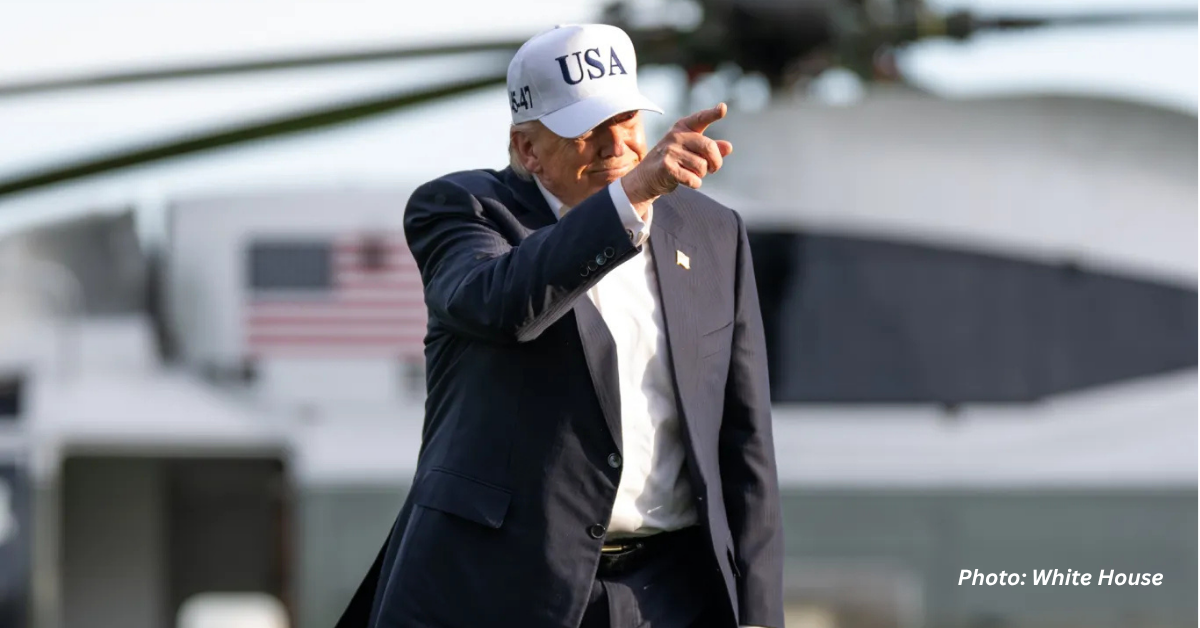
President Donald Trump said Monday that the United States would be reimbursed at a 20% rate on cargo shipped through the Strait of Hormuz in return for providing security.
Trump announced the plan in a post on Truth Social.
The Hormuz Strait is OPEN, and will remain OPEN, with or without Iran. — President Donald Trump
Trump said the United States was reinstating what he called “THE IRANIAN BLOCKADE.” He described it as stopping Iran’s ships or customers from entering or leaving while allowing other countries fair and open access.
The president said the United States would become “THE GUARDIAN OF THE HORMUZ STRAIT.” It would be reimbursed “at the rate of 20% on all cargo shipped” for the costs of securing the waterway, he said.
Trump said the process and formation would begin immediately. His post did not explain who would pay, what the 20% rate would apply to or how the United States would collect the reimbursement.
Competing Claims Over the Strait
U.S. Central Command said Sunday that the Strait of Hormuz was open to lawful shipping and that traffic was flowing.
An accompanying CENTCOM graphic said more than 140 ships had crossed the strait during the previous seven days. U.S. forces were positioned to preserve freedom of navigation, the command said.
Iran’s Revolutionary Guard navy said Sunday that it had closed the strait until further notice after striking an unidentified vessel it accused of using an unauthorized route, Reuters reported.
Iran said the closure would remain until U.S. interference in the region ended. The U.S. and Iranian statements offered conflicting accounts of the waterway’s status.
U.S. Strikes Follow Shipping Attacks
CENTCOM said it completed another wave of strikes against dozens of Iranian targets at multiple locations July 12.
The targets included Iranian air-defense systems, coastal radar sites, missile and drone capabilities and small boats, the command said. Fighter aircraft, naval vessels and one-way attack aerial drones carried out the strikes.
CENTCOM also said it used one-way attack sea drones for the first time.
The operation was intended to reduce Iran’s ability to attack international shipping through the strait, the command said. It did not report casualties or provide damage assessments.
CENTCOM previously accused Revolutionary Guard forces of attacking M/V GFS Galaxy, a Cyprus-flagged container ship traveling through the strait. One civilian crew member was missing, the command said, and an onboard fire and significant engine room damage left the vessel unable to continue.
Payment Details Remain Unclear
Senior U.S. officials previously said Washington wanted Iran to stop attacking ships and open all transit lanes without tolls.
Trump’s announcement did not explain whether the proposed reimbursement would operate separately from tolls or how it fit with that earlier position.
Reuters reported that Iranian Foreign Minister Abbas Araqchi and Omani Foreign Minister Sayyid Badr Albusaidi discussed possible mechanisms for ships to pass safely through the Strait of Hormuz.
The report said Oman’s state news agency later announced that Omani and Iranian negotiators would continue talks at the technical and political levels.
Reuters also reported that about one-fifth of the world’s oil supply passed through the strait before the war. The outlet said Iran’s effective blockade had driven up energy prices and fueled global inflation.
This is a developing story. Virginia Times will update as information becomes available.

A global media for the latest news, entertainment, music fashion, and more.