











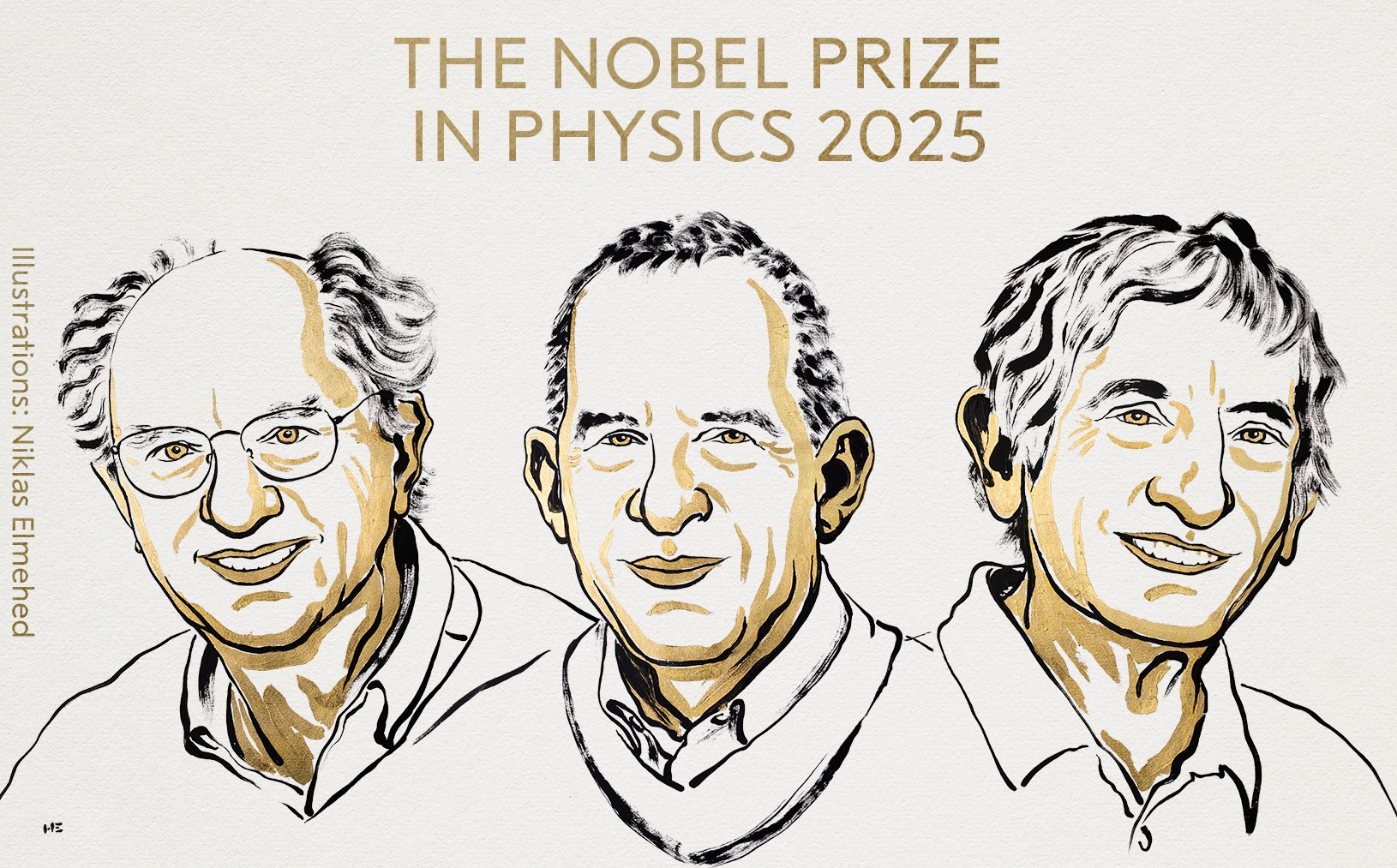
John Clarke, Michel H. Devoret, and John M. Martinis won the 2025 Nobel Prize in Physics on Tuesday, October 7, 2025, for showing that quantum mechanical tunneling and energy quantization can happen in an electrical circuit that is big enough to hold in your hand. On Tuesday, the Royal Swedish Academy of Sciences announced in a press release.
The laureates’ chip-scale experiments, carried out in the mid-1980s, used superconducting circuits separated by thin insulating barriers—Josephson junctions—to reveal a system that behaves like a single “macroscopic particle.” In that setup, the circuit tunneled out of a zero-voltage state and absorbed or emitted only discrete amounts of energy, as reported by the Royal Swedish Academy of Sciences press release.
Clarke is at the University of California, Berkeley; Devoret is affiliated with Yale University and the University of California, Santa Barbara; and Martinis is at the University of California, Santa Barbara, according to the Royal Swedish Academy of Sciences press release.
“This is wonderful to be able to celebrate—the way that century-old quantum mechanics continually offers new surprises,” said Olle Eriksson, chair of the Nobel Committee for Physics, as quoted by the Royal Swedish Academy of Sciences press release.
In an interview shortly after the prize announcement, new physics laureate John Clarke said he is “still stunned” by the Nobel news and praised co-laureates John Martinis and Michel Devoret, recalling years of joint work in Berkeley that led to their breakthrough.
“It took us a long time to get all of this worked out. None of this work would have happened without the two of them.” — John Clarke, as quoted by the Nobel Prize on X.
The committee noted that the study supports today’s push for quantum technology, which includes quantum cryptography, quantum computers, and improved sensors. They also reminded people that modern digital electronics are already based on quantum principles.