











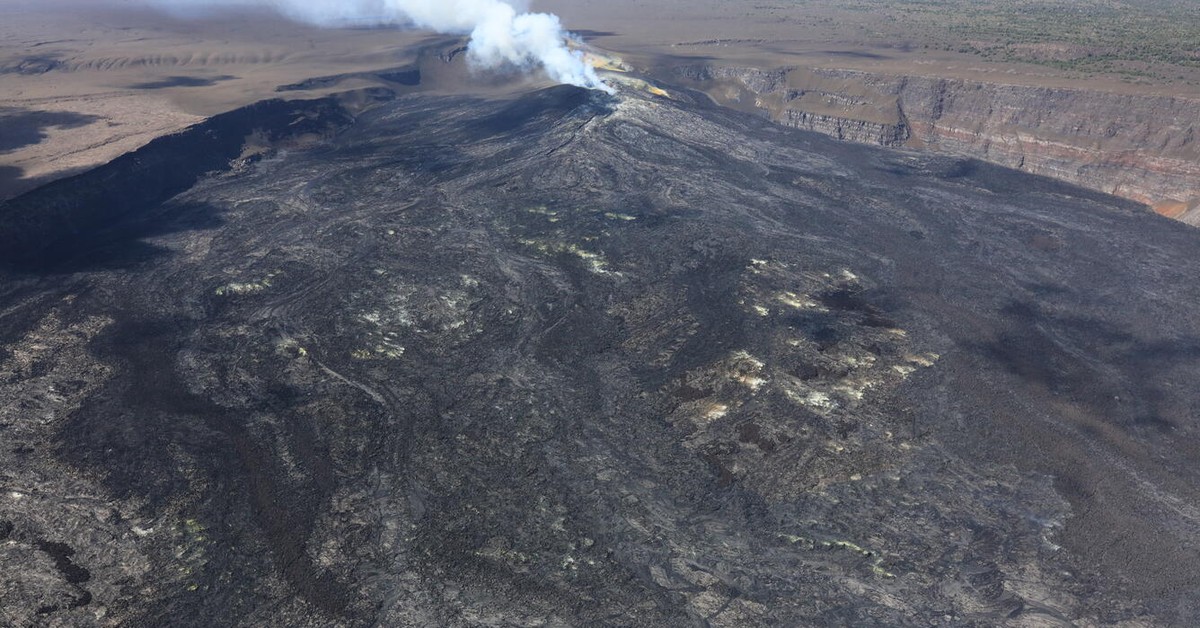
HAWAII VOLCANOES NATIONAL PARK, Hawaii — The U.S. Geological Survey raised the alert level for Kilauea to Watch on Sunday after low-level lava overflows began at the volcano’s summit, a sign that a new fountaining episode could start within days.
The Hawaiian Volcano Observatory said the precursory activity for episode 57 of the ongoing Halemaumau eruption began around 1:21 a.m. Hawaii time on Sunday, with overflows from the north vent. Two more overflows followed. The last one ended at 3:03 a.m., and each lasted about 15 to 20 minutes.
Between overflows, both the north and southwest vents kept glowing strongly, with frequent spatter and flames visible. The observatory expects the intermittent overflows to continue until the fountains of episode 57 begin.
That forecast window runs from Sunday through Thursday, Nov. 26. The observatory said the low-level activity can go on for hours, or for days, before the fountaining starts, and it will publish another notice when that happens.
Along with the ground alert, the aviation color code went up from Yellow to Orange. Winds at ground level were blowing from the north northeast at 10 to 15 mph, carrying the volcanic gas plume toward the south southwest. No tephra was being produced at the time of the notice.
All of the vents and lava flows remain inside Halemaumau crater, within Hawaii Volcanoes National Park. Most fountaining episodes since the eruption began on Dec. 23, 2024, have lasted a day or less, the observatory said.
The gases are the wider concern. Water vapor, carbon dioxide and sulfur dioxide come out of the volcano throughout an eruption, and the sulfur dioxide can form the haze known as vog downwind, which can cause respiratory problems.
Tephra is the other hazard once fountaining begins. The small glassy fragments — ash, pumice, Pele’s hair and reticulite — fall heaviest within about three miles of the vents, though lighter material can travel much farther and can irritate skin, eyes and lungs.
The observatory also warned that the ground around the caldera rim stays dangerous. The crater walls can crack and slump, and the rim area around Halemaumau has been closed to the public since late 2007.
For now, the volcano is being watched around the clock. Three summit livestreams show the crater, and the observatory said it will issue further notices as the activity changes.