

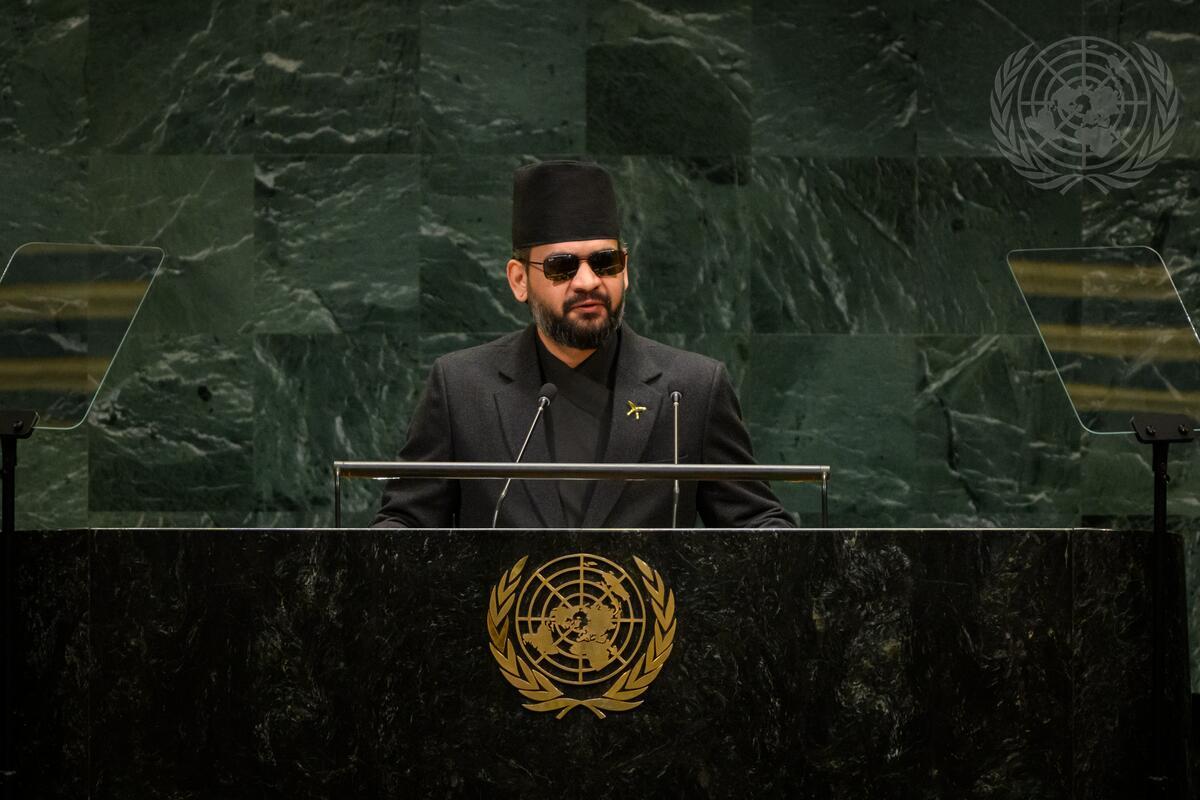
Nepal’s Prime Minister Balendra Shah proposed a climate resilience mechanism led by Nepal, India and China at the United Nations on Sept. 24, calling last month’s Himalayan floods “a warning to the world.”
The proposed Himalayan Climate Resilience Mechanism would help countries share satellite data and expertise, monitor dangerous glacial lakes, strengthen joint early warning systems and coordinate disaster assistance across borders.
Addressing the General Assembly’s 81st session, Shah said the floods devastated communities on both sides of the Nepal-China border and continued downstream into India. Homes, roads, bridges, schools and livelihoods were swept away, he said.
“Climate change does not recognize borders,” Shah said.
“Climate change does not recognize borders.”
Nepal now faced a major recovery and reconstruction effort, he told delegates. He thanked India and China for their prompt assistance, along with other countries, the United Nations, humanitarian agencies and private donors.
Invoking Nepal’s reconstruction after the 2015 Gorkha earthquake, Shah appealed for continued international support.
Nepal contributes less than 0.1% of global greenhouse gas emissions, Shah said, while facing retreating glaciers, unstable mountain slopes and increasingly unpredictable rivers.
“We did not create this crisis. Yet we are paying a colossal price for it,” he said.
Shah described climate disasters as a development emergency as well as a humanitarian crisis. They destroyed infrastructure and livelihoods, erased years of progress and forced poorer countries to borrow money to repair damage they had not caused, he said.
Political leaders had been negligent in translating climate warnings into action at the speed and scale vulnerable communities needed, Shah told the assembly.
Citing the U.N. Framework Convention on Climate Change and its principle of common but differentiated responsibilities, he urged countries with greater historical responsibility for emissions and greater capacity to respond to do more.
Climate justice, he argued, must address both who bears the costs and who has a voice in decisions.
Shah called for adequate grant funding, saying large loans and scattered small grants could not meet the needs of poorer countries recovering from disasters. He described the Loss and Damage Fund, the Global Environment Facility and other financing mechanisms as inadequate.
He also criticized bureaucracy in climate finance, arguing that vulnerable countries should not have to wait years for assistance.
Shah pointed to Nepal’s forest restoration, hydropower expansion, electric vehicle adoption and local adaptation efforts as examples of its own contribution. But the country could not build resilience alone, he said.
The address also called for a fairer international economic system. Shah described shortages of fertilizer, bitumen for roads and cooking gas in Nepal, contrasting those difficulties with the movement of weapons across borders.
“We have built a world with flawless logistics for war and broken logistics for food,” he said.
Shah argued that smaller, poorer countries needed a stronger voice in international decisions. At home, he linked his government’s priorities to young Nepalis’ demands for integrity, accountability and opportunity, pledging decent jobs and social protection.
He urged governments to move toward lasting preparedness through stronger infrastructure, insurance, innovation and early warning systems, while reducing dependence on fossil fuels.
Shah said Nepal would help lead further climate discussions at the Sagarmatha to Seaside event at the United Nations on Sept. 25.

A global media for the latest news, entertainment, music fashion, and more.