
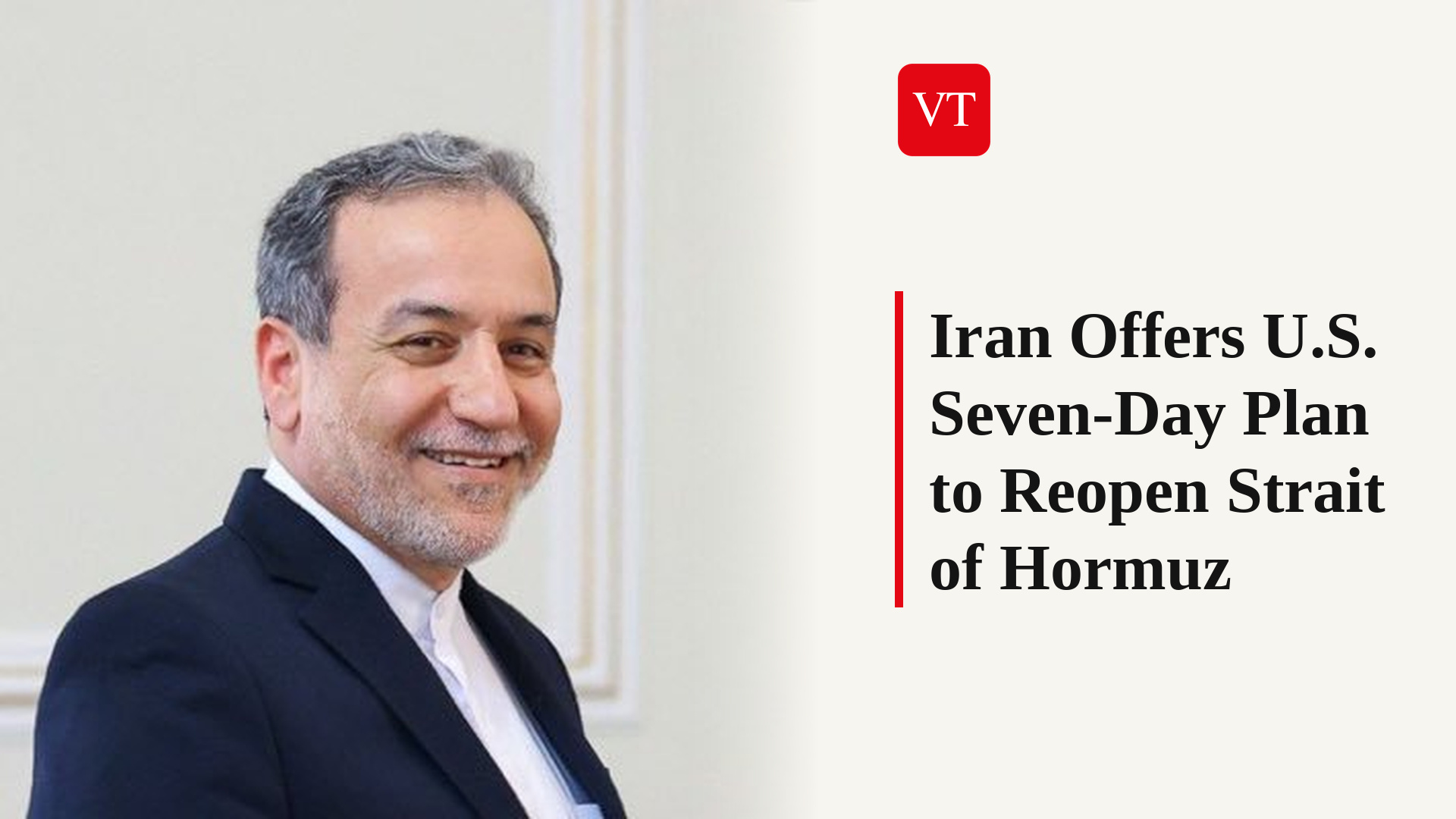
Iran has sent the United States a seven-day plan that would halt fighting, reopen the Strait of Hormuz and restart talks on a final deal if Washington meets its conditions, Foreign Minister Abbas Araghchi said.
Araghchi told reporters Thursday, Sept. 24, at the United Nations General Assembly in New York that Qatar had passed the proposal to Washington. The timetable could begin the day after the U.S. accepts it, he said.
He gave a more detailed schedule on Friday. According to Business Standard, Araghchi said the required U.S. steps could be finished in four or five days, with the strait reopening on the sixth day and talks resuming on the seventh.
“The choice now rests with the United States.”
Under the proposal, as reported by The New York Times and cited by The Hill, hostilities in Iran and Lebanon would end during the seven days. Washington would release billions of dollars in frozen Iranian assets, waive oil sanctions and lift its naval blockade.
Comprehensive negotiations over Iran’s nuclear program would follow immediately. Araghchi did not publicly detail the conditions, Al Jazeera reported, though its correspondent Gabriel Elizondo described the same sequence.
The White House said Friday that U.S. officials were having positive and constructive conversations with mediators, according to PBS NewsHour. A U.S. official separately told the Times that the administration was holding constructive talks but would not rush into an agreement.
The Wall Street Journal reported that Trump had rejected an Iranian ceasefire proposal and expected to renew strikes after the midterm elections, The Times of Israel noted. It is unclear whether that report refers to the seven-day plan, and it has not been independently verified.
Araghchi met U.S. envoy Steve Witkoff and Jared Kushner, Trump’s son-in-law, on Tuesday in talks mediated by Qatar. Secretary of State Marco Rubio said it would be wrong to call the meeting a major breakthrough, according to Al Jazeera.
The two sides also differ on sequencing. The U.S. wants Iran’s nuclear program discussed immediately, while Iran has said it will not address the issue until the blockade is lifted and sanctions are repealed, Al Jazeera reported.
Araghchi said it “would be better” to reach a deal before the November midterm elections.
In his General Assembly address Tuesday, Trump said Iran was “waiting to see how I do in the midterm election” and predicted a deal would come after the vote. He also threatened to “annihilate the Islamic Republic” if no agreement was reached.
Iranian President Masoud Pezeshkian pushed back Thursday. “We don’t want it to get to the midterm elections,” he told reporters, according to NBC News.
In his own U.N. speech Wednesday, Pezeshkian said, “We will never bow our head or bend at the knee.” He indicated that Iran remained willing to negotiate, provided it was not forced to do so under threat.
Araghchi said the new plan closely tracks the 14-point memorandum of understanding that Trump and Pezeshkian signed remotely June 17. That agreement gave the two sides up to 60 days, extendable by mutual consent, to reach a final deal.
The memorandum called for an end to military operations on all fronts, including Lebanon. It also provided U.S. waivers for Iranian oil exports and measures to restore shipping through the strait. Fighting resumed July 8, and the agreement expired in mid-August.
The war began Feb. 28, and Iran blocked the strait soon afterward. Before the conflict, about 20% of the world’s oil passed through the waterway, NBC News reported. The U.S. imposed its naval blockade of Iranian ports in April.
Brent crude averaged $91 a barrel in August, $7 higher than in July, as Middle East exports remained constrained, the U.S. Energy Information Administration reported.
World food prices also rose in August. The U.N. Food and Agriculture Organization cited the Middle East conflict as one factor, along with adverse weather and disruptions to Black Sea trade.
Trump has reportedly been frustrated by the lack of a way out of the war. A Sept. 10 Quinnipiac University poll found 65% of voters disapproved of his handling of Iran, while 29% approved. NBC News polling showed a similar 69% to 31% split.
Early Saturday, Trump posted an image on Truth Social labeling the waterway “Trump Strait.” ABC News called it his first public signal since Iran made its proposal, and the White House had not elaborated on the post.
Editor’s Note: AI assisted with research, organization and initial drafting. Virginia Times verified the information and is responsible for the final story.

A global media for the latest news, entertainment, music fashion, and more.