











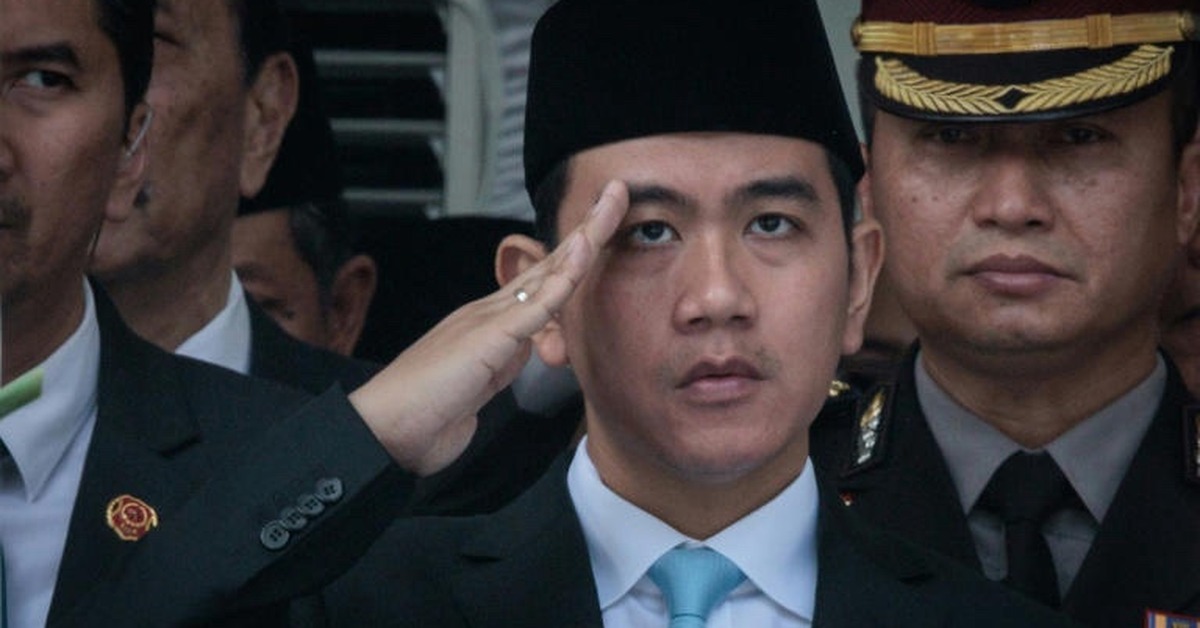
Indonesia’s vice president, Gibran Rakabuming Raka, resigned Thursday, undone by a scandal over his high school diploma, according to AFP. The departure adds to pressure on a government facing widespread dissatisfaction over the economy, graft and wildfires.
There had been repeated calls for Gibran, 39, to step down after the Supreme Court ruled last month to annul his high school qualification, obtained abroad.
On Thursday, he submitted his resignation to President Prabowo Subianto and to parliament.
Prabowo told reporters he had accepted the resignation “with a heavy heart.” He praised Gibran for acting:
“for a greater cause, for the interests of the nation, the state, and the people of Indonesia”
“He certainly feels that he has pursued his education through an orderly process, but we all understand that the education system abroad is different from the education system in Indonesia,” the president said.
Indonesia’s vice president has few constitutionally defined powers. Apart from representing the president at official events, the holder takes over if the president is incapacitated.
Political realignment
Gibran’s fall followed weeks of street protests. Thousands of Indonesians demonstrated against economic hardship and graft, and against perceived authoritarianism and the government’s handling of months of wildfires that have sent toxic haze across the country.
His exit is likely to complicate a loose governing alliance. It includes the parties of Prabowo and of his predecessor, Joko Widodo, who is Gibran’s father and is known as Jokowi.
The resignation “marks a significant political realignment, but does not necessarily threaten government stability”, said Khairul Fahmi, executive director of the Institute for Security and Strategic Studies, a think tank known as ISESS.
“Jokowi will retain political influence, but Gibran’s departure could reduce his network’s direct access to power. For Prabowo, this creates greater room to consolidate his leadership and pursue his own political agenda,” Khairul told AFP.
Two years into his term, Prabowo’s popularity has reached record lows.
Last week, Indonesian authorities arrested the former national police chief and three senior police officials for allegedly tapping the president’s telephone. On Thursday, police said they were investigating possible treason.
Prabowo’s rise to power was widely credited to support from the popular Jokowi, who served two terms from 2014 to 2024.
Picking Gibran as his running mate strengthened ties between Prabowo’s Gerindra party and figures aligned to Jokowi. Until then, Jokowi had been a political rival who defeated Prabowo twice in presidential elections.
Under the alliance, Gibran and other Jokowi allies were appointed to key posts in Prabowo’s government. Prabowo is seen as close to the military, while the police have traditionally been loyal to Jokowi.
Youngest-ever vice president
Gibran became the youngest person ever to hold Indonesia’s vice presidency when he took office in 2024.
Two years into his term, detractors went to court to challenge his high school certificate, a prerequisite for the job.
Gibran had completed his schooling in Singapore. He went on to study for a marketing degree there.
When he submitted his candidacy to the General Elections Commission, known as the KPU, in 2024, he filed a certificate saying his overseas education was equivalent to a vocational high school in Indonesia.
The Supreme Court ruled last month to invalidate that document. The ruling prompted moves in parliament to unseat him.
Gibran has consistently defended his credentials.
“If I didn’t graduate from high school, then I obviously wouldn’t have been able to go to college. I studied up to a bachelor’s degree in Singapore,” he has said.
Prabowo now has 14 days to submit two names. Parliament will then have two months to pick Gibran’s replacement.
Arya Fernandes, a researcher at Indonesia’s Centre for Strategic and International Studies, known as CSIS, told AFP Prabowo will likely seek “a candidate who is acceptable to all coalition members to avoid triggering divisions within the coalition” that includes Jokowi’s party.
“The vice-presidential candidate nominated by Prabowo could potentially become his running mate in 2029, or emerge as a political competitor. He will therefore carefully weigh the pros and cons of each potential nominee,” he said.