

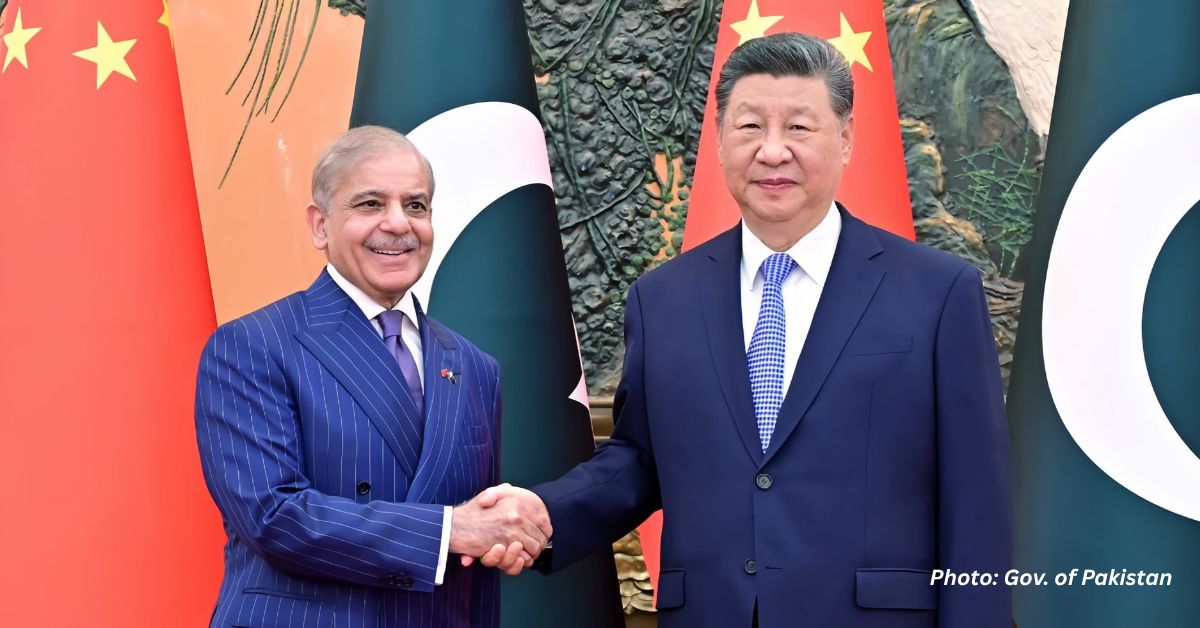
China and Pakistan pledged Tuesday to deepen cooperation across defense, trade, infrastructure and space, as Pakistani Prime Minister Muhammad Shehbaz Sharif wrapped up a four-day visit to China marking 75 years of diplomatic relations between the two countries.
India pushed back the same day, rejecting portions of the joint statement outright. The Indian Ministry of External Affairs said New Delhi “categorically rejects unwarranted references” to the Union Territory of Jammu and Kashmir, calling it an “integral and inalienable” part of India and saying no other country has standing to comment on it.
The joint statement, released by China’s State Council Information Office, said President Xi Jinping met with Sharif during the visit, while Premier Li Qiang held formal talks with him. Both governments committed to accelerating work under a bilateral action plan running through 2029 and said their partnership had taken on greater strategic importance.
The statement said China reiterated that Jammu and Kashmir is a dispute “left over from history” that should be resolved through the U.N. Charter, relevant Security Council resolutions and bilateral agreements. India said its position on the matter is consistent and well known to the parties involved.
New Delhi also objected to references to the China-Pakistan Economic Corridor, parts of which pass through territory India claims as its own. The ministry said India “resolutely opposes and rejects any moves by other countries to reinforce or legitimize Pakistan’s illegal and forcible occupation of these territories” and said that objection has been conveyed to both governments multiple times.
India further challenged joint statement language on “trans-boundary water resources cooperation” between China and Pakistan, saying the two countries share no common boundary. New Delhi added that it has never recognized the 1963 boundary agreement between Pakistan and China.
On infrastructure, China and Pakistan agreed to advance an upgraded version of the economic corridor, move forward with the Karakoram Highway realignment between Thakot and Raikot in phases, and develop Gwadar Port as a regional connectivity hub.
The two governments said they would pursue cooperation in artificial intelligence, digital infrastructure, mining and agriculture. On space, the statement said China welcomed two Pakistani astronauts for training and expressed hope that a Pakistani astronaut would be among the first foreign nationals to enter the China Space Station, though no timeline was given.
Both sides also said they would work to establish a China-Pakistan Security Partnership and strengthen counterterrorism cooperation. The statement specifically named the Tehreek-e-Taliban Pakistan and the Eastern Turkistan Islamic Movement as groups that must not be allowed to use Afghan territory to threaten regional security.
Pakistan reaffirmed its commitment to the one-China principle, stating that Taiwan is “an inalienable part” of Chinese territory. China said it would continue to back Pakistan’s sovereignty and territorial integrity.
On the Middle East, the statement said China credited Pakistan with helping facilitate a temporary ceasefire between the United States and Iran and with hosting the Islamabad Talks.
Sharif’s visit ran from May 23 to May 26 and included a trip to Hangzhou in Zhejiang Province and ceremonies marking the 75th anniversary of diplomatic relations between China and Pakistan.