

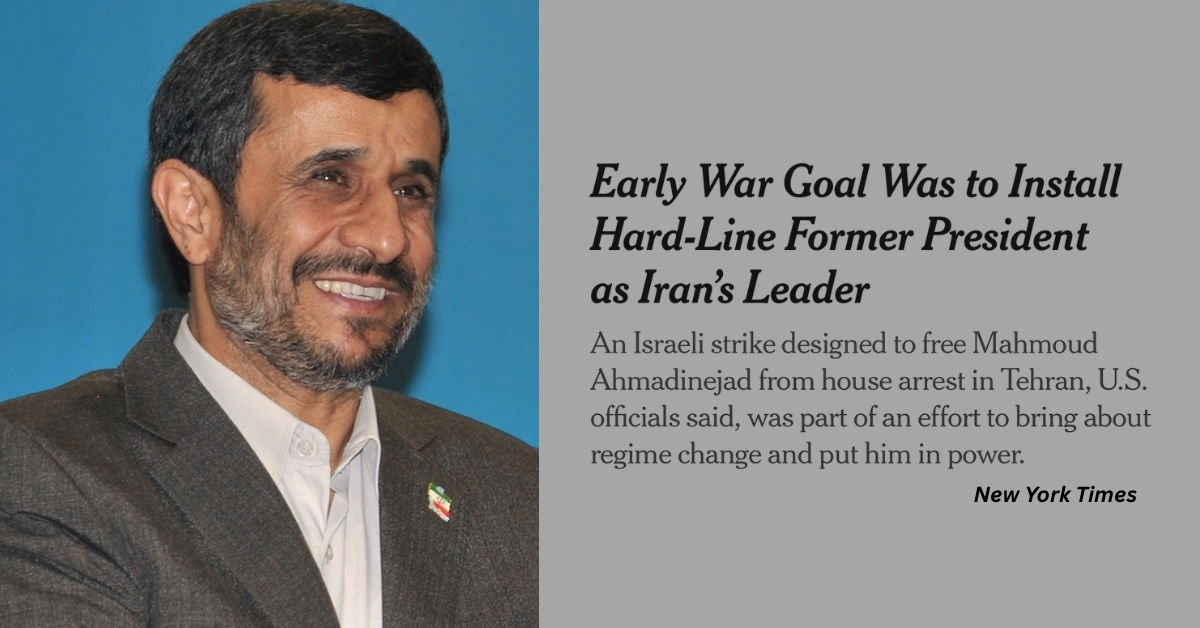
The United States and Israel considered former Iranian President Mahmoud Ahmadinejad as a possible figure in a new Iranian government during the Iran war, according to The New York Times, which reported that the plan unraveled on the first day of the conflict.
The plan was developed by Israel, and Ahmadinejad had been consulted about it, the Times reported, citing U.S. officials briefed on the effort.
On the opening day of the war, the Israeli Air Force struck a security post outside Ahmadinejad’s home in the Narmak section of eastern Tehran, according to the report. American officials told the Times the strike was meant to kill Revolutionary Guard members watching him and free him from house arrest.
Ahmadinejad survived but was injured, the report said. An associate told the Times that Ahmadinejad became disillusioned with the plan after the near miss. He has not been seen publicly since, and his current whereabouts and condition remain unknown.
Some American officials were skeptical from the start that Ahmadinejad could realistically be returned to power, according to the Times.
The White House did not directly address the Ahmadinejad details in its response to the Times.
“From the outset, President Trump was clear about his goals for Operation Epic Fury: destroy Iran’s ballistic missiles, dismantle their production facilities, sink their navy, and weaken their proxy,” said Anna Kelly, a White House spokeswoman. “The United States military met or exceeded all of its objectives, and now, our negotiators are working to make a deal that would end Iran’s nuclear capabilities for good.”
Mossad, Israel’s foreign intelligence agency, declined to comment, according to the Times.
Ahmadinejad was an unusual figure for such a plan. As president from 2005 to 2013, he was known for hard-line views toward Israel and the United States, support for Iran’s nuclear program, Holocaust denial and a crackdown on internal dissent.
After leaving office, Ahmadinejad increasingly clashed with Iran’s ruling clerics. He accused senior officials of corruption and tried to run again for president in 2017, 2021 and 2024, but Iran’s Guardian Council blocked each campaign, according to the report.
His aides were arrested, and his movements were later restricted to his home, where Revolutionary Guard members watched over him, the Times reported.
How Ahmadinejad was recruited into the plan remains unclear.
An associate told the Times that American officials viewed Ahmadinejad as someone who could manage “Iran’s political, social and military situation.” The associate also said the Americans appeared to see him as similar to Delcy Rodriguez, who assumed power in Venezuela after U.S. forces seized President Nicolás Maduro and later worked with the Trump administration.
The broader Israeli plan envisioned several stages, according to the Times: airstrikes and the killing of senior Iranian leaders, political destabilization backed by Kurdish forces, and the eventual creation of what Israeli planners called an “alternative government.”
The first phase included Israeli strikes that killed Supreme Leader Ayatollah Ali Khamenei and other senior officials at the start of the war, according to the report. But much of the broader plan did not unfold as Israeli planners had hoped.
The Times reported that Iran’s government did not collapse and that the alternative government never materialized.
Mossad chief David Barnea later told associates he still believed the plan could have worked if it had received approval to move forward, according to the report.
Questions about Ahmadinejad’s ties to the West had circulated for years. The Times noted that associates had faced accusations of links to Israeli and British intelligence, and that Ahmadinejad traveled to Guatemala and Hungary between 2023 and 2025.
In a 2019 interview with the Times, Ahmadinejad praised Trump as “a man of action” and argued for better relations between Iran and the United States.
Early Iranian media reports said Ahmadinejad had been killed in the strike on his home. Official news agencies later said he had survived and that his guards had been killed, according to the Times.
Discussion of Ahmadinejad briefly rose on Iranian social media after those reports, then faded into confusion about his whereabouts, according to an analysis by FilterLabs cited by the Times.