

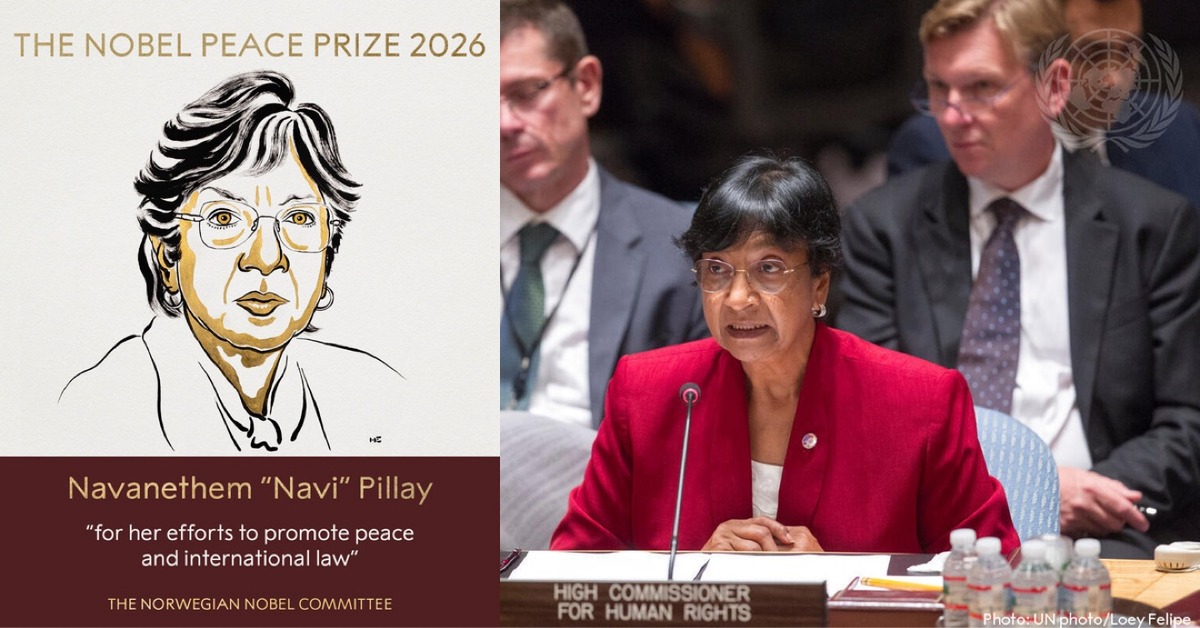
Navanethem “Navi” Pillay, a judge born under apartheid in Durban, South Africa, won the 2026 Nobel Peace Prize on Friday for her part in bringing war crimes, crimes against humanity and genocide to trial.
The Norwegian Nobel Committee cited her efforts for peace and international law. Its announcement credited her with strengthening the institutions behind that law and with holding states and national leaders to account.
Few international jurists command as much respect, the committee said, pointing to her independence, expertise and steadfastness.
Pillay was born into a family of Indian Tamil origin. As a lawyer under apartheid, she ran up against deep discrimination, segregation and exclusion. Among her early clients were Nelson Mandela and others who resisted the system.
From there, she moved to the bench. She sat on South Africa’s High Court, the International Criminal Tribunal for Rwanda and the International Criminal Court.
She was also the U.N. high commissioner for human rights. Until recently, she chaired the UN Independent International Commission of Inquiry on the Occupied Palestinian Territory.
Today she is a judge on the International Court of Justice, in the case in which Myanmar is accused of genocide.
Her time on the Rwanda tribunal drew particular praise. When that court found that rape and sexual violence could amount to a crime against humanity, and to genocide, her influence was a significant factor, according to the committee.
The same case broke new ground a second time. For the first time, a defendant was charged with incitement to commit genocide based only on spreading propaganda. Pillay was instrumental in that step as well, the committee said.
The committee said it wanted the award to remind the world of something. International law is under heavy strain, it warned. Its institutions are under attack, and power politics is crowding out respect for legal frameworks.
“Peace requires justice.”
Judges themselves are now being sanctioned. At such a moment, the committee said, the world needs people of courage, vision and determination, and Pillay shows those qualities on the bench.
The committee did not claim the system works evenly. Major powers have often dodged responsibility, it said. Cases have also ended differently depending on who committed the crimes and who suffered them.
The first peace prize was handed out 125 years ago. Even then, the committee stressed settling conflicts through international law. This year’s choice, it said, comes straight out of Alfred Nobel’s will.
Earlier 2026 Nobel Prizes
Pillay’s award is the fifth Nobel announced this year. The other four are listed on the Nobel Prize’s official website.
In physiology or medicine, Karl Deisseroth, Peter Hegemann and Georg Nagel were honored “for their discoveries concerning light-gated ion channels and optogenetics.” Optogenetics lets researchers switch single nerve cells in a living brain on or off. Labs worldwide now use it to study the brain.
Francis Halzen won in physics. He realized that ice at the South Pole could be used to track neutrinos, and his leadership was central to the IceCube Neutrino Observatory.
That detector is a cubic kilometer of ice fitted with light sensors. It catches neutrinos produced by extremely energetic events far across the universe. Halzen’s prize also recognized the discovery of high-energy neutrinos from cosmic sources.
Henri B. Kagan and Kenso Soai shared the chemistry prize “for the discovery of non-linear effects and autocatalysis in asymmetric organic synthesis.”
Some molecules, amino acids among them, come in two mirror-image versions. Living things contain only one. How that imbalance arose puzzled chemists for a long time, and Kagan and Soai were recognized for solving it.
Canadian author Anne Carson took the literature prize for a bold, inventive body of work that engages the classical tradition to create new kinds of contemporary writing.
Carson has spent her career moving among poetry, translation and university teaching. Words and their origins, she has said, are where all her work begins.