

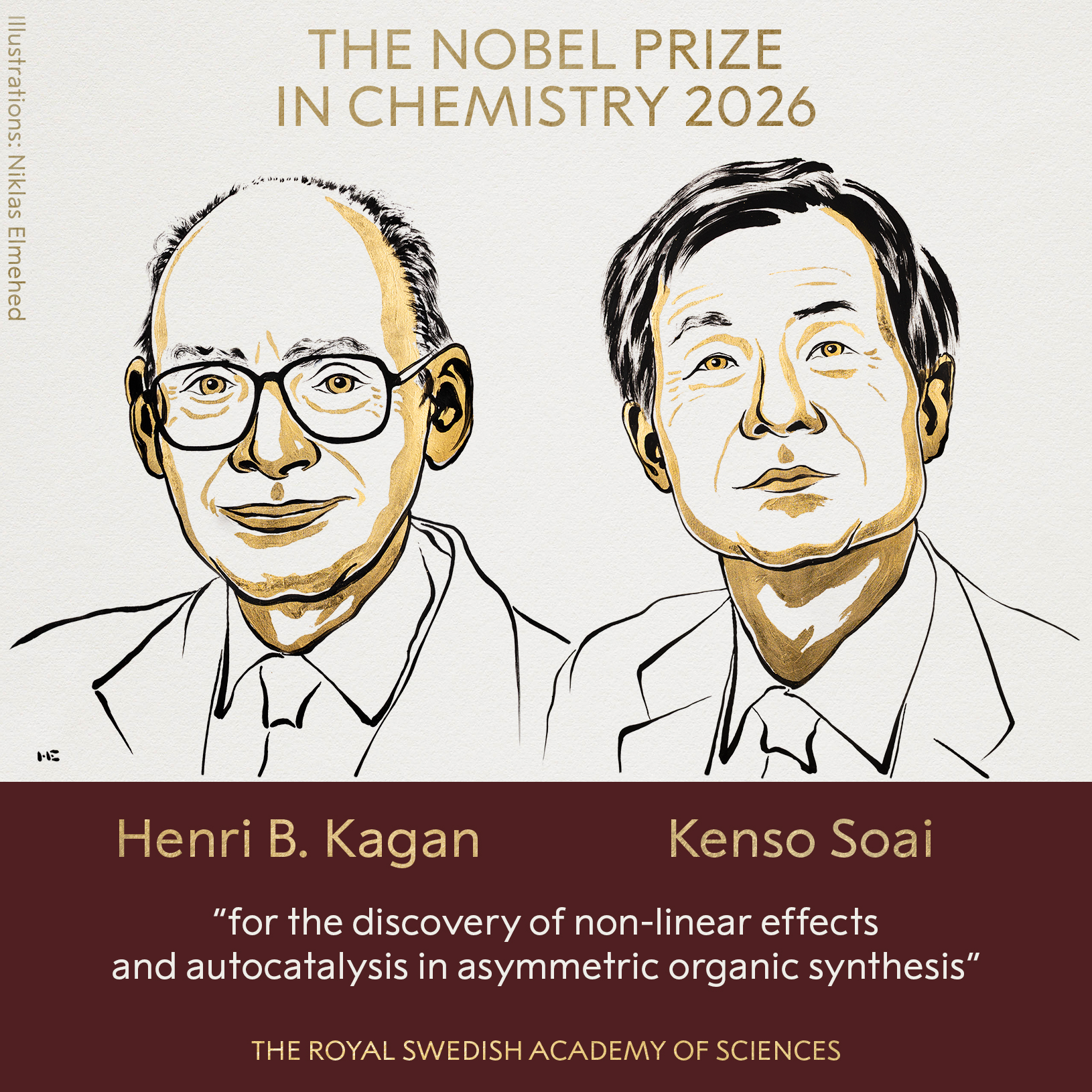
Henri B. Kagan and Kenso Soai won the 2026 Nobel Prize in Chemistry on Wednesday for discoveries that let chemists drive reactions toward producing only one of two mirror-image molecules.
The Royal Swedish Academy of Sciences honored Kagan, of Université Paris-Sud in France, and Soai, of Tokyo University of Science in Japan, “for the discovery of non-linear effects and autocatalysis in asymmetric organic synthesis.”
Their work tackles a long-standing puzzle. Some molecules, including amino acids, come in two forms that mirror each other, the way a left hand mirrors a right. Proteins in living cells use just one form, and the other rarely turns up in nature.
Chemists call this property homochirality, from the Greek words for “same” and “hand.” How it first arose had long baffled the field.
Heiner Linke, chair of the Nobel Committee for Chemistry, credited the pair with solving a mystery more than a century old: how homochirality can emerge spontaneously.
“The chemical reactions they have developed are spectacular.”
For a long time, reactions capable of forming both mirror images gave chemists equal amounts of each. That posed a problem for drug development. In molecules designed to interact with living things, such as pharmaceuticals, only one of the two forms has the desired effect.
Kagan took the first decisive step in 1986 with a new way to manipulate chemical reactions. It allowed him to produce a larger surplus of one mirror image than chemists had believed possible.
Soai built on that work. According to the academy, a key 1995 publication described his design for the first chemical reaction with the potential to be homochiral.
He reached that goal in 2003, presenting a reaction that formed just one of the two possible mirror images. The academy said nothing but life itself had managed that before.
The academy described the discoveries as decisive for chemists who design reactions to manufacture pharmaceuticals.
Peter Somfai, a member of the Nobel Committee for Chemistry, tied the award to the broader aims of basic research in an interview with freelance journalist Sharon Jåma immediately after the announcement.
“In basic research, we want to learn more and more about how molecules behave and how they can interact – this year’s prize fits into that,” Somfai said, according to a post from the Nobel Prize on X.