
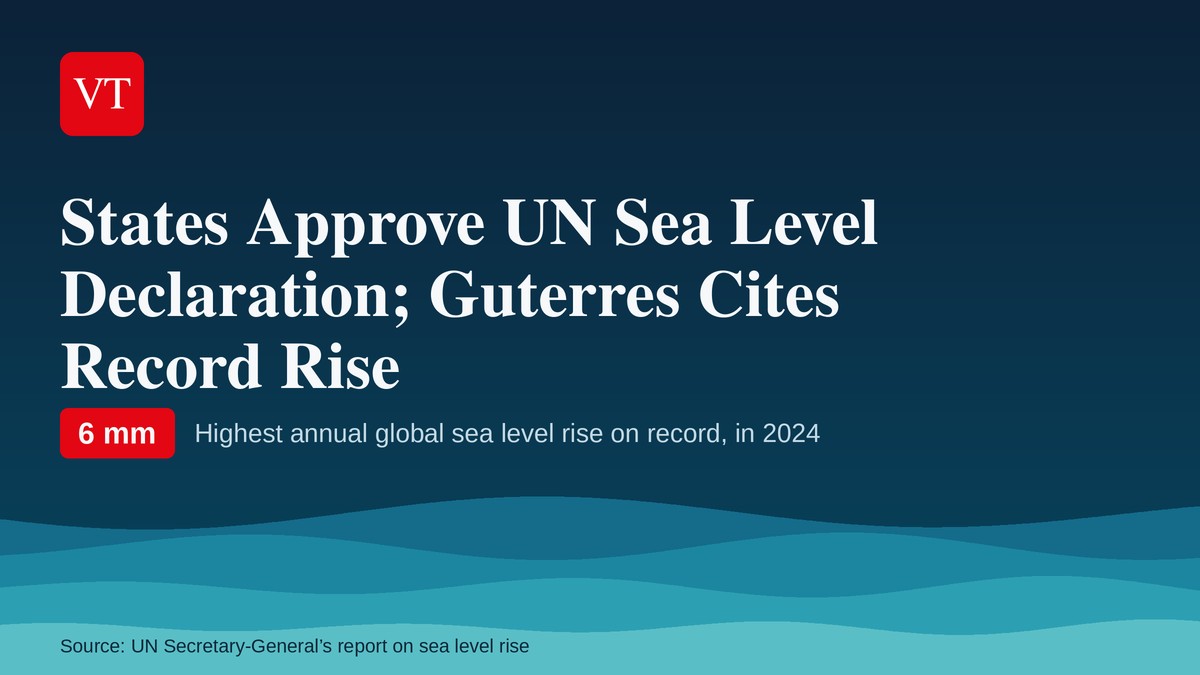
Member states at the United Nations approved a draft declaration on sea level rise during a high-level meeting alongside the General Assembly’s annual debate, aiming to send it to the assembly for formal adoption.
Secretary-General António Guterres opened the meeting with a report showing that the global sea level rose 6 millimeters in 2024. That was the highest annual increase ever recorded.
The draft UN Declaration on Sea Level Rise emphasizes using knowledge and adaptation measures to protect livelihoods and provide legal certainty for those affected. The General Assembly held its first high-level meeting on the issue in 2024, although sea level rise has been on the UN agenda for decades.
“Rising seas are sinking futures.”
Guterres noted that the Intergovernmental Panel on Climate Change projects a rise of half a meter by 2100, even in its “best-case scenario.”
Without significant adaptation and mitigation, Guterres warned, risks to coastal cities and communities could increase tenfold. He called sea level rise a “threat multiplier” and added: “This is climate injustice — those who did least to cause this crisis pay the highest price.”
His report outlines action on three fronts: tackling root causes, protecting people from rising waters and closing legal gaps. Guterres stressed that any overshoot of the 1.5 C warming limit must be as small and short as possible. “The Group of 20 must lead, and COP31 in Türkiye must deliver,” he said.
He commended member states for negotiating the declaration. He also urged them to build on the Agreement on Marine Biological Diversity of Areas beyond National Jurisdiction, which recently reached 100 signatories.
General Assembly President Khalilur Rahman of Bangladesh said sea level rise “does not respect borders.” Countries with the fewest resources and the least capacity to adapt, relocate and rebuild often face the greatest risks, he said, calling prevention and preparedness among the most cost-effective investments available.
In Rahman’s view, the question is no longer whether solutions exist but whether they reach those who need them most. He called for adequate resources for the Fund for Responding to Loss and Damage, as well as debt solutions.
Island States Press for Legal Certainty
“For States that are literally defined by the ocean around us, the impact of sea level rise will be life-altering,” said Palau President Surangel Whipps Jr., speaking for the Alliance of Small Island States. “The climate crisis is not of our making,” he added.
Tuvalu Prime Minister Feleti Penitala Teo said the crisis threatens the region’s culture, heritage and identities. He welcomed the declaration as fundamental to his country’s future.
Speaking for the Caribbean Community, Jamaica’s representative welcomed the declaration’s recognition that maritime zones remain stable and statehood continues despite climate-induced sea level rise. He called those provisions safeguards for sovereignty, security, livelihoods and identity.
Romania’s representative called legal predictability “the ultimate safeguard for all nations, large and small.” The European Union’s representative said today’s choices would shape the scale of sea level rise for generations. He added that the bloc is building resilience through the European Ocean Pact and strategies for islands and coastal communities.
Leaders Say Declaration Must Lead to More Action
Cabo Verde Prime Minister Francisco Carvalho said the declaration’s approval by consensus sends a message of hope and shows that multilateralism still works. Micronesia Vice President Aren Palik urged that it “must not be the last work done by this body.”
Saint Vincent and the Grenadines Prime Minister Godwin Friday described the challenge as developmental, economic and humanitarian as well as environmental. “Let this Declaration turn commitment into financing, vulnerability into resilience and solidarity into action,” Tanzania Vice President Deogratius Ndejembi said.
Iceland’s representative called the declaration “a milestone, but it is not the finish line.”
“We cannot address what cannot be measured,” said Maldives Vice President Hussain Mohamed Latheef, calling for a mechanism to monitor sea level rise. Namibia’s representative urged the largest contributors to climate change to scale up support for those least responsible.
Papua New Guinea Prime Minister James Marape urged states to shrink their carbon footprints and ease concessional lending. “Support the Pacific Resilience Fund, and we will help ourselves,” he said.
Australia’s representative commended Pacific leaders for “not waiting to be spoken for” and said no region has done more to draw global attention to the issue. The Marshall Islands’ representative said Pacific leaders have sounded the alarm for more than three decades and helped shape the global response.
South Korea’s representative said his country has tracked sea level change at more than 20 tide-gauge stations over 36 years. He offered to share that experience and technical expertise.
Pledges, Expertise and Criticism on Finance
The Netherlands’ representative said his country stands ready to share its knowledge of water management, coastal protection and freshwater security. “We cannot afford to be patient,” he warned.
The United Kingdom’s representative highlighted a recent policy change under which London recognizes a state’s statehood even if it loses some or all of its land to rising seas. He also cited a £330 million pledge by the foreign secretary to the Global Environment Facility’s ninth replenishment.
Norway’s delegate said his country prioritizes investment in knowledge and data and encouraged others to do the same. European Commissioner for Fisheries and Oceans Costas Kadis pointed to the new OceanEye International Alliance for ocean observation, which 30 countries have backed with $250 million in pledges.
Cuba’s representative voiced concern about negative trends in climate finance from developed countries. “Industrialized countries are the main culprits of climate change, and they should pay the climate debt,” he said, adding that climate change cannot be combated unless the international order changes.
Yemen’s representative said adaptation cannot be postponed for the least developed countries. Peru’s representative called for more cooperation, financing, science and protection for vulnerable communities.
Effects Beyond Coastal States
Landlocked countries also took the floor. Lesotho’s representative said ocean changes affect his country’s high-altitude wetlands, seasonal rainfall and water networks. He called for the declaration to prioritize accessible climate finance, data-driven decisions and systemic resilience.
Mexico’s representative called for a human-centered response that prioritizes the rights of vulnerable people. He said “what is being lost cannot be measured merely in square kilometres.”

A global media for the latest news, entertainment, music fashion, and more.