

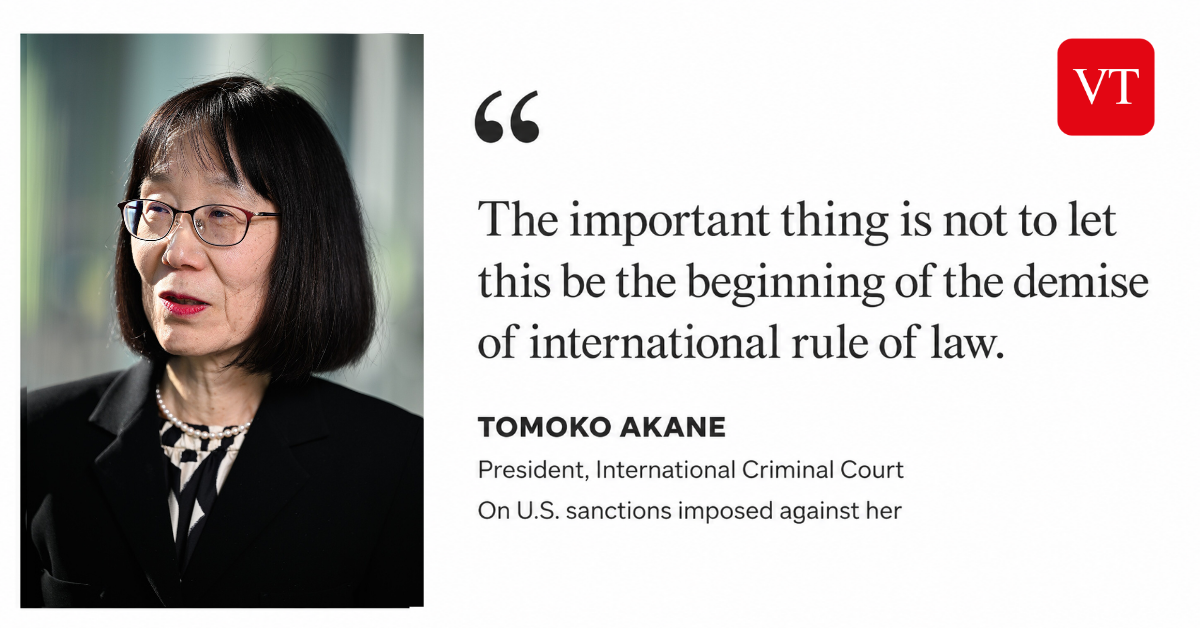
International Criminal Court President Tomoko Akane warned Friday against allowing U.S. sanctions imposed on her to mark “the beginning of the demise of international rule of law.”
In a statement released on X by her publisher, Bungei Shunju, Akane said she had anticipated the sanctions “to an extent” and was “not surprised.”
Secretary of State Marco Rubio announced the designations Aug. 18 in a State Department statement. Akane, of Japan, and Senior Trial Lawyer Abdoulaye Seye, of Senegal, were designated under section 1(a)(ii)(A) of Executive Order 14203.
Rubio accused both officials of directly participating in ICC efforts to investigate, arrest, detain or prosecute officials from governments that have not accepted the court’s jurisdiction. The statement did not detail the actions attributed to Akane or Seye.
The administration described the ICC as “corrupt and fatally politicized” and accused it of abusing its authority and exceeding its mandate. Rubio said the U.S. campaign would be sweeping and that he expected more countries to end their funding and participation in the court.
The International Criminal Court called the sanctions a “flagrant attack” on the independence of an impartial judicial institution. According to the court, nine of its 18 judges, both deputy prosecutors, the former prosecutor and one staff member are now under U.S. sanctions.
The court said measures targeting judges, prosecutors and staff undermine the rule of law and affect the ability of victims to seek justice. It said it would continue carrying out its mandate independently and impartially under the Rome Statute.
In an Aug. 20 statement, France’s Ministry for Europe and Foreign Affairs condemned threats and coercive measures against the court, its staff and civil society organizations that support it.
The French statement said the latest designations were added to sanctions previously imposed on 11 judges. The ICC said nine of its 18 judges are currently sanctioned. Neither statement explained the apparent difference.
France described the measures as an attack on the ICC and all 125 States Parties to the Rome Statute. It expressed solidarity with the targeted judges and said the sanctions were contrary to judicial independence.
In matching posts on X, Ursula von der Leyen and the European Council president expressed support for the ICC, Akane and court officials. They said the court’s judges and officials must be able to work independently and without external pressure.
In a separate post, Benjamin Netanyahu praised Rubio’s actions, called the ICC a “kangaroo court” and accused it of abusing its power.
In a July 2 statement, the Justice Department rejected ICC jurisdiction over Americans. It said the United States is not a party to the Rome Statute and has never consented to the court’s authority.
Acting Attorney General Todd Blanche said the department would not cooperate with ICC investigations or proceedings or extradite or transfer U.S. persons to the court. He said the United States would also oppose efforts by other countries to do so.
The department cited the 2002 American Servicemembers’ Protection Act, which it said prohibits cooperation with the ICC and authorizes the president to secure the release of U.S. persons detained under an ICC warrant or request.