

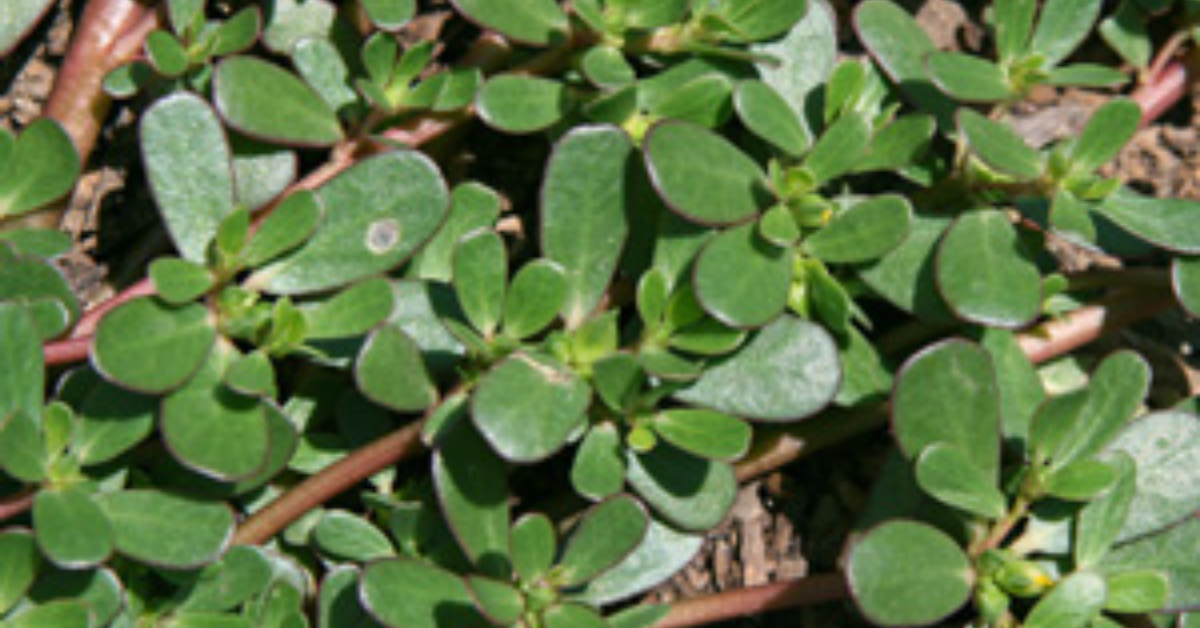
That succulent creeping through your garden beds might be dinner. Common purslane turns into a tangy refrigerator pickle in just a day or two, but safe preparation starts with two non-negotiables: correct identification and vinegar labeled 5% acidity.
Purslane (Portulaca oleracea) is an annual succulent found nearly everywhere. According to the University of Wisconsin-Madison Extension, its tender stems, leaves and flower buds carry a slightly tart, almost salty flavor, and they can be eaten fresh or cooked.
The plant offers omega-3 fatty acids, vitamins A and C and several minerals. It also contains a fair amount of oxalates, so the extension cautions anyone prone to kidney stones against eating it in large quantities.
How to Identify Purslane
Purslane sprawls close to the ground on smooth, reddish stems. Look for several features together:
- Thick, fleshy leaves that are oval or spoon-shaped
- Smooth leaf edges
- Leaves clustered at the stem joints
- Leaves arranged alternately along the stem
- Small yellow flowers that usually have five notched petals
You may not see the flowers at all. They tend to open only during hot, sunny stretches of the day, so no flowers does not necessarily mean the plant is not purslane.
The plant most often confused with purslane is spotted spurge, which forms similar low mats. Spurge gives itself away in a few respects: its small leaves grow in opposite pairs, sometimes with reddish spots, and its leaves, stems, flowers and fruit are often hairy.
Here is the most important test: Snap a stem. Spurge releases a milky sap that the UC Statewide Integrated Pest Management Program describes as poisonous and irritating to the eyes and skin. Purslane does not.
Never eat a plant that oozes milky sap. If you are not completely sure what you are looking at, leave it alone or bring a sample to your local cooperative extension office or a qualified plant expert for confirmation.
Where you harvest matters as much as what you harvest. Stick to spots free of pesticides, skip roadsides, get permission before gathering on someone else’s land and follow local foraging rules, per guidance from the University of Minnesota Extension.
Quick-Pickled Purslane Recipe
Ingredients
- 3½ to 4 cups tender purslane stems and leaves, or enough to pack the jar closely
- 1½ cups commercial apple cider vinegar or white distilled vinegar labeled 5% acidity
- 1 cup water
- 1 tablespoon pickling or canning salt
- 2 teaspoons granulated sugar
- 1 teaspoon dill seed
- 1 teaspoon mustard seed
- ½ teaspoon whole coriander seed
- ½ teaspoon black peppercorns
- ½ teaspoon red pepper flakes (optional)
- 2 to 3 peeled garlic cloves
Equipment
- 1 clean, heat-safe glass jar (1 quart)
- 1 clean lid
- Medium saucepan
- Measuring cups and spoons
- Colander
- Clean spoon or utensil
Instructions
-
Prepare the purslane
Wash your hands with soap and water. Trim away the purslane roots, tough stem ends and anything damaged or spoiled.
-
Rinse and drain
Rinse the purslane well under running water and drain it in the colander. Skip the soap, detergent and commercial produce washes. The Food and Drug Administration advises plain water only for produce.
-
Add the seasonings
Drop the dill seed, mustard seed, coriander seed, peppercorns, red pepper flakes and garlic into the bottom of the jar.
-
Pack the jar
Pack the purslane in snugly without crushing it, leaving about ½ inch of space at the top.
-
Make the brine
Combine the vinegar, water, salt and sugar in a medium saucepan. Bring the mixture to a simmer, stirring until the salt and sugar dissolve, then take it off the heat.
-
Cover with brine
Pour the warm brine over the purslane until everything is submerged. Slide a clean utensil down the sides to release trapped air, then top off with more brine if needed, keeping ½ inch of headspace.
-
Seal the jar
Seal the jar with a clean lid. Do not shake a jar full of hot brine.
-
Refrigerate
Refrigerate right away at 40 degrees Fahrenheit or below. Give the purslane 24 to 48 hours to pickle before tasting it.
Storage
- Return the jar to the refrigerator after every use and keep it cold the entire time.
- The University of Maine Cooperative Extension recommends eating refrigerator pickles within one month.
- Discard the contents if you notice mold, sliminess, an off odor or bubbling that is not caused by moving the jar.
Have something to promote?
Bring your business, services or event to our readers.